Review
. 2021 Apr 12:2021:5578727.
doi: 10.1155/2021/5578727. eCollection 2021.

Understanding the Integrated Pathways and Mechanisms of Transporters, Protein Kinases, and Transcription Factors in Plants under Salt Stress

Affiliations
Review

Understanding the Integrated Pathways and Mechanisms of Transporters, Protein Kinases, and Transcription Factors in Plants under Salt Stress

Wasifa Hafiz Shah et al. Int J Genomics. .

Abstract

Abiotic stress is the major threat confronted by modern-day agriculture. Salinity is one of the major abiotic stresses that influence geographical distribution, survival, and productivity of various crops across the globe. Plants perceive salt stress cues and communicate specific signals, which lead to the initiation of defence response against it. Stress signalling involves the transporters, which are critical for water transport and ion homeostasis. Various cytoplasmic components like calcium and kinases are critical for any type of signalling within the cell which elicits molecular responses. Stress signalling instils regulatory proteins and transcription factors (TFs), which induce stress-responsive genes. In this review, we discuss the role of ion transporters, protein kinases, and TFs in plants to overcome the salt stress. Understanding stress responses by components collectively will enhance our ability in understanding the underlying mechanism, which could be utilized for crop improvement strategies for achieving food security.


Conflict of interest statement

The authors declare that they have no conflicts of interest.

Figures

Figure 1
Figure 1
Schematic representation of Na+ and K+ transporters mediating Na+ and K+ homeostasis in plant roots under salt stress. Na+ ions enter the cells via nonselective cation channels (NSCCs) and possibly via other cation transporters (symplast flow) and intercellular spaces (apoplast flow). The SOS1 extrudes Na+ at the root-soil interface and the xylem parenchyma cells. Likewise, HKT also retrieves Na+ from the xylem. SOS1, localized in the xylem parenchyma cells, mediate Na+ efflux from xylem vessels under high salinity. Excessive Na+ in root is sequestered in the large central vacuole by tonoplast-localized NHX exchangers, V-ATPase, and V-PPase which also generate electrochemical potential gradient for secondary active transport.
Figure 2
Figure 2
Picture depicting different transporters and channels with functions responsible for ion homeostasis under salt stress. These transporters and channels are found on plasma membrane (PM), tonoplast (TP), and endomembranes (EM). K+ homeostasis-related transporters/channels include voltage-dependent K+ channel, two-pore K+ channel (TPK), K+ uptake permease/high-affinity K+/K+ transporter (KUP/HAK/KT), and cation/H+ exchanger (CHX). Na+ homeostasis-related transporters/channels include Na+/H+ exchanger (NHX), salt overly sensitive 1 (SOS1), and high-affinity K+ transporter (HKT). Ca2+-related transporters/channels include cyclic nucleotide-gated channels (CNGCs), glutamate receptor-like channels (GLRs), two-pore channels (TPCs), mechanosensitive channels (MCAs), and reduced hyperosmolality-induced Ca2+ increase channels (OSCAs).
Figure 3
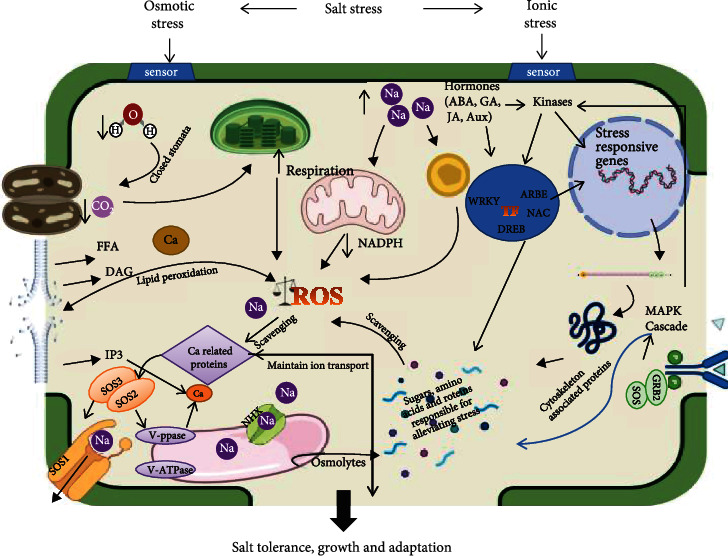
Figure 3
Mechanism of salinity tolerance in plants. The excess influx of sodium causes ion toxicity and water deficit, which results in the closure of stomata and decreased availability of CO2 for photosynthetic ETC. This water deficit eventually causes ion imbalance and overproduction of ROS in chloroplast, mitochondria, peroxisomes, and apoplastic space. In response, the plants increase enzymatic/non enzymatic antioxidants and osmolytes. Transporters like NHX sequester Na+ inside the vacuole and SOS1 extrudes Na+ outside the cell. In this response, there is an increased expression of salt-responsive genes, transcription factors (TFs), and kinases inside the cell, which help the plants to alleviate the stresses encountered by them.

References

    1. Qin F., Shinozaki K., Yamaguchi-Shinozaki K. Achievements and challenges in understanding plant abiotic stress responses and tolerance. Plant & Cell Physiology. 2011;52(9):1569–1582. doi: 10.1093/pcp/pcr106. - DOI - PubMed
    1. Machado R. M. A., Serralheiro R. P. Soil salinity: effect on vegetable crop growth. Management practices to prevent and mitigate soil salinization. Horticulturae. 2017;3(2):p. 30. doi: 10.3390/horticulturae3020030. - DOI
    1. Ivushkin K., Bartholomeus H., Bregt A. K., Pulatov A., Kempen B., De Sousa L. Global mapping of soil salinity change. Remote Sensing of Environment. 2019;231, article 111260 doi: 10.1016/j.rse.2019.111260. - DOI
    1. Ahanger M. A., Tomar N. S., Tittal M., Argal S., Agarwal R. M. Plant growth under water/salt stress: ROS production; antioxidants and significance of added potassium under such conditions. Physiology and Molecular Biology of Plants. 2017;23(4):731–744. doi: 10.1007/s12298-017-0462-7. - DOI - PMC - PubMed
    1. Almeida D. M., Oliveira M. M., Saibo N. J. M. Regulation of Na+ and K+ homeostasis in plants: towards improved salt stress tolerance in crop plants. Genetics and Molecular Biology. 2017;40(1 suppl 1):326–345. doi: 10.1590/1678-4685-gmb-2016-0106. - DOI - PMC - PubMed

LinkOut - more resources