


Lives and Costs Saved by Expanding and Expediting Coronavirus Disease 2019 Vaccination
- PMID: 33954775
- PMCID: PMC8136017
- DOI: 10.1093/infdis/jiab233
Lives and Costs Saved by Expanding and Expediting Coronavirus Disease 2019 Vaccination
Abstract
Background: With multiple coronavirus disease 2019 (COVID-19) vaccines available, understanding the epidemiologic, clinical, and economic value of increasing coverage levels and expediting vaccination is important.
Methods: We developed a computational model (transmission and age-stratified clinical and economics outcome model) representing the United States population, COVID-19 coronavirus spread (February 2020-December 2022), and vaccination to determine the impact of increasing coverage and expediting time to achieve coverage.
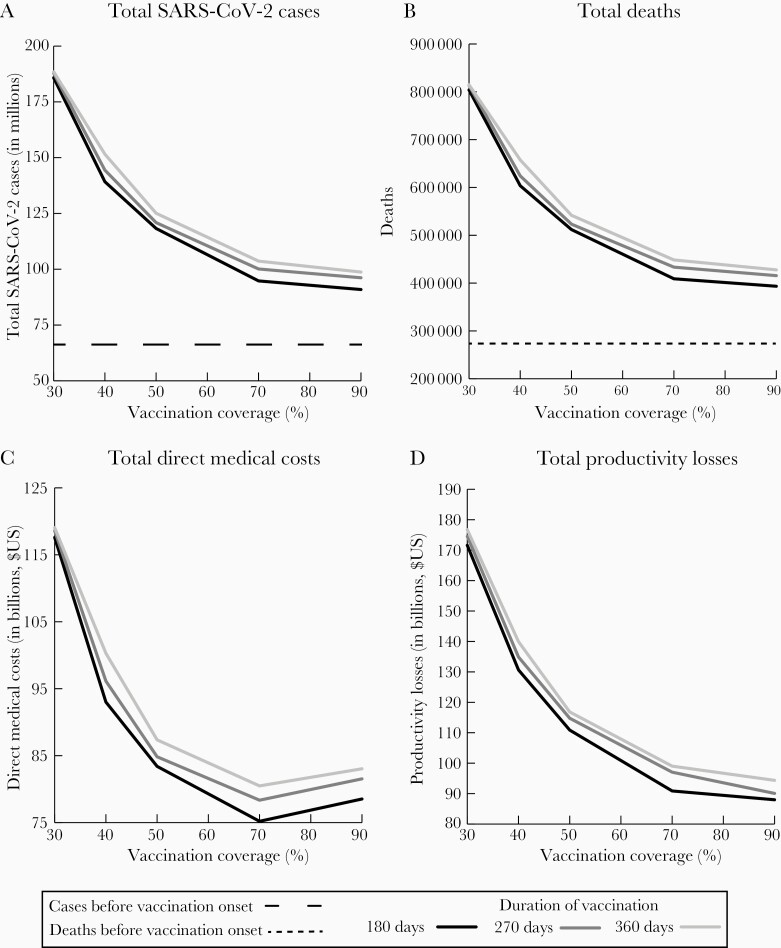
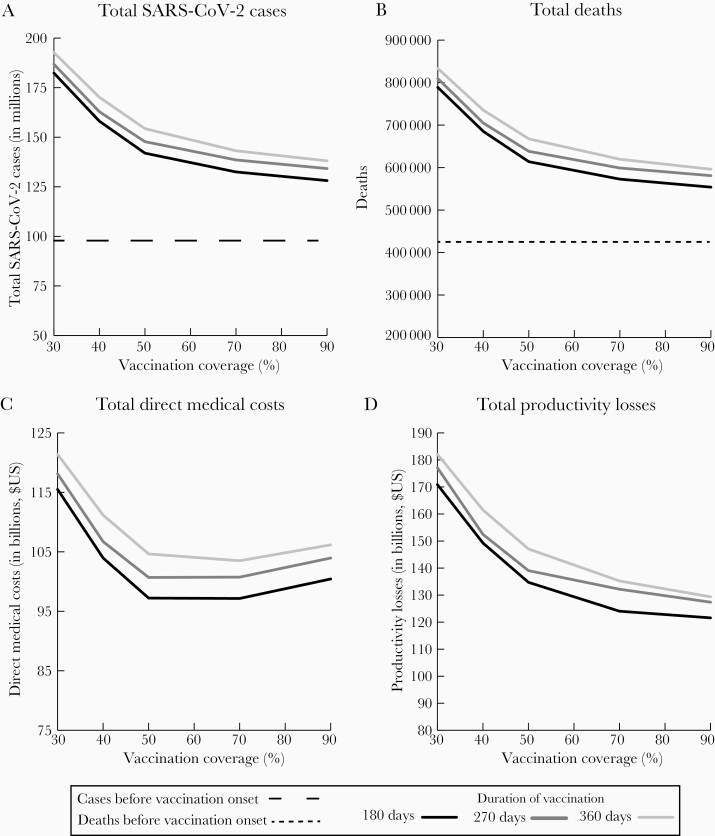
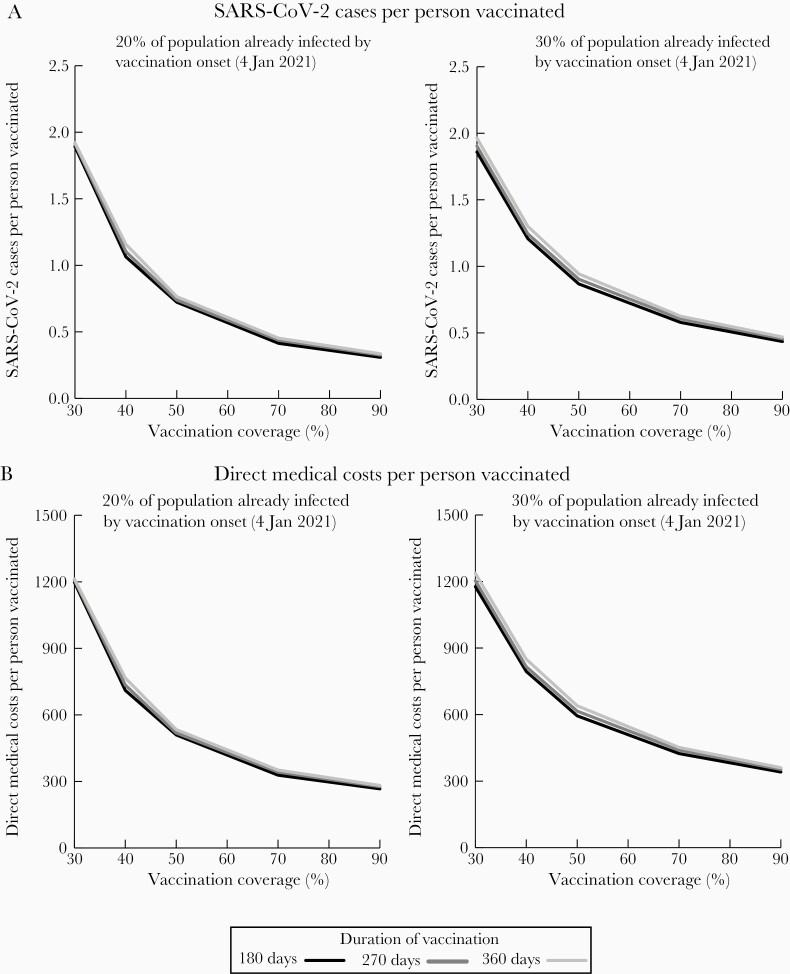
Results: When achieving a given vaccination coverage in 270 days (70% vaccine efficacy), every 1% increase in coverage can avert an average of 876 800 (217 000-2 398 000) cases, varying with the number of people already vaccinated. For example, each 1% increase between 40% and 50% coverage can prevent 1.5 million cases, 56 240 hospitalizations, and 6660 deaths; gain 77 590 quality-adjusted life-years (QALYs); and save $602.8 million in direct medical costs and $1.3 billion in productivity losses. Expediting to 180 days could save an additional 5.8 million cases, 215 790 hospitalizations, 26 370 deaths, 206 520 QALYs, $3.5 billion in direct medical costs, and $4.3 billion in productivity losses.
Conclusions: Our study quantifies the potential value of decreasing vaccine hesitancy and increasing vaccination coverage and how this value may decrease with the time it takes to achieve coverage, emphasizing the need to reach high coverage levels as soon as possible, especially before the fall/winter.
Keywords: COVID-19; coronavirus; coverage; rate; vaccination.
© The Author(s) 2021. Published by Oxford University Press for the Infectious Diseases Society of America. All rights reserved. For permissions, e-mail: journals.permissions@oup.com.
Figures

Comment in
-
Herd Immunity: The Journey Is as Important as the Destination.J Infect Dis. 2021 Sep 17;224(6):931-933. doi: 10.1093/infdis/jiab234. J Infect Dis. 2021. PMID: 33954748 Free PMC article. No abstract available.
References
-
- White House COVID-19 Response Team. Fact sheet: President Biden announces 90% of the adult U.S. population will be eligible for vaccination and 90% will have a vaccination site within 5 miles of home by April 19.https://www.whitehouse.gov/briefing-room/statements-releases/2021/03/29/.... Accessed 31 March 2021.
-
- The White House . Fact sheet: President Biden to announce all Americans to be eligible for vaccinations by May 1, puts the nation on a path to get closer to normal by July 4th.https://www.whitehouse.gov/briefing-room/statements-releases/2021/03/11/.... Accessed 31 March 2021.
-
- New York Times. See how the vaccine rollout is going in your county and state.2021. https://www.nytimes.com/interactive/2020/us/covid-19-vaccine-doses.html. Accessed 3 May 2021.
-
- Tyson A, Johnson C, Funk C;. Pew Research Center. US public now divided over whether to get covid-19 vaccine. 2020. https://www.pewresearch.org/science/2020/09/17/u-s-public-now-divided-ov.... Accessed 17 September 2020.
-
- Funk C, Tyson A.. Growing share of Americans say they plan to get a COVID-19 vaccine—or already have. 2021. https://www.pewresearch.org/science/2021/03/05/growing-share-of-american.... Accessed 3 May 2021.
Publication types
MeSH terms
Substances
Grants and funding
LinkOut - more resources
Full Text Sources
Other Literature Sources
Medical
