


Urolithiasis in cats: Evaluation of trends in urolith composition and risk factors (2005-2018)
- PMID: 33955071
- PMCID: PMC8162610
- DOI: 10.1111/jvim.16121
Urolithiasis in cats: Evaluation of trends in urolith composition and risk factors (2005-2018)
Abstract
Background: Urolithiasis is an important upper and lower urinary tract disease in cats that results in morbidity and mortality.
Objective: To describe trends in composition of uroliths in cats and evaluate risk factors related to age, breed, sex, urolith location, and bacterial urolith cultures.
Sample population: A total of 3940 uroliths and the cats from which they were obtained.
Methods: The database of the UC Davis Gerald V. Ling Urinary Stone Analysis Laboratory was searched for all urolith submissions from cats between January 2005 and December 2018. Mineral type, age, breed, sex, and urolith location and culture results were recorded. Trends were evaluated and variables compared to evaluate risk factors.
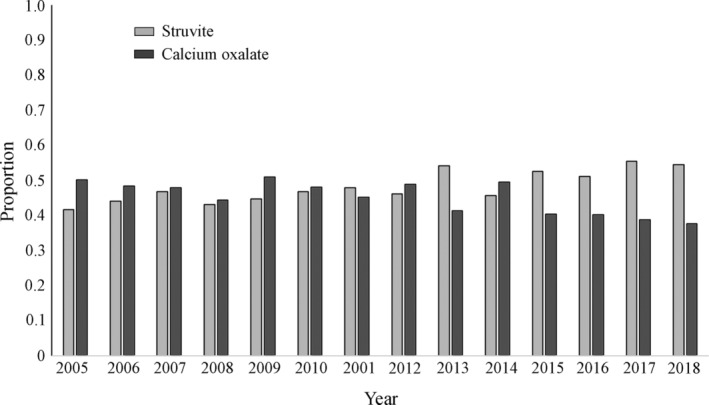
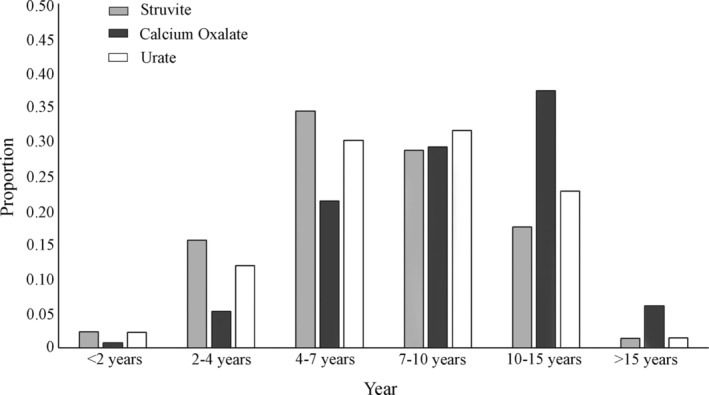
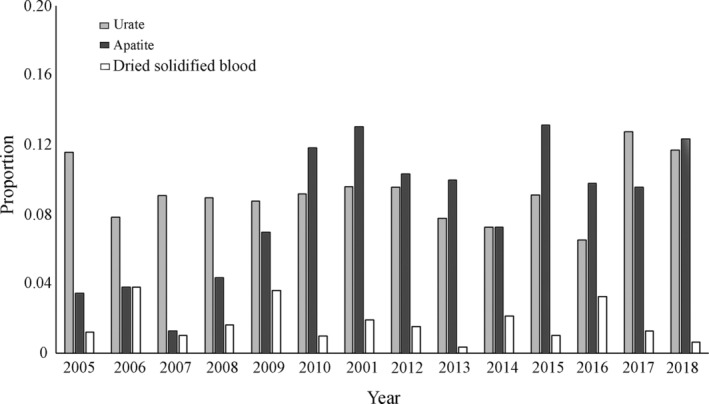
Results: A significant decrease in the proportion of calcium oxalate (CaOx)-containing uroliths occurred over time (P = .02), from 50.1% (204/407) of all submissions in 2005 to 37.7% (58/154) in 2018. In contrast, the proportion of struvite-containing uroliths increased significantly (P = .002), from 41.8% (170/407) in 2005 to 54.5% (84/154) in 2018. The proportion of CaOx-containing uroliths in the upper urinary tract was significantly higher compared to the proportion of other urolith types in the upper urinary tract. Urate-containing uroliths were the third most common type (361/3940, 9.2%). Overall, sex and age predispositions were similar to those reported previously.
Conclusions and clinical importance: The decrease in the proportion of CaOx-containing uroliths and increase in the proportion of struvite-containing uroliths warrants investigation. Further education regarding the efficacy of medical dissolution of struvite-containing uroliths is recommended.
Keywords: calcium oxalate; feline; struvite; urate; urolithiasis.
© 2021 The Authors. Journal of Veterinary Internal Medicine published by Wiley Periodicals LLC on behalf of American College of Veterinary Internal Medicine.
Conflict of interest statement
Authors declare no conflict of interest.
Figures
References
-
- Cannon AB, Westropp JL, Ruby AL, Kass PH. Evaluation of trends in urolith composition in cats: 5,230 cases (1985‐2004). J Am Vet Med Assoc. 2007;231:570‐576. - PubMed
-
- Osborne CA, Lulich JP, Kruger JM, Ulrich LK, Koehler LA. Analysis of 451,891 canine uroliths, feline uroliths, and feline urethral plugs from 1981 to 2007: perspectives from the Minnesota Urolith Center. Vet Clin North Am Small Anim Pract. 2009;39:183‐197. - PubMed
-
- Berent AC, Weisse CW, Todd K, Bagley DH. Technical and clinical outcomes of ureteral stenting in cats with benign ureteral obstruction: 69 cases (2006‐2010). J Am Vet Med Assoc. 2014;244:559‐576. - PubMed
-
- Berent AC, Weisse CW, Bagley DH, Lamb K. Use of a subcutaneous ureteral bypass device for treatment of benign ureteral obstruction in cats: 174 ureters in 134 cats (2009‐2015). J Am Vet Med Assoc. 2018;253:1309‐1327. - PubMed
MeSH terms
Substances
LinkOut - more resources
Full Text Sources
Other Literature Sources
Miscellaneous
