


Real-Time UV Measurement With a Sun Protection System for Warning Young Adults About Sunburn: Prospective Cohort Study
- PMID: 33955844
- PMCID: PMC8138709
- DOI: 10.2196/25895
Real-Time UV Measurement With a Sun Protection System for Warning Young Adults About Sunburn: Prospective Cohort Study
Abstract
Background: Melanoma is attributable to predisposing phenotypical factors, such as skin that easily sunburns and unprotected exposure to carcinogenic UV radiation. Reducing the proportion of young adults who get sunburned may reduce the incidence of melanoma, a deadly form of skin cancer. Advances in technology have enabled the delivery of real-time UV light exposure and content-relevant health interventions.
Objective: This study aims to examine the feasibility of young adults performing the following tasks daily: wearing a UV dosimeter, receiving text messages and real-time UV-B doses on their smartphone, and responding to daily web-based surveys about sunburn and sun protection.
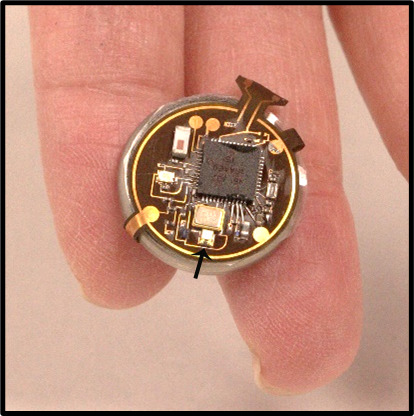
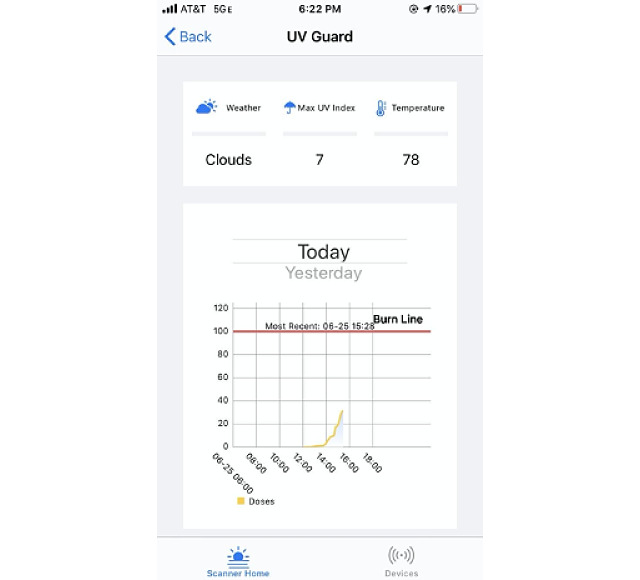
Methods: Young adults aged 18-39 years (n=42) were recruited in the United States in June 2020 via social media. Participants received the UV Guard sun protection system, which consisted of a UV dosimeter and a smartphone app. During 3 consecutive periods, intervention intensity increased as follows: real-time UV-B dose; UV-B dose and daily behavioral facilitation text messages; and UV-B dose, goal setting, and daily text messages to support self-efficacy and self-regulation. Data were self-reported through daily web-based surveys for 28 days, and UV-B doses were transmitted to cloud-based storage.
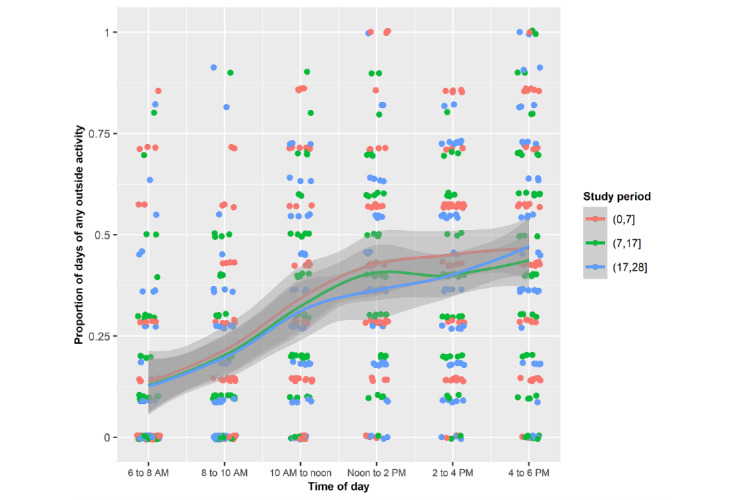
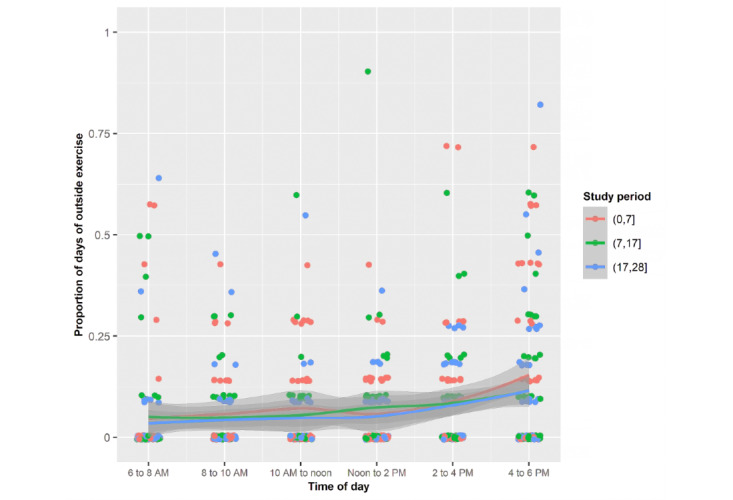
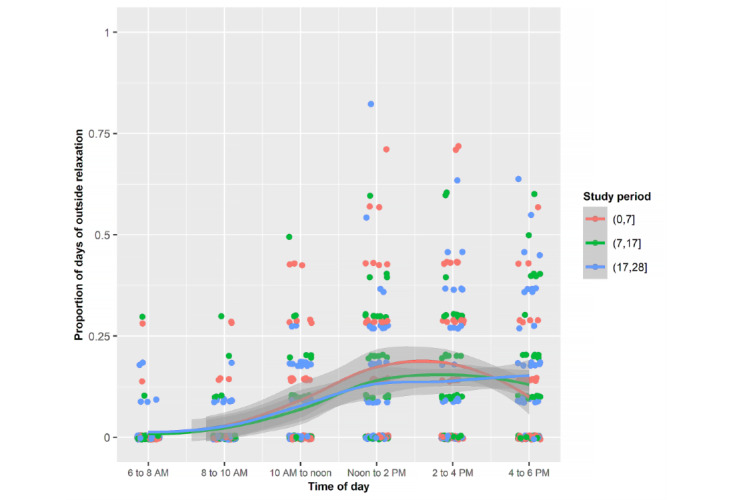
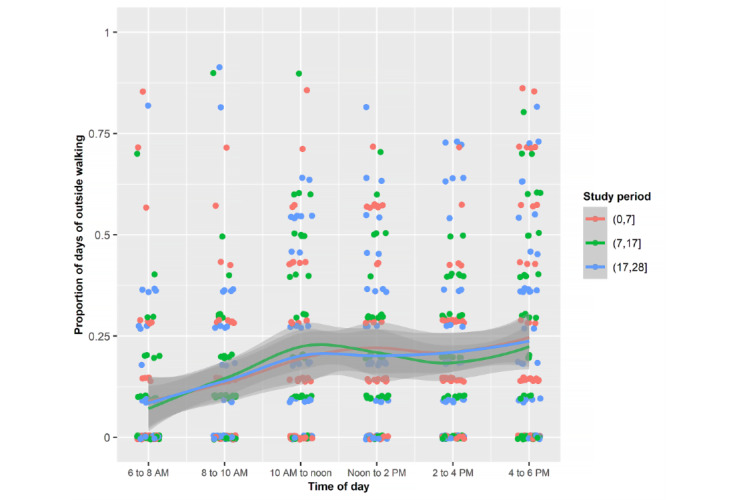
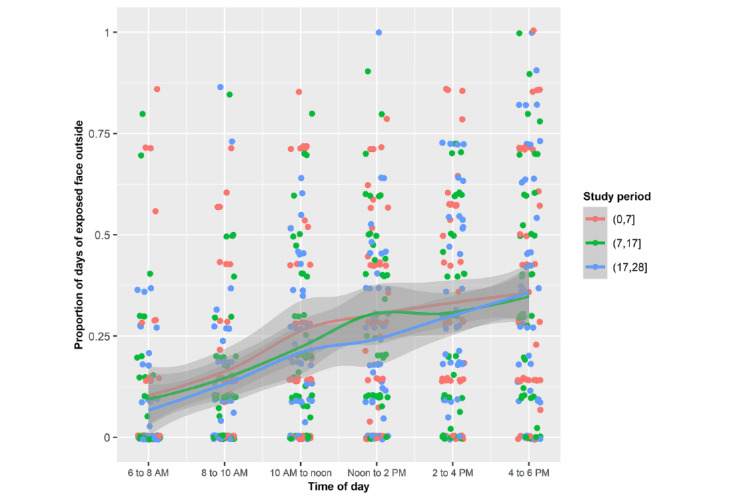
Results: Patients' median age was 22 years (IQR 20, 29), and all patients had sun-sensitive skin. Sunburns were experienced during the study by fewer subjects (n=18) than those in the preceding 28 days (n=30). In July and August, the face was the most commonly sunburned area among 13 body locations; 52% (22/42) of sunburns occurred before the study and 45% (19/42) occurred during the study. The mean daily UV-B dose decreased during the 3 periods; however, this was not statistically significant. Young adults were most often exercising outdoors from 2 to 6 PM, walking from 10 AM to 6 PM, and relaxing from noon to 2 PM. Sunburn was most often experienced during exercise (odds ratio [OR] 5.65, 95% CI 1.60-6.10) and relaxation (OR 3.69, 95% CI 1.03-4.67) relative to those that did not exercise or relax in each category. The self-reported exit survey indicated that participants felt that they spent less time outdoors this summer compared to the last summer because of the COVID-19 pandemic and work. In addition, 38% (16/42) of the participants changed their use of sun protection based on their app-reported UV exposure, and 48% (20/42) shifted the time they went outside to periods with less-intense UV exposure. A total of 79% (33/42) of the participants were willing to continue using the UV Guard system outside of a research setting.
Conclusions: In this proof-of-concept research, young adults demonstrated that they used the UV Guard system; however, optimization was needed. Although some sun protection behaviors changed, sunburn was not prevented in all participants, especially during outdoor exercise.
Trial registration: ClinicalTrials.gov NCT03344796; http://clinicaltrials.gov/ct2/show/NCT03344796.
Keywords: UV dosimeter; health promotion technology; melanoma; mobile phone; preventive medicine; sun protection; sunburn.
©June K Robinson, Shiv Patel, Seung Yun Heo, Elizabeth Gray, Jaeman Lim, Kyeongha Kwon, Zach Christiansen, Jeffrey Model, Jacob Trueb, Anthony Banks, Mary Kwasny, John A Rogers. Originally published in JMIR mHealth and uHealth (https://mhealth.jmir.org), 06.05.2021.
Conflict of interest statement
Conflicts of Interest: There are no conflicts or competing interests for JKR, SP, ZC, EG, SYH, KK, JM, JT, JL, and MK. AB and JAR declare a relationship with Wearifi Inc and a patent on the device (US Patent Application 15/578,602 and US Patent Application 15/578,617).
Figures
References
-
- Adolescents and young adults with cancer. National Cancer Institute. [2020-10-05]. https://www.cancer.gov/types/aya.
-
- Moore SC, Lee I, Weiderpass E, Campbell PT, Sampson JN, Kitahara CM, Keadle SK, Arem H, de Gonzalez AB, Hartge P, Adami H, Blair CK, Borch KB, Boyd E, Check DP, Fournier A, Freedman ND, Gunter M, Johannson M, Khaw K, Linet MS, Orsini N, Park Y, Riboli E, Robien K, Schairer C, Sesso H, Spriggs M, Van Dusen R, Wolk A, Matthews CE, Patel AV. Association of leisure-time physical activity with risk of 26 types of cancer in 1.44 million adults. JAMA Intern Med. 2016 Jun 01;176(6):816–25. doi: 10.1001/jamainternmed.2016.1548. http://europepmc.org/abstract/MED/27183032 - DOI - PMC - PubMed
-
- Holman DM, Berkowitz Z, Guy Jr GP, Hartman AM, Perna FM. The association between demographic and behavioral characteristics and sunburn among U.S. adults - National Health Interview Survey, 2010. Prev Med. 2014 Jun;63:6–12. doi: 10.1016/j.ypmed.2014.02.018. http://europepmc.org/abstract/MED/24589442 - DOI - PMC - PubMed
-
- Dennis LK, Vanbeek MJ, Freeman LE, Smith BJ, Dawson DV, Coughlin JA. Sunburns and risk of cutaneous melanoma: does age matter? A comprehensive meta-analysis. Ann Epidemiol. 2008 Aug;18(8):614–27. doi: 10.1016/j.annepidem.2008.04.006. http://europepmc.org/abstract/MED/18652979 - DOI - PMC - PubMed
Publication types
MeSH terms
Substances
Associated data
Grants and funding
LinkOut - more resources
Full Text Sources
Other Literature Sources
Medical
