Disease severity impacts plerixafor-mobilized stem cell collection in patients with sickle cell disease
- PMID: 33956057
- PMCID: PMC8114546
- DOI: 10.1182/bloodadvances.2021004232
Disease severity impacts plerixafor-mobilized stem cell collection in patients with sickle cell disease
Abstract
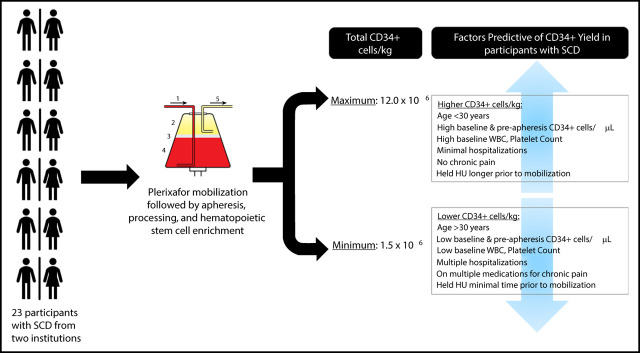
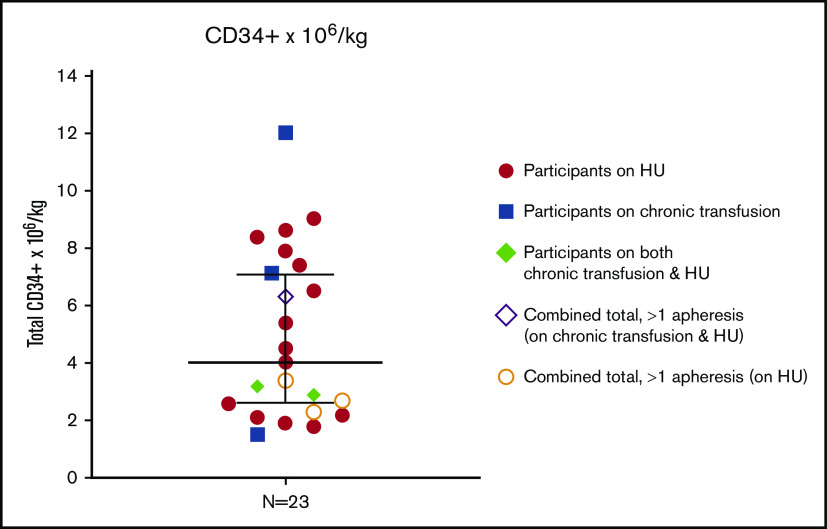
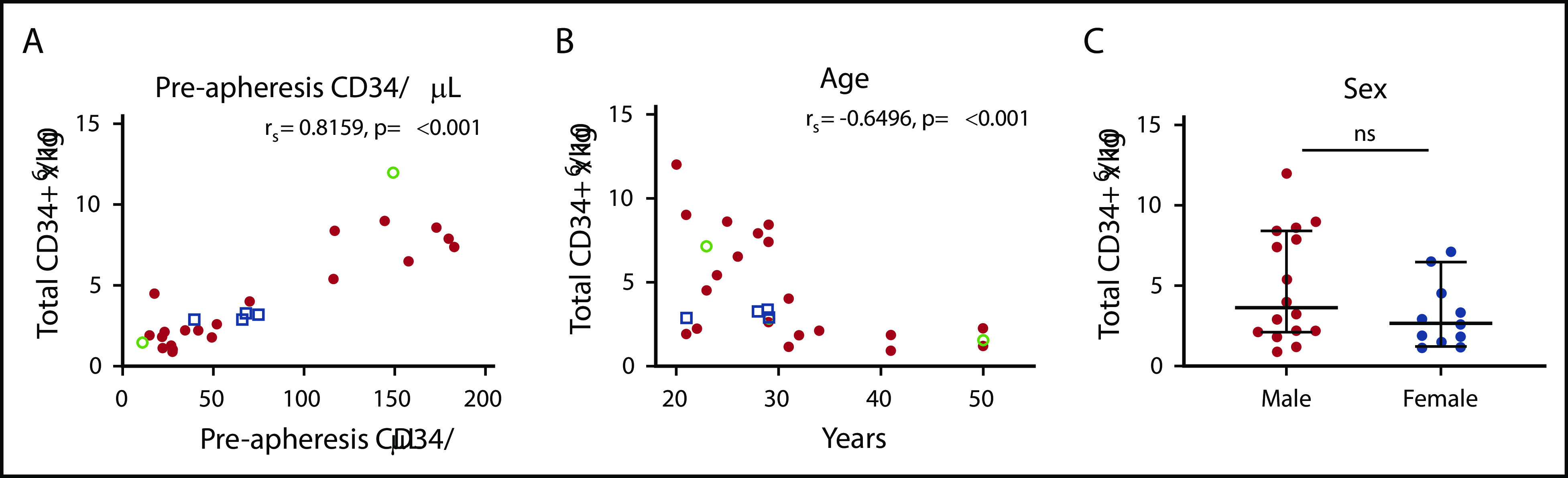
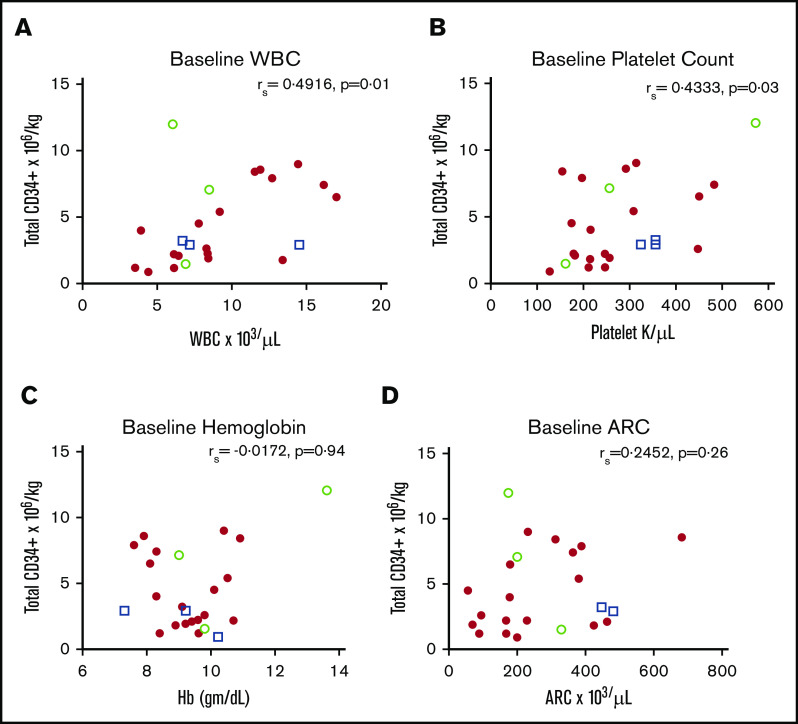
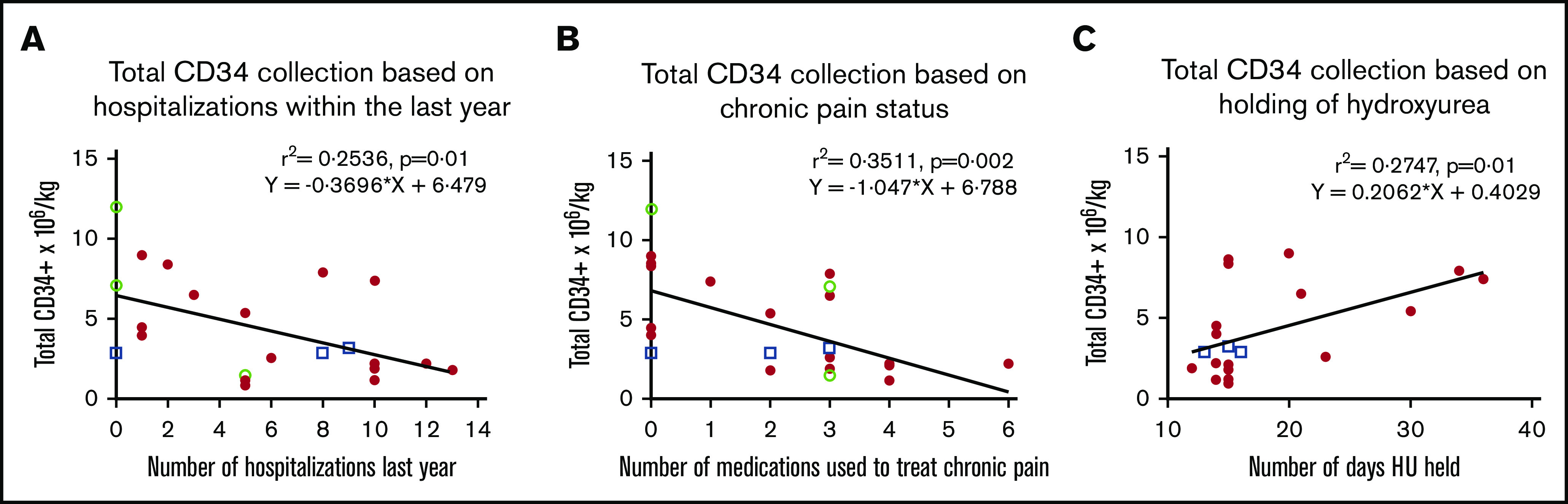
Recent studies suggest that plerixafor mobilization and apheresis in patients with sickle cell disease (SCD) is safe and can allow collection of sufficient CD34+ hematopoietic stem cell (HSC) collection for clinical gene therapy applications. However, the quantities of plerixafor-mobilized CD34+ cells vary between different SCD patients for unknown reasons. Twenty-three participants with SCD underwent plerixafor mobilization followed by apheresis, processing, and HSC enrichment under a phase 1 safety and efficacy study conducted at 2 institutions. Linear regression or Spearman's correlation test was used to assess the relationships between various hematologic and clinical parameters with total CD34+ cells/kg collected. Median CD34+ cells/kg after 2 or fewer mobilization and apheresis cycles was 4.0 × 10⁶ (range, 1.5-12.0). Similar to what is observed generally, CD34+ yield correlated negatively with age (P < .001) and positively with baseline (P = .003) and preapheresis blood CD34+ cells/µL (P < .001), and baseline white blood cell (P = .01) and platelet counts (P = .03). Uniquely for SCD, CD34+ cell yields correlated positively with the number of days hydroxyurea was held (for up to 5 weeks, P = .01) and negatively with markers of disease severity, including hospitalization frequency within the preceding year (P = .01) and the number of medications taken for chronic pain (P = .002). Unique SCD-specific technical challenges in apheresis were also associated with reduced CD34+ cell collection efficiency and purification. Here, we describe factors that impact plerixafor mobilization success in patients with SCD, confirming known factors as described in other populations in addition to reporting previously unknown disease specific factors in patients with SCD. This trial was registered at www.clinicaltrials.gov as #NCT03226691.
Conflict of interest statement
Conflict-of-interest disclosure: The authors declare no competing financial interests.
Figures
References
-
- Walters MC, Patience M, Leisenring W, et al. Bone marrow transplantation for sickle cell disease. N Engl J Med. 1996;335(6):369-376. - PubMed
-
- Ribeil JA, Hacein-Bey-Abina S, Payen E, et al. Gene therapy in a patient with sickle cell disease. N Engl J Med. 2017;376(9):848-855. - PubMed
-
- To LB, Haylock DN, Simmons PJ, Juttner CA. The biology and clinical uses of blood stem cells. Blood. 1997;89(7):2233-2258. - PubMed
-
- Abboud M, Laver J, Blau CA. Granulocytosis causing sickle-cell crisis. Lancet. 1998;351(9107):959. - PubMed
Publication types
MeSH terms
Substances
Associated data
Grants and funding
LinkOut - more resources
Full Text Sources
Other Literature Sources
Medical