


Patients' perceived walking abilities, daily-life gait behavior and gait quality before and 3 months after total knee arthroplasty
- PMID: 33956227
- PMCID: PMC9110478
- DOI: 10.1007/s00402-021-03915-y
Patients' perceived walking abilities, daily-life gait behavior and gait quality before and 3 months after total knee arthroplasty
Abstract
Introduction: Functional outcome and patients' daily-life activities after total knee arthroplasty are becoming more important with a younger and more active patient population. In addition to patient-reported outcome measures (PROMs), trunk-based accelerometry has shown to be a promising method for evaluating gait function after total knee arthroplasty. The aim of this study was to evaluate daily-life perceived walking abilities, gait behavior and gait quality before and 3 months after total knee arthroplasty, using PROMs and trunk-based accelerometry.
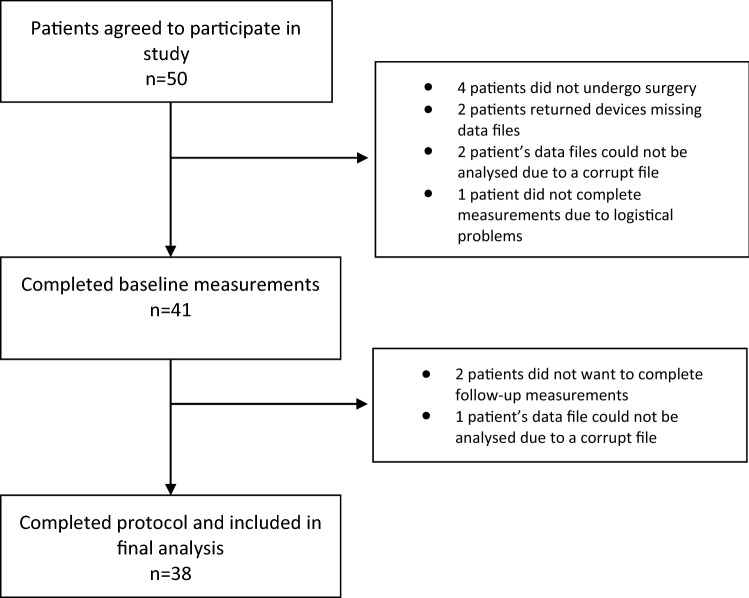
Materials and methods: A cohort of 38 patients completed questionnaires including the Oxford Knee Score and modified Gait Efficacy Scale before and 3 months after primary unilateral total knee arthroplasty. At both time points, they wore a tri-axial accelerometer at the lower back for seven consecutive days and nights. Gait behavior was calculated using gait quantity and walking speed, and multiple gait quality parameters were calculated.
Results: Significant improvements were seen after 3 months in the Oxford Knee Score [median (interquartile range) 29 (10) vs 39 (8), p < 0.001] and modified Gait Efficacy Scale [median (interquartile range) 67 (24) vs 79 (25), p = 0.001]. No significant changes were observed in gait behavior (quantity and speed) or gait quality variables.
Conclusions: In contrast to the significant improvements in patients' perception of their walking abilities and PROMs, patients did not show improvements in gait behavior and gait quality. This implies that after 3 months patients' perceived functional abilities after total knee arthroplasty do not necessarily represent their actual daily-life quantity and quality of gait, and that more focus is needed on postoperative rehabilitation to improve gait and functional behavior.
Keywords: Arthroplasty; Behavior; Functional outcome; Gait analysis; Knee.
© 2021. The Author(s).
Conflict of interest statement
None of the authors reported any conflict of interest.
Figures

References
MeSH terms
LinkOut - more resources
Full Text Sources
Other Literature Sources
Medical
