


Risk Factors for Infection and Health Impacts of the Coronavirus Disease 2019 (COVID-19) Pandemic in People With Autoimmune Diseases
- PMID: 33956972
- PMCID: PMC8135997
- DOI: 10.1093/cid/ciab407
Risk Factors for Infection and Health Impacts of the Coronavirus Disease 2019 (COVID-19) Pandemic in People With Autoimmune Diseases
Abstract
Background: People with autoimmune or inflammatory conditions taking immunomodulatory/suppressive medications may have higher risk of novel coronavirus disease 2019 (COVID-19). Chronic disease care has also changed for many patients, with uncertain downstream consequences.
Methods: We included participants with autoimmune or inflammatory conditions followed by specialists at Johns Hopkins. Participants completed periodic surveys querying comorbidities, disease-modifying medications, exposures, COVID-19 testing and outcomes, social behaviors, and disruptions to healthcare. We assessed whether COVID-19 risk is higher among those on immunomodulating or suppressive agents and characterized pandemic-associated changes to care and mental health.
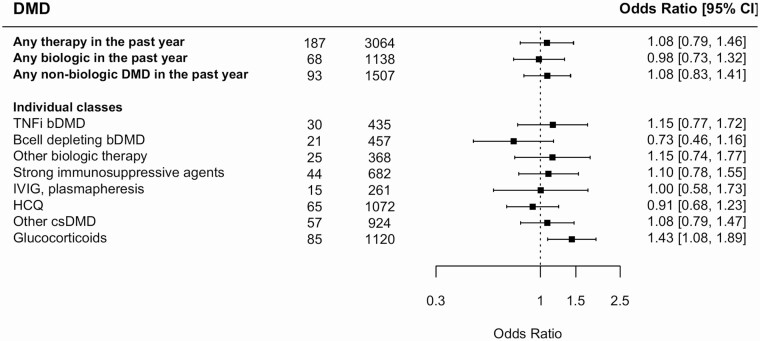
Results: In total, 265 (5.6%) developed COVID-19 over 9 months of follow-up (April-December 2020). Patient characteristics (age, race, comorbidity, medications) were associated with differences in social distancing behaviors during the pandemic. Glucocorticoid exposure was associated with higher odds of COVID-19 in models incorporating behavior and other potential confounders (odds ratio [OR]: 1.43; 95% confidence interval [CI]: 1.08, 1.89). Other medication classes were not associated with COVID-19 risk. Diabetes (OR: 1.72; 95% CI: 1.08, 2.73), cardiovascular disease (OR: 1.68; 95% CI: 1.24, 2.28), and kidney disease (OR: 1.76; 95% CI: 1.04, 2.97) were associated with higher odds of COVID-19. Of the 2156 reporting pre-pandemic utilization of infusion, mental health or rehabilitative services, 975 (45.2%) reported disruptions therein, which disproportionately affected individuals experiencing changes to employment or income.
Conclusions: Glucocorticoid exposure may increase risk of COVID-19 in people with autoimmune or inflammatory conditions. Disruption to healthcare and related services was common. Those with pandemic-related reduced income may be most vulnerable to care disruptions.
Keywords: COVID-19; autoimmune disease; glucocorticoids; immune-modulating medications.
© The Author(s) 2021. Published by Oxford University Press for the Infectious Diseases Society of America. All rights reserved. For permissions, e-mail: journals.permissions@oup.com.
Figures
Update of
-
RISK FACTORS FOR INFECTION AND HEALTH IMPACTS OF THE COVID-19 PANDEMIC IN PEOPLE WITH AUTOIMMUNE DISEASES.medRxiv [Preprint]. 2021 Feb 5:2021.02.03.21251069. doi: 10.1101/2021.02.03.21251069. medRxiv. 2021. Update in: Clin Infect Dis. 2022 Feb 11;74(3):427-436. doi: 10.1093/cid/ciab407. PMID: 33564774 Free PMC article. Updated. Preprint.
References
-
- Sormani MP. An Italian programme for COVID-19 infection in multiple sclerosis. Lancet Neurol 2020. Available at: https://www.thelancet.com/journals/laneur/article/PIIS1474-4422(20)30147.... Accessed 21 May 2020. - PMC - PubMed
-
- Zabalza A, Cárdenas‐Robledo S, Tagliani P, et al. COVID-19 in multiple sclerosis patients: susceptibility, severity risk factors and serological response. Eur J Neurol n/a. Available at: https://onlinelibrary.wiley.com/doi/abs/10.1111/ene.14690. Accessed 20 January 2021. - DOI - PubMed
-
- Doran MF, Crowson CS, Pond GR, O’Fallon WM, Gabriel SE. Frequency of infection in patients with rheumatoid arthritis compared with controls: a population-based study. Arthritis Rheum 2002; 46:2287–93. - PubMed
-
- Wijnands JMA, Zhu F, Kingwell E, et al. Disease-modifying drugs for multiple sclerosis and infection risk: a cohort study. J Neurol Neurosurg Psychiatry 2018; 89:1050–6. - PubMed
Publication types
MeSH terms
Grants and funding
LinkOut - more resources
Full Text Sources
Other Literature Sources
Medical
Miscellaneous
