Review
. 2021 Aug;148(2):293-308.
doi: 10.1016/j.jaci.2021.03.049. Epub 2021 May 4.

Multifaceted MRGPRX2: New insight into the role of mast cells in health and disease

Affiliations
Review

Multifaceted MRGPRX2: New insight into the role of mast cells in health and disease

Saptarshi Roy et al. J Allergy Clin Immunol. 2021 Aug.

Abstract

Cutaneous mast cells (MCs) express Mas-related G protein-coupled receptor-X2 (MRGPRX2; mouse ortholog MrgprB2), which is activated by an ever-increasing number of cationic ligands. Antimicrobial host defense peptides (HDPs) generated by keratinocytes contribute to host defense likely by 2 mechanisms, one involving direct killing of microbes and the other via MC activation through MRGPRX2. However, its inappropriate activation may cause pseudoallergy and likely contribute to the pathogenesis of rosacea, atopic dermatitis, allergic contact dermatitis, urticaria, and mastocytosis. Gain- and loss-of-function missense single nucleotide polymorphisms in MRGPRX2 have been identified. The ability of certain ligands to serve as balanced or G protein-biased agonists has been defined. Small-molecule HDP mimetics that display both direct antimicrobial activity and activate MCs via MRGPRX2 have been developed. In addition, antibodies and reagents that modulate MRGPRX2 expression and signaling have been generated. In this article, we provide a comprehensive update on MrgprB2 and MRGPRX2 biology. We propose that harnessing MRGPRX2's host defense function by small-molecule HDP mimetics may provide a novel approach for the treatment of antibiotic-resistant cutaneous infections. In contrast, MRGPRX2-specific antibodies and inhibitors could be used for the modulation of allergic and inflammatory diseases that are mediated via this receptor.

Keywords: G protein–coupled receptor; MRGPRX2; MrgprB2; host defense peptides; mast cells; neurogenic inflammation; single nucleotide polymorphisms.


Conflict of interest statement

Disclosure of potential conflict of interest: The authors declare no potential conflicts of interest.

Figures

FIG 1.
FIG 1.
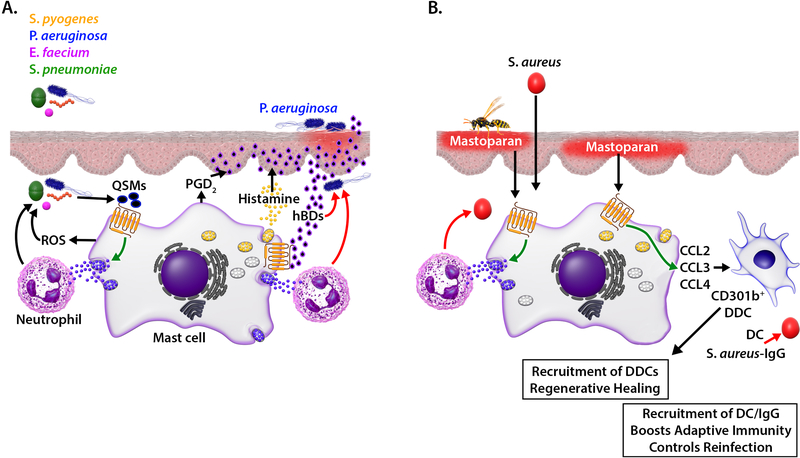
Contribution of MRGPRX2 in host defense to bacterial infection and cutaneous wound healing. (A) QSMs released from bacteria activate MCs via MRGPRX2, resulting in degranulation, reactive oxygen species (ROS) generation and recruitment of neutrophils which collectively participate in bacterial killing (red arrows). In addition, skin infection with pathogen such as P. aeruginosa induces human β defensin (hBD) from keratinocytes, which kill bacteria directly and activate MCs via MRGPRX2. MC mediators (histamine, PGD2) cause additional hBD secretion from keratinocytes, which causes further MC activation and recruitment of neutrophils, resulting in resolution of infection. (B) Based on studies with mice, we propose that topical application of mastoparan activates cutaneous MCs via MRGPRX2 to control S. aureus skin infection. Activated MCs release chemokines and recruit CD301b+ dermal dendritic cells to mediate regenerative healing. Mastoparan treatment also elicits S. aureus–specific IgG to induce antibacterial adaptive immunity to control reinfection.
FIG 2.
FIG 2.
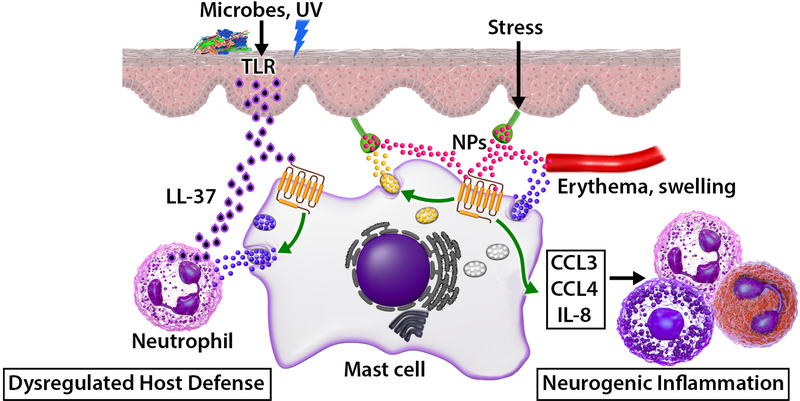
Upregulation of LL-37, induction of SP and aberrant activation of cutaneous MCs via MRGPRX2 contributes to rosacea. Microbial assault induces excessive release of LL-37 from keratinocytes which activates MCs via MRGPRX2. Activated MCs release mediators to promote neutrophil recruitment, which generate additional LL-37 to cause chronic inflammation and rosacea pathogenesis via further activation of MCs via MRGPRX2. Moreover, stress induces the release of SP from the sensory neurons, which also activates MCs by MRGPRX2, resulting in the release of chemokines and cytokines. Recruitment of inflammatory cells leads to neurogenic inflammation and exacerbation of rosacea.
FIG 3.
FIG 3.
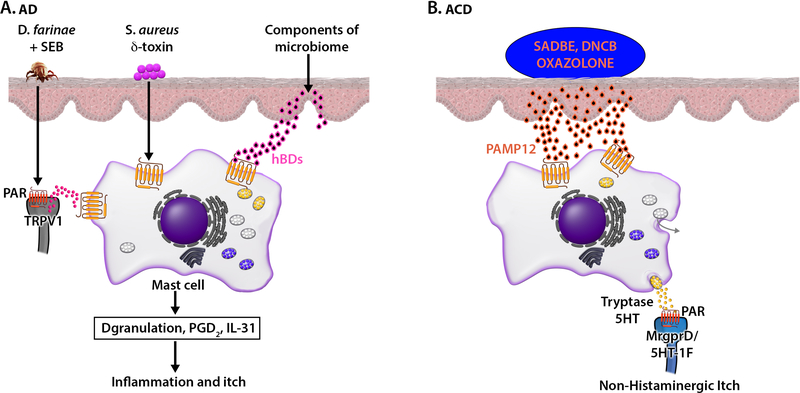
MRGPRX2 contributes to AD, ACD and non-histaminergic itch. (A) Dermatophagoides farinae (D. farinae) + staphylococcal enterotoxin B (SEB) activate TRPV1+Tac1+ sensory neurons to release SP, which activates cutaneous MCs via MRGPRX2. S. aureus secreted δ-toxin and hBDs released from keratinocytes activate human MCs via MRGPRX2. Activated MCs release mediators and cytokines resulting in itch sensations associated with AD. (B) Based on studies performed with mice, we propose that haptens such as SADBE, DNCB and oxazolone cause the release of PAMP12 from keratinocytes, which activate cutaneous MCs via MRGPRX2 to release tryptase and 5HT. Tryptase cleaves proteinase-activated receptors (PARs) present on MrgprD and 5-HT-1F expressing itch sensory neurons to induce itch sensation.
FIG 4.
FIG 4.
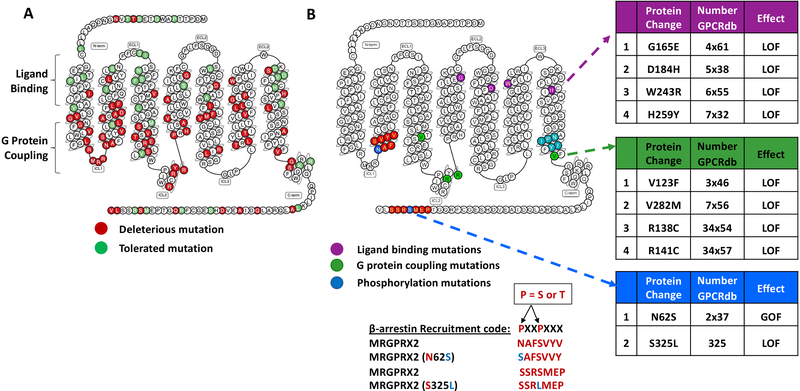
MRGPRX2 single nucleotide polymorphisms (SNPs). (A) Snake diagram of secondary structure of MRGPRX2 with each circle representing amino acid residue with one letter code. Solid background in red denotes deleterious and green denotes tolerated SNPs in MRGPRX2. (B) SNPs for ligand binding (purple), G protein coupling (green) and β-arrestin binding (blue) are shown. Conserved sequence on MRGPRX2 for β-arrestin binding (β-arrestin recruitment code) and mutations identified within this code are also shown.
FIG 5.
FIG 5.
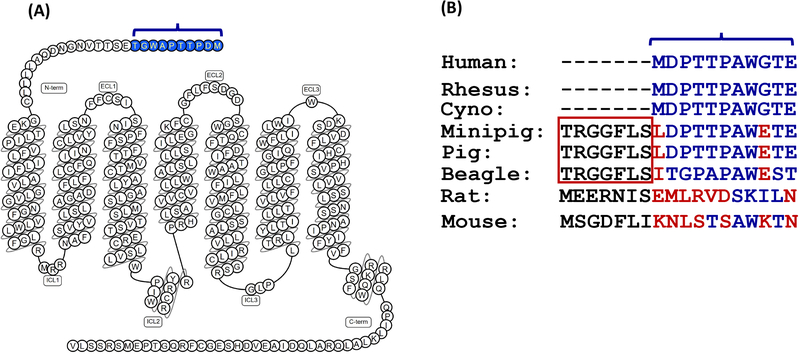
Sequence disparity in the N-terminus of Mas-related GPCRs in different species. (A) Snake diagram of secondary structure of MRGPRX2 with solid blue representing first 10 N-terminal amino acids. (B) Comparison of N-terminal sequence of human MRGPRX2 with the corresponding rhesus, cynomolgus (Cyno), minipig, pig, beagle, rat and mouse receptors.
FIG 6.
FIG 6.
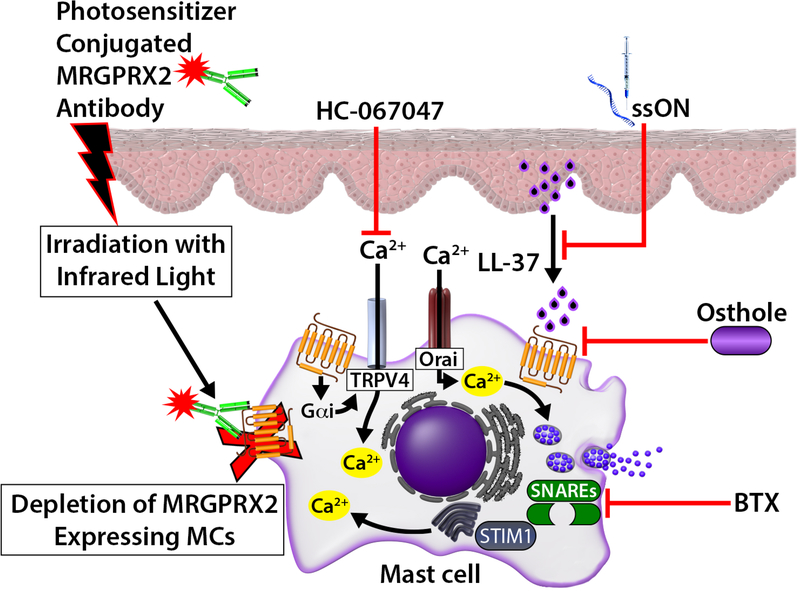
Modulation of MRGPRX2 and its signaling in cutaneous MCs. Injection of photosensitizer conjugated with MRGPRX2 antibody can selectively destroy targeted skin MCs. Single-stranded oligonucleotide (ssON) inhibits LL-37-induced degranulation in human MCs and reduces LL-37-induced experimental rosacea in mice. Osthole, TRPV4 inhibitor HC-067047 and Botulinum toxin (BTX) inhibit different component of MRGPRX2 and its signaling in human MCs to block LL-37induced rosacea in mice.

References

    1. Galli SJ, Gaudenzio N, Tsai M. Mast Cells in Inflammation and Disease: Recent Progress and Ongoing Concerns. Annu Rev Immunol 2020; 38:49–77. - PubMed
    1. Weller K, Foitzik K, Paus R, Syska W, Maurer M. Mast cells are required for normal healing of skin wounds in mice. FASEB J 2006; 20:2366–8. - PubMed
    1. Zimmermann C, Troeltzsch D, Gimenez-Rivera VA, Galli SJ, Metz M, Maurer M, et al. Mast cells are critical for controlling the bacterial burden and the healing of infected wounds. Proc Natl Acad Sci U S A 2019; 116:20500–4. - PMC - PubMed
    1. Oskeritzian CA, Zhao W, Min HK, Xia HZ, Pozez A, Kiev J, et al. Surface CD88 functionally distinguishes the MCTC from the MCT type of human lung mast cell. J Allergy Clin Immunol 2005; 115:1162–8. - PMC - PubMed
    1. Aridor M, Rajmilevich G, Beaven MA, Sagi-Eisenberg R. Activation of exocytosis by the heterotrimeric G protein Gi3. Science 1993; 262:1569–72. - PubMed

Publication types

MeSH terms