Review
. 2021 Aug:69:170-177.
doi: 10.1016/j.conb.2021.03.015. Epub 2021 May 3.

Cell adhesion molecules regulating astrocyte-neuron interactions

Affiliations
Review

Cell adhesion molecules regulating astrocyte-neuron interactions

Christabel X Tan et al. Curr Opin Neurobiol. 2021 Aug.

Abstract

A tripartite synapse comprises a neuronal presynaptic axon and a postsynaptic dendrite, which are closely ensheathed by a perisynaptic astrocyte process. Through their structural and functional association with thousands of neuronal synapses, astrocytes regulate synapse formation and function. Recent work revealed a diverse range of cell adhesion-based mechanisms that mediate astrocyte-synapse interactions at tripartite synapses. Here, we will review some of these findings unveiling a highly dynamic bidirectional signaling between astrocytes and synapses, which orchestrates astrocyte morphological maturation and synapse development. Moreover, we will discuss the roles of these newly discovered molecular pathways in brain physiology and function both in health and disease.


Conflict of interest statement

Conflict of interest statement Nothing declared.

Figures
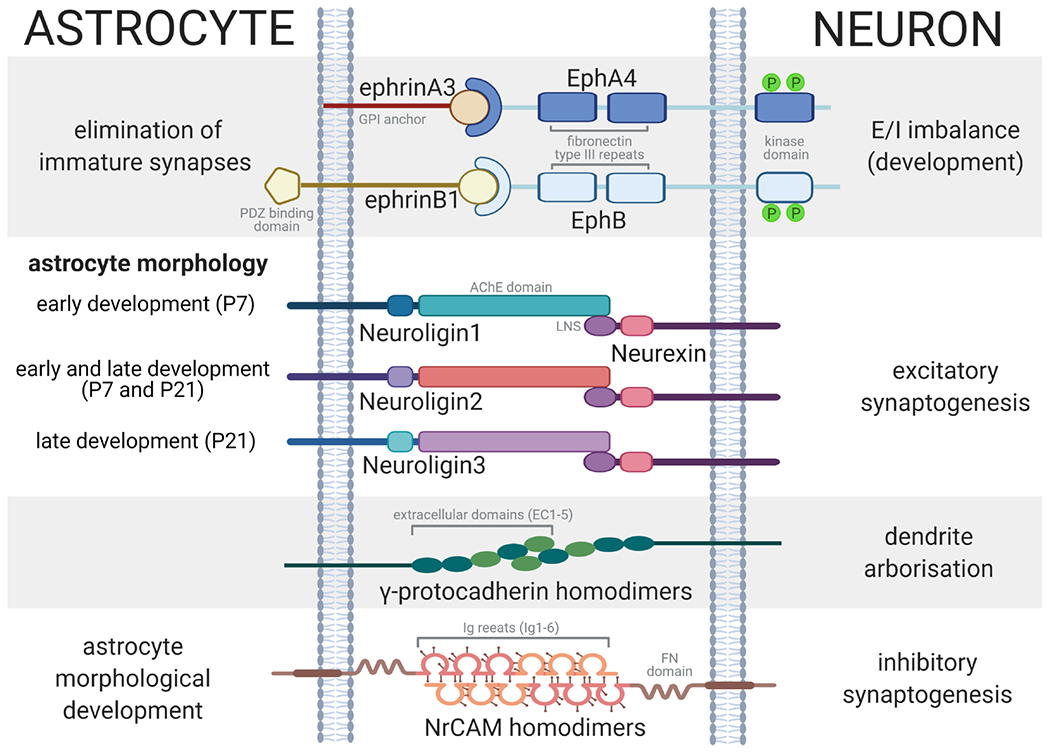
Figure 1.
Figure 1.. Overview of cell adhesion mechanisms mediating astrocyte-neuron interactions.
4 classes of adhesion molecules are discussed in this review. (1) Astrocytic ephrins bind to neuronal Eph receptors to negatively regulate synaptogenesis by eliminating immature synapses. ephrinAs are anchored to the astrocyte cell surface by a GPI anchor; whereas, ephrinBs have a C-terminal PDZ-binding domain that greatly augments the possiblity of astrocyte-neuron bidirectional signaling. In constrast, EphA and EphB have similar structures, comprising of extracellular fibronectin type II repeats and an intracellular kinase domain that is known to be critical for E/I balance. (2) Neuroligin-neurexin interactions are mediated by the binding of neuroligin’s acetylcholinesterase (AChE) domain and neurexin’s LNS (laminin, neurexin, sexhormone binding globulin) domain. Different neuroligins regulate astrocyte morphological complexity at different developmental timepoints. Collectively astrocytic neuroligin/neuronal neurexin interactions molecularly link astrocyte complexity with synaptogenesis during a critical window of postnatal cortical development. (3) γ-protocadherins trans-dimerize via binding of its extracellular domains at the astrocyte-neuron interface to regulate dendrite arborization. (4) The extracellular domain of NrCAM is composed of 6 immunoglobulin-like (Ig) repeats and several fibronectin (FN) domains. Astrocytic NrCAM forms homodimers with neuronal NrCAM via its Ig repeats to regulate both astrocyte morphology and inhibitory synaptogenesis.
Figure 2.
Figure 2.. Modes of astrocyte-neuron contact-contact mediated interactions.
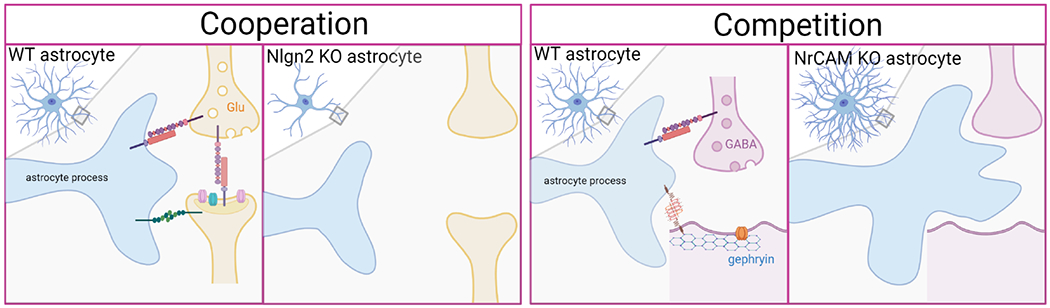
(Left) Astrocytes mature morphologically concurrently with synapse development. Cooperation between developing astrocytes and neurites are critical in stabilizing trans-synaptic connections, resulting in a functional tripartite synapse. (Right) On the other hand, astrocyte-neuron contacts may act as a negative regulator of astrocyte overgrowth that would otherwise encroach into the forming synapse and prevent synaptogenesis.

References

    1. Farhy-Tselnicker I, Allen NJ: Astrocytes, neurons, synapses: A tripartite view on cortical circuit development. Neural Dev 2018, 13:1–12. - PMC - PubMed
    1. Papouin T, Dunphy J, Tolman M, Foley JC, Haydon PG: Astrocytic control of synaptic function. Philos Trans R Soc B Biol Sci 2017, 372. - PMC - PubMed
    1. Santello M, Toni N, Volterra A: Astrocyte function from information processing to cognition and cognitive impairment. Nat Neurosci 2019, 22:154–166. - PubMed
    1. Pfrieger FW, Barres BA: Synaptic efficacy enhanced by glial cells in vitro. Science 1997, 277:1684–1687. - PubMed
    1. Ullian EM, Sapperstein SK, Christopherson KS, Barres BA: Control of synapse number by glia. Science 2001, 291:657–661. - PubMed

Publication types

Substances

LinkOut - more resources