


Plasma proteomics of green turtles (Chelonia mydas) reveals pathway shifts and potential biomarker candidates associated with health and disease
- PMID: 33959286
- PMCID: PMC8084024
- DOI: 10.1093/conphys/coab018
Plasma proteomics of green turtles (Chelonia mydas) reveals pathway shifts and potential biomarker candidates associated with health and disease
Abstract
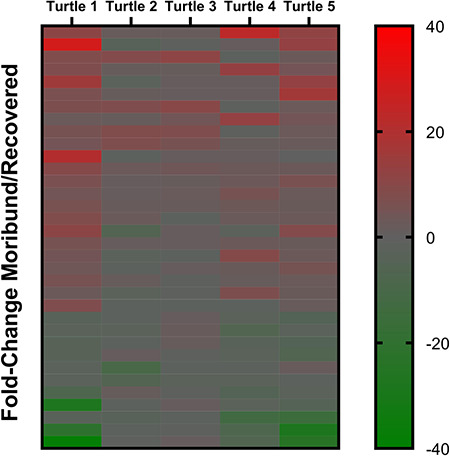
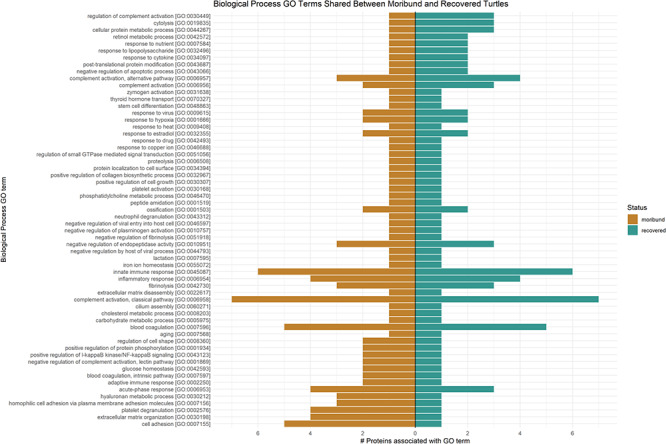
Evaluating sea turtle health can be challenging due to an incomplete understanding of pathophysiologic responses in these species. Proteome characterization of clinical plasma samples can provide insights into disease progression and prospective biomarker targets. A TMT-10-plex-LC-MS/MS platform was used to characterize the plasma proteome of five, juvenile, green turtles (Chelonia mydas) and compare qualitative and quantitative protein changes during moribund and recovered states. The 10 plasma samples yielded a total of 670 unique proteins. Using ≥1.2-fold change in protein abundance as a benchmark for physiologic upregulation or downregulation, 233 (34.8%) were differentially regulated in at least one turtle between moribund and recovered states. Forty-six proteins (6.9%) were differentially regulated in all five turtles with two proteins (0.3%) demonstrating a statistically significant change. A principle component analysis showed protein abundance loosely clustered between moribund samples or recovered samples and for turtles that presented with trauma (n = 3) or as intestinal floaters (n = 2). Gene Ontology terms demonstrated that moribund samples were represented by a higher number of proteins associated with blood coagulation, adaptive immune responses and acute phase response, while recovered turtle samples included a relatively higher number of proteins associated with metabolic processes and response to nutrients. Abundance levels of 48 proteins (7.2%) in moribund samples significantly correlated with total protein, albumin and/or globulin levels quantified by biochemical analysis. Differentially regulated proteins identified with immunologic and physiologic functions are discussed for their possible role in the green turtle pathophysiologic response and for their potential use as diagnostic biomarkers. These findings enhance our ability to interpret sea turtle health and further progress conservation, research and rehabilitation programs for these ecologically important species.
© The Author(s) 2021. Published by Oxford University Press and the Society for Experimental Biology.
Figures


References
-
- Bolten AB, Bjorndal KA (1992) Blood profiles for a wild population of green turtles (Chelonia mydas) in the southern Bahamas: size-specific and sex-specific relationships. J Wildl Dis 28: 407–413. - PubMed
-
- Bradford MM (1976) A rapid and sensitive method for the quantitation of microgram quantities of protein utilizing the principle of protein-dye binding. Anal Biochem 72: 248–254. - PubMed
-
- Buchfink B, Xie C, Huson DH (2015) Fast and sensitive protein alignment using DIAMOND. Nat Methods 12: 59–60. - PubMed
LinkOut - more resources
Full Text Sources
Other Literature Sources
