Review
. 2021 Mar 10;8(3):201991.
doi: 10.1098/rsos.201991.

A brief review on Group A Streptococcus pathogenesis and vaccine development

Affiliations
Review

A brief review on Group A Streptococcus pathogenesis and vaccine development

Sowmya Ajay Castro et al. R Soc Open Sci. .

Abstract

Streptococcus pyogenes, also known as Group A Streptococcus (GAS), is a Gram-positive human-exclusive pathogen, responsible for more than 500 000 deaths annually worldwide. Upon infection, GAS commonly triggers mild symptoms such as pharyngitis, pyoderma and fever. However, recurrent infections or prolonged exposure to GAS might lead to life-threatening conditions. Necrotizing fasciitis, streptococcal toxic shock syndrome and post-immune mediated diseases, such as poststreptococcal glomerulonephritis, acute rheumatic fever and rheumatic heart disease, contribute to very high mortality rates in non-industrialized countries. Though an initial reduction in GAS infections was observed in high-income countries, global outbreaks of GAS, causing rheumatic fever and acute poststreptococcal glomerulonephritis, have been reported over the last decade. At the same time, our understanding of GAS pathogenesis and transmission has vastly increased, with detailed insight into the various stages of infection, beginning with adhesion, colonization and evasion of the host immune system. Despite deeper knowledge of the impact of GAS on the human body, the development of a successful vaccine for prophylaxis of GAS remains outstanding. In this review, we discuss the challenges involved in identifying a universal GAS vaccine and describe several potential vaccine candidates that we believe warrant pursuit.

Keywords: Group A Streptococcus; M protein; gas vaccine; pharyngitis; rheumatic fever; toxic shock syndrome.


Figures

Figure 1.
Figure 1.
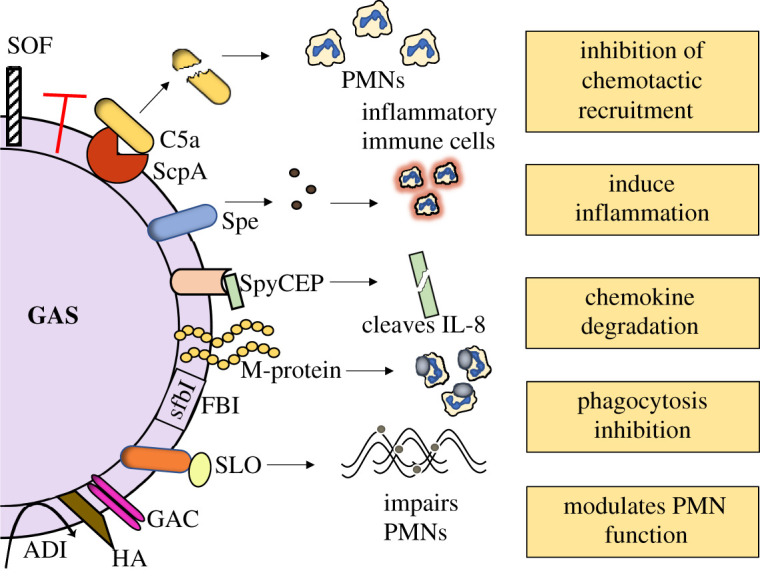
Virulence factors of GAS. A variety of antigens on the surface of the GAS are involved in virulence. Each of the displayed antigens have been well documented for their association to impair the host immune system. GAS produces several secreted toxins that cleave human proteins. Examples are ScpA, which cleaves the chemoattractant C5a and spyCEP cleaves neutrophil attracting chemokines, e.g. IL-8 on PMNs. This in turn inhibits the phagocyte recruitment. M-proteins bind to the components of the immune system thereby conferring resistance to phagocytosis. SLO impairs neutrophil function, whereas the carbohydrates GAC and HA promote GAS survival within the human blood. Abbreviations: NETs – Neutrophil extracellular traps; PMNs – Polymorphonuclear leukocytes; ScpA, streptococcal C5a peptidase; Spe, streptococcal pyrogenic exotoxin; SpeA, streptococcal pyrogenic exotoxin A; spyCEP, streptococcal pyogenes cell envelope protease; GAC, Group A Carbohydrate; FBI, fibronectin-binding protein; sfbI, S. pyogenes fibronectin-binding protein; SOF, serum opacity factor; ADI, arginine deaminase; HA, hyaluronic acid capsule; GAS, Group A Streptococcus.
Figure 2.
Figure 2.
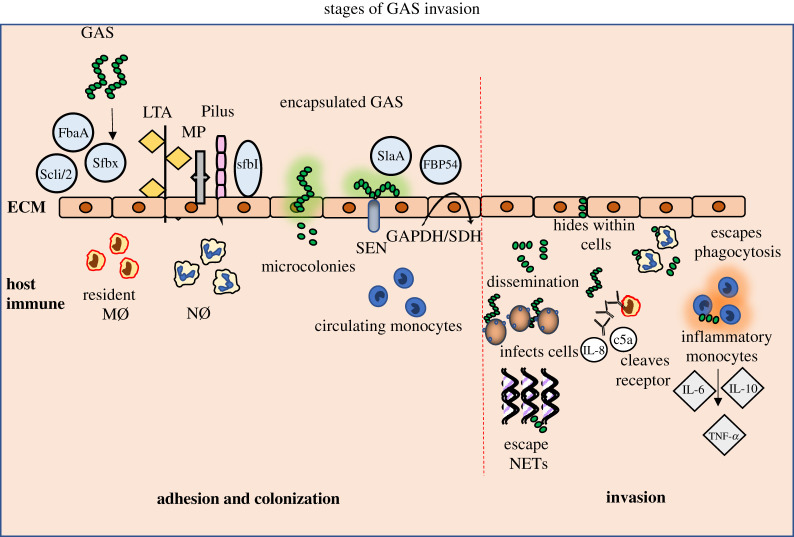
Stages of GAS invasion of the host immune system. A wide range of bacterial protein adhesins engage with the adherence and colonization of the GAS pathogen to the ECM of the host tissue. Initial attachment of GAS is followed by formation of microcolonies accompanied by cell wall-anchored adhesins and anchorless enzymes. Once colonized within the tissue sites GAS disseminates inside the host by surviving and multiplying. GAS survives by different mechanisms, including hiding within the epithelial cell lines, inhibiting phagocytosis and degrading DNase of NETs. GAS-infected cells trigger a strong inflammatory response, thereby inducing a cytokine storm. Abbreviations: GAS, Group A Streptococcus; ECM, extracellular matrix; LTA, lipoteichoic acid; MP, M-protein; FbaA, Scli/2, sfbX, sfbI, SlaA, FBP54, protein adhesins; SEN, streptococcal surface enolase; streptococcal surface dehydrogenase, GAPDH/SDH; MØ, macrophages; NØ, neutrophils; NETs, neutrophil extracellular traps.

References

    1. Cunningham MW. 2000. Pathogenesis of group A streptococcal infections. Clin. Microbiol. Rev. 13, 470-511. (10.1128/CMR.13.3.470) - DOI - PMC - PubMed
    1. Walker MJ, Barnett TC, Mcarthur JD, Cole JN, Gillen CM, Henningham A, Sriprakash KS, Sanderson-Smith ML, Nizet V. 2014. Disease manifestations and pathogenic mechanisms of Group A Streptococcus. Clin. Microbiol. Rev. 27, 264-301. (10.1128/CMR.00101-13) - DOI - PMC - PubMed
    1. Gerber MA. 1996. Antibiotic resistance: relationship to persistence of group A streptococci in the upper respiratory tract. Pediatrics 97, 971-975. - PubMed
    1. Passàli D, Lauriello M, Passàli GC, Passàli FM, Bellussi L. 2007. Group A Streptococcus and its antibiotic resistance. Acta otorhinolaryngologica Italica: organo ufficiale della Societa italiana di otorinolaringologia e chirurgia cervico-facciale 27, 27-32. - PMC - PubMed
    1. Sela S, Barzilai A. 1999. Why do we fail with penicillin in the treatment of group A Streptococcus infections? Ann. Med. 31, 303-307. (10.3109/07853899908995895) - DOI - PubMed

LinkOut - more resources