Review
. 2021 Aug 11;72(16):5905-5918.
doi: 10.1093/jxb/erab200.

Chloroplast dismantling in leaf senescence

Affiliations
Review

Chloroplast dismantling in leaf senescence

Fernando Domínguez et al. J Exp Bot. .

Abstract

In photosynthetic plant cells, chloroplasts act as factories of metabolic intermediates that support plant growth. Chloroplast performance is highly influenced by environmental cues. Thus, these organelles have the additional function of sensing ever changing environmental conditions, thereby playing a key role in harmonizing the growth and development of different organs and in plant acclimation to the environment. Moreover, chloroplasts constitute an excellent source of metabolic intermediates that are remobilized to sink tissues during senescence so that chloroplast dismantling is a tightly regulated process that plays a key role in plant development. Stressful environmental conditions enhance the generation of reactive oxygen species (ROS) by chloroplasts, which may lead to oxidative stress causing damage to the organelle. These environmental conditions trigger mechanisms that allow the rapid dismantling of damaged chloroplasts, which is crucial to avoid deleterious effects of toxic by-products of the degradative process. In this review, we discuss the effect of redox homeostasis and ROS generation in the process of chloroplast dismantling. Furthermore, we summarize the structural and biochemical events, both intra- and extraplastid, that characterize the process of chloroplast dismantling in senescence and in response to environmental stresses.

Keywords: Autophagy; ROS; chlorophagy; chloroplast; gerontoplast; plastoglobule; senescence.


Figures

Fig. 1.
Fig. 1.
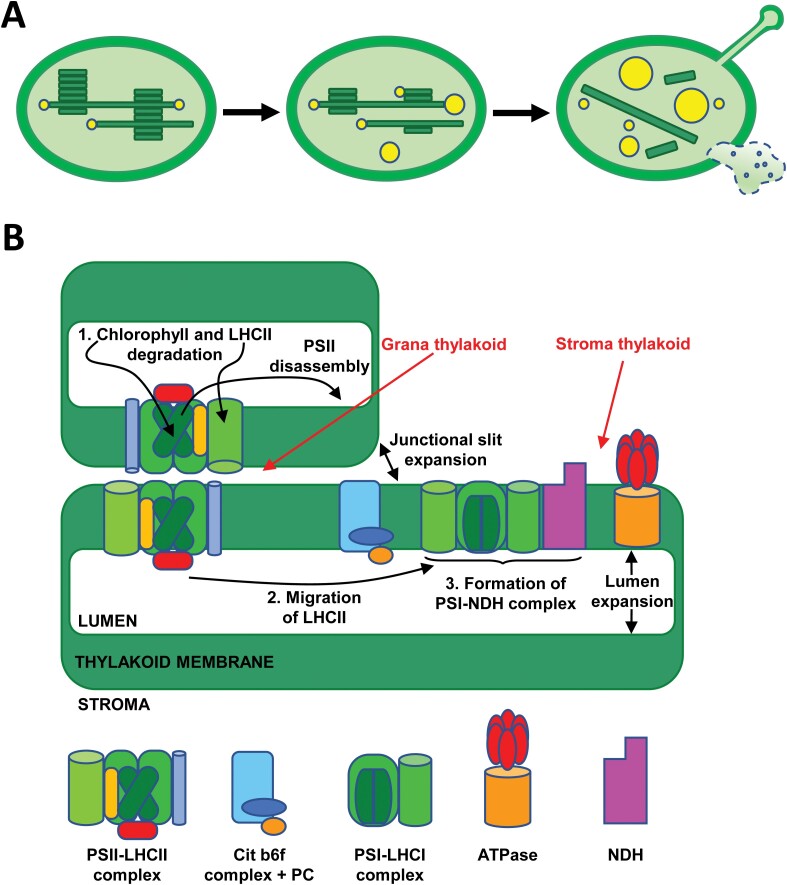
Chloroplast macrodomain and subdomain rearrangements during senescence. (A) Main ultrastructural changes associated with chloroplast-to-gerontoplast transition. As senescence progresses, mature chloroplasts (left panel) show increased disorganization of the thylakoid membrane system and an increase in the size and number of plastoglobules (middle panel); finally, gerontoplasts (right panel) are characterized by the almost complete loss of thylakoids, highest plastoglobule size, and envelope perforations that allow extrusion of stroma content. (B) Rearrangements occurring during grana unstacking in the chloroplast-to-gerontoplast transition were classified in stages: 1, chlorophyll and LHCII degradation; 2, LHCII migration; 3, formation of PSI–NDH complex. Schemes representing each of the complexes are indicated.
Fig. 2.
Fig. 2.
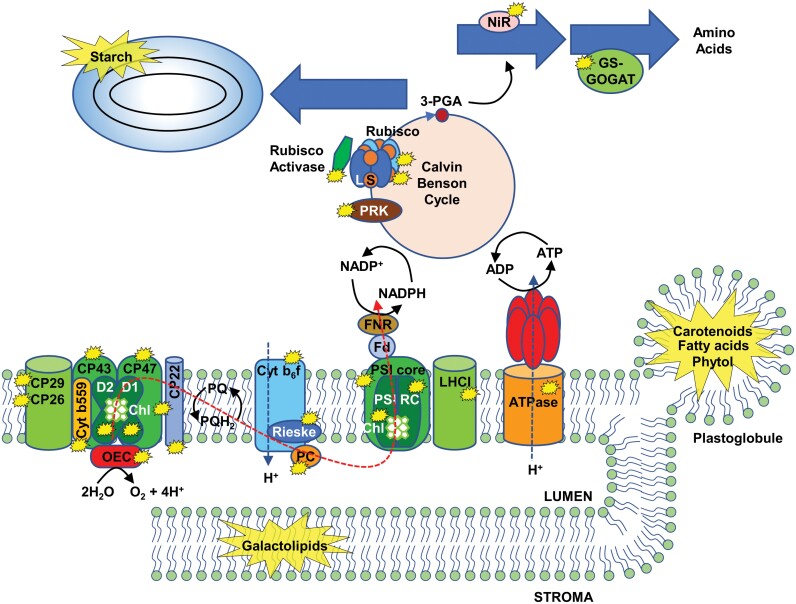
Localization of the main targets undergoing degradation during chloroplast dismantling. Thylakoid membrane and stromal components degraded during chloroplast dismantling are marked with yellow stars. Red dashed line indicates the linear flow of the photosynthetic electron chain. Cyt, cytochrome; Fd, ferredoxin; FNR, reduced ferredoxin-NADPH reductase; GOGAT, glutamate synthase; GS, glutamine synthase; LHCI, light-harvesting complex I; NIR, nitrite reductase; OEC, oxygen-evolving complex; PC, plastocyanin; 3-PGA, 3-phosphoglyceric acid; PRK, phosphoribulokinase; PSI, photosystem I; PSIRC, PSI reaction centre.
Fig. 3.
Fig. 3.
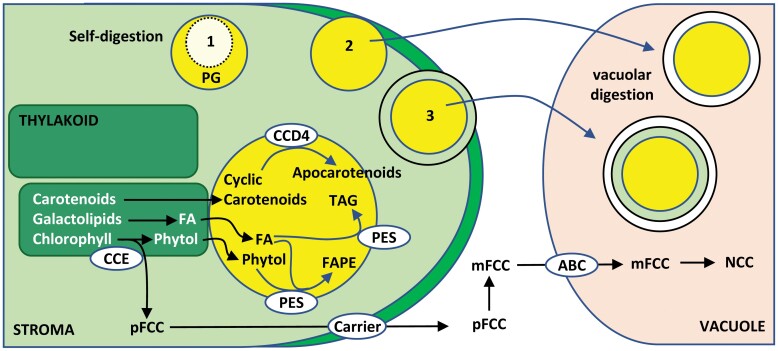
Intra- and extraplastid pathways for pigment and lipid degradation during chloroplast dismantling. Chlorophyll and galactolipid breakdown are initiated within thylakoid membranes. Phytol and fatty acids, by-products in the cleavage of chlorophyll and galactolipids, respectively, are esterified in plastoglobules (yellow) to avoid their toxicity. The first non-toxic, colourless by-product of chlorophyll breakdown (pFCC) is released to the chloroplast stroma and then to the cytosol where it is converted to modified fluorescent chlorophyll catabolite (mFCC), which is transported to the vacuole by an ATP-binding cassette (ABC)-type vacuolar transporter. In the vacuole, mFCC is degraded to non-fluorescent chlorophyll catabolite (NCC). Alternative types of plastoglobules elimination are indicated with numbers: 1, self-digestion within chloroplast; 2, vacuolar degradation of extruded plastoglobule; 3, plastoglobule-containing vesicles after microautophagy. CCD4, carotenoid cleavage dioxygenase 4; FA, fatty acid; FAPE, fatty acid phytyl esters; PES, phytyl ester synthase; pFCC, primary blue-fluorescent chlorophyll catabolite; TAG, triacylglycerol.
Fig. 4.
Fig. 4.
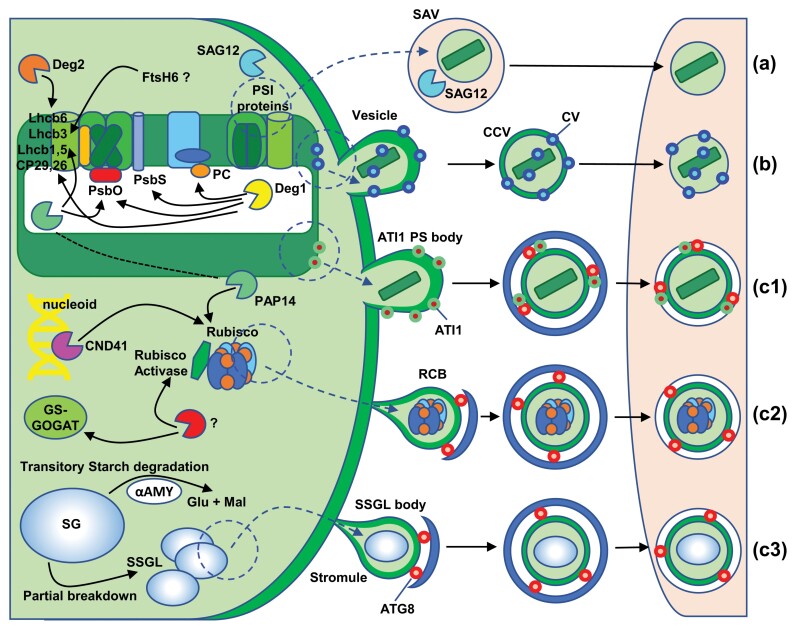
Intra- and extraplastid events of chloroplast dismantling during senescence and stress. Intraplastid events (left side) include the disassembly and cleavage of different thylakoid membrane proteins, catalysed by Deg1, Deg2, FtsH6, and HvPAP14 proteases, the proteolysis of Rubisco and other stroma proteins catalysed by CND41 and HvPAP14 proteases, and the cleavage of starch granules (SG) to small starch granules (SSG) and formation of small starch granule-like (SSGL) bodies. Extraplastid events (right side) include the different pathways for chloroplast degradation: senescence associated vacuoles (SAV) (a), chloroplast vesiculation (CV) (b), and chlorophagy (c). Three types of piecemeal chlorophagy are distinguished: ATG8-interacting protein 1-positive (ATI1 PS) body (c1), Rubisco containing bodies (RCB) (c2), and SSGL body (c3). ATI1 PS, RCB, and SSGL bodies are removed by macroautophagy, an ATG-dependent piecemeal chlorophagy through autophagosomes (blue double-membrane vesicle) marked by ATG8 (red circles). SAV and CV-containing vesicles (CCV) are degraded by microautophagy (ATG-independent pathways). αAMY, amylase; GS-GOGAT, glutamine synthetase–glutamate synthase.

References

    1. Albanese P, Tamara S, Saracco G, Scheltema RA, Pagliano C. 2020. How paired PSII-LHCII supercomplexes mediate the stacking of plant thylakoid membranes unveiled by structural mass-spectrometry. Nature Communications 11, 1361. - PMC - PubMed
    1. Armbruster U, Labs M, Pribil M, et al. 2013. Arabidopsis CURVATURE THYLAKOID1 proteins modify thylakoid architecture by inducing membrane curvature. The Plant Cell 25, 2661–2678. - PMC - PubMed
    1. Austin JR 2nd, Frost E, Vidi PA, Kessler F, Staehelin LA. 2006. Plastoglobules are lipoprotein subcompartments of the chloroplast that are permanently coupled to thylakoid membranes and contain biosynthetic enzymes. The Plant Cell 18, 1693–1703. - PMC - PubMed
    1. Avila-Ospina L, Moison M, Yoshimoto K, Masclaux-Daubresse C. 2014. Autophagy, plant senescence, and nutrient recycling. Journal of Experimental Botany 65, 3799–3811. - PubMed
    1. Bernal-Bayard P, Hervás M, Cejudo FJ, Navarro JA. 2012. Electron transfer pathways and dynamics of chloroplast NADPH-dependent thioredoxin reductase C (NTRC). The Journal of Biological Chemistry 287, 33865–33872. - PMC - PubMed

Publication types

Substances

LinkOut - more resources