. 2021 Aug;231(4):1449-1461.
doi: 10.1111/nph.17447. Epub 2021 Jun 10.

Aldoximes are precursors of auxins in Arabidopsis and maize

Affiliations

Aldoximes are precursors of auxins in Arabidopsis and maize

Veronica C Perez et al. New Phytol. 2021 Aug.

Abstract

Two natural auxins, phenylacetic acid (PAA) and indole-3-acetic acid (IAA), play crucial roles in plant growth and development. One route of IAA biosynthesis uses the glucosinolate intermediate indole-3-acetaldoxime (IAOx) as a precursor, which is thought to occur only in glucosinolate-producing plants in Brassicales. A recent study showed that overproducing phenylacetaldoxime (PAOx) in Arabidopsis increases PAA production. However, it remains unknown whether this increased PAA resulted from hydrolysis of PAOx-derived benzyl glucosinolate or, like IAOx-derived IAA, is directly converted from PAOx. If glucosinolate hydrolysis is not required, aldoxime-derived auxin biosynthesis may occur beyond Brassicales. To better understand aldoxime-derived auxin biosynthesis, we conducted an isotope-labelled aldoxime feeding assay using an Arabidopsis glucosinolate-deficient mutant sur1 and maize, and transcriptomics analysis. Our study demonstrated that the conversion of PAOx to PAA does not require glucosinolates in Arabidopsis. Furthermore, maize produces PAA and IAA from PAOx and IAOx, respectively, indicating that aldoxime-derived auxin biosynthesis also occurs in maize. Considering that aldoxime production occurs widely in the plant kingdom, aldoxime-derived auxin biosynthesis is likely to be more widespread than originally believed. A genome-wide transcriptomics study using PAOx-overproduction plants identified complex metabolic networks among IAA, PAA, phenylpropanoid and tryptophan metabolism.

Keywords: Arabidopsis thaliana; aldoxime; auxin; indole-3-acetic acid (IAA); phenylacetic acid (PAA); phenylpropanoid.


Figures

Figure 1.
Figure 1.
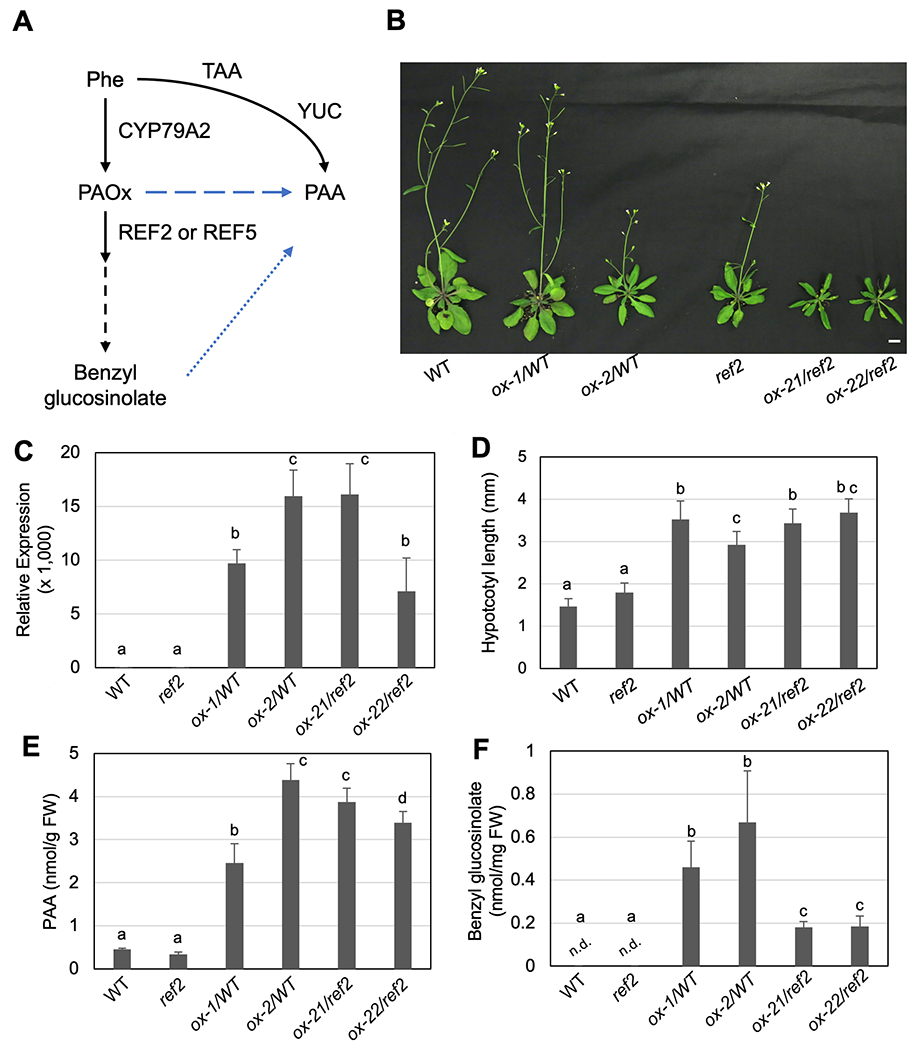
Increased PAOx production results in the accumulation of benzyl glucosinolate and PAA. A) A schematic diagram of PAOx metabolism and PAA biosynthesis in Arabidopsis thaliana. Proposed routes of PAOx-derived PAA biosynthesis are shown with the dashed blue line. B) Representative 4-week-old CYP79A2 overexpression lines in the wild-type and ref2 genetic backgrounds compared to their controls. Scale bar = 1 cm. C) Relative expression of CYP79A2 in wild type, ref2, and CYP79A2 overexpression lines in the wild-type (ox-1, ox-2) and ref2 (ox-21, ox-22) genetic backgrounds (N=3). D) Hypocotyl length of seven-days-old wild-type, ref2, and CYP79A2 overexpression lines (N=8). E) Free PAA content of wild-type, ref2, and CYP79A2 overexpression lines (N=3). F) Benzyl glucosinolate content of wild-type, ref2, and CYP79A2 overexpression lines (N=4). 2-week-old whole aerial parts were extracted to measure relative amount of benzyl glucosinolate. Data represent mean ± SD. The means were compared by one-way ANOVA, and statistically significant differences (P < 0.05) were identified by Tukey’s test and indicated by letters to represent difference among groups.
Figure 2.
Figure 2.
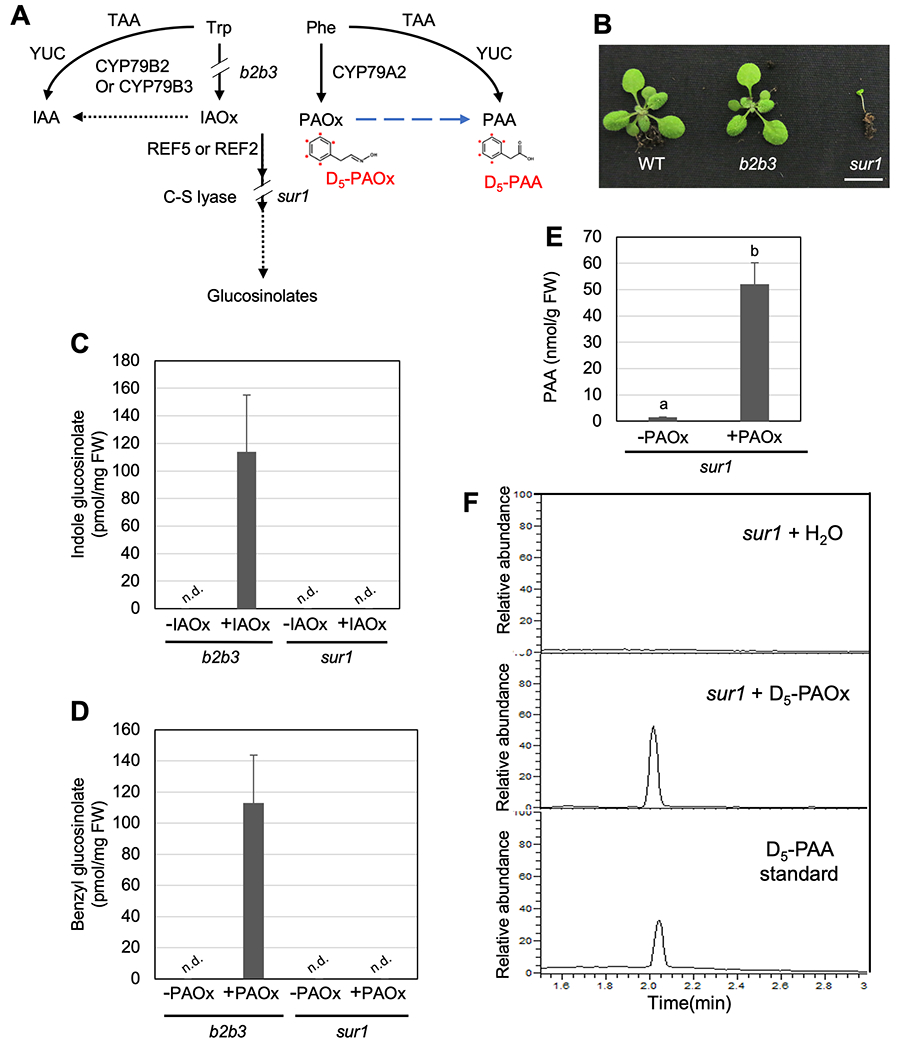
PAOx can be converted to PAA without benzyl glucosinolate hydrolysis. A) A schematic diagram of PAOx and IAOx metabolism in Arabidopsis. The point of disruption in b2b3 and sur1 is marked in the schematic. The chemical structures shown represent deuterium labeled compound D5-PAOx and D5-PAA (the input and expected output of the labeled PAOx feeding assays done with sur1), with the red dots denoting the location of deuterium atoms. B) Representative 3-week-old wild type, cyp79b2 cyp79b3 double mutant (b2b3), and sur1 mutant. Scale bar = 1 cm. C) Indole-3-ylmethyl glucosinolate level in b2b3 and sur1 plants fed with water or IAOx for 24 hours (N=2 for sur1 and N=4 for b2b3). D) Benzyl glucosinolate level in b2b3 and sur1 plants fed with water or PAOx for 24 hours (N=2 for sur1 and N=4 for b2b3). C-E) Data represent mean ± SD. The means were compared by one-way ANOVA, and statistically significant differences (P < 0.05) were identified by Tukey’s test and indicated by letters to represent difference among groups. E) Free PAA content of water-fed and PAOx-fed 2-week-old sur1 seedlings (N=4). F) LC-MS chromatograms for the D5-PAA standard (bottom) and endogenous D5-PAA in sur1 seedlings after feeding D5-PAOx (middle) or water (top).
Figure 3.
Figure 3.
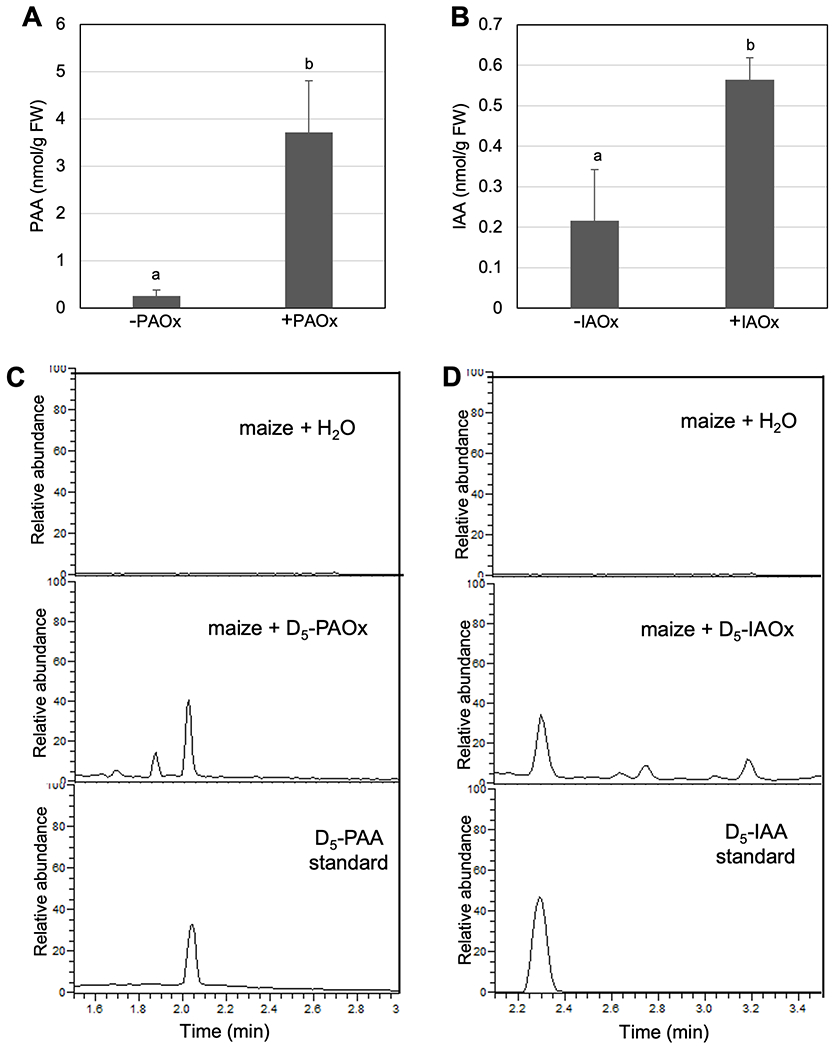
Maize converts IAOx and PAOx to IAA and PAA, respectively. A) Free PAA content of maize leaves fed with water or PAOx (N=3). B) Free IAA content of maize leavs fed with water or IAOx (N=2). Data represent mean ± SD. First leaves from 12-day-old maize plants were incubated in either water or water containing 30 μM of aldoximes for 24 hours. C) LC-MS chromatograms for the D5-PAA standard (bottom) and endogenous D5-PAA in maize leaves after feeding with water (top) or D5-PAOx (middle). D) LC-MS chromatograms for the D5-IAA standard (bottom) and endogenous D5-IAA in maize leaves after feeding with water (top) or D5-IAOx (middle). The means were compared by one-way ANOVA, and statistically significant differences (P < 0.05) were identified by Tukey’s test and indicated by letters to represent difference among groups.
Figure 4.
Figure 4.
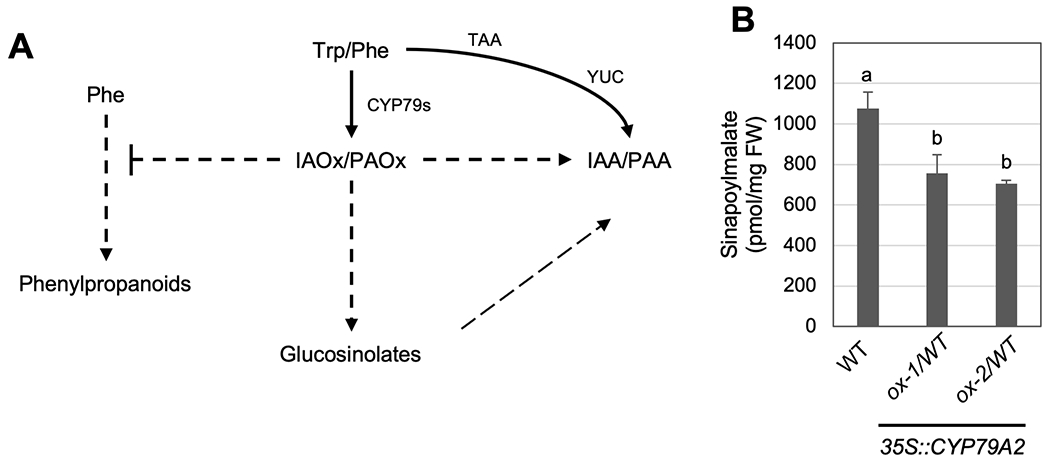
PAOx metabolism is linked to phenylpropanoid production. A) A schematic of the metabolic network of IAOx and PAOx in Arabidopsis, as well as the major route of IAA and PAA biosynthesis. B) The level of sinapoylmalate in wild type and CYP79A2 overexpression (ox-1, ox-2) (N=4). Data represent mean ± SD. The means were compared by one-way ANOVA, and statistically significant differences (P < 0.05) were identified by Tukey’s test and indicated by letters to represent difference among groups.
Figure 5.
Figure 5.
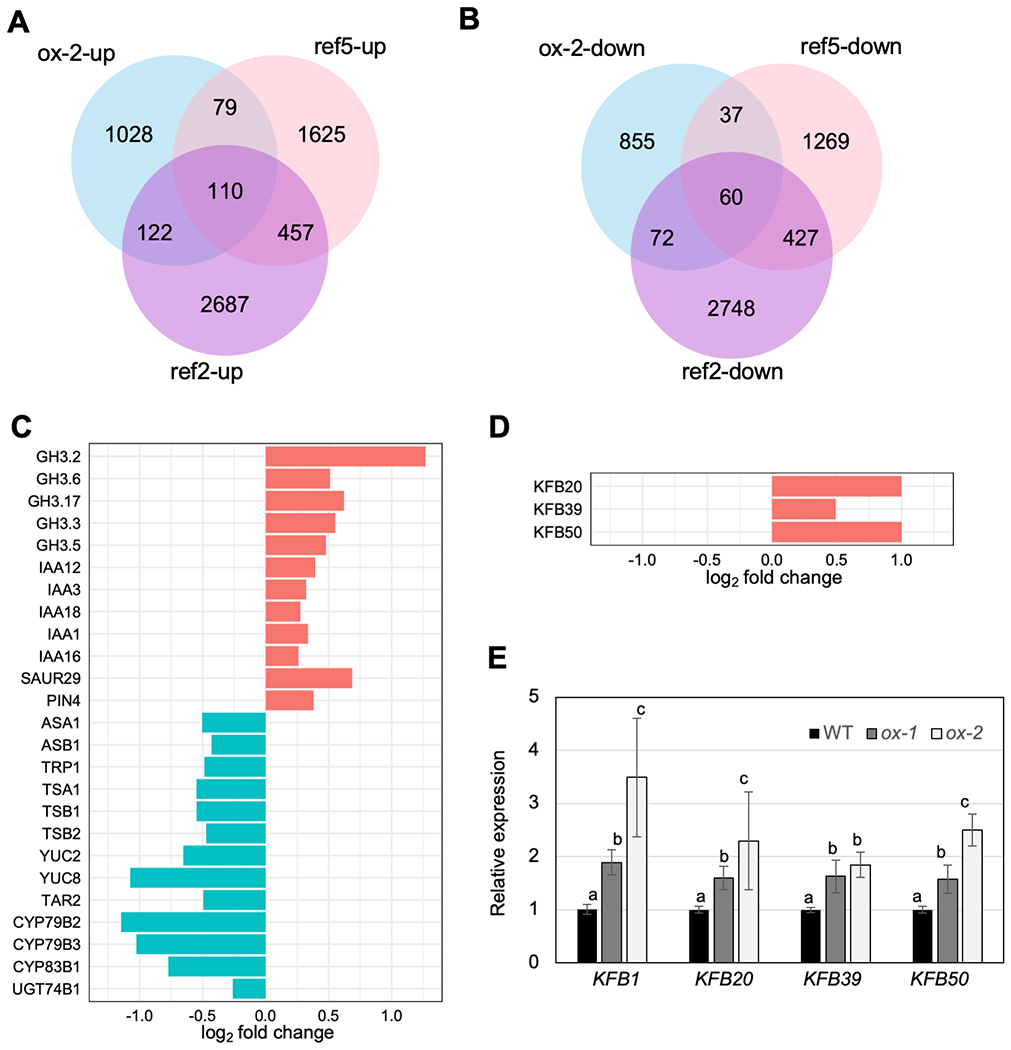
Increased PAOx metabolism alters the expression of genes related to auxin response, tryptophan metabolism, and phenylpropanoid biosynthesis. A) The number of genes with significantly increased expression in CYP79A2 overexpression line ox-2 (ox-2-up), ref2 (ref2-up), and ref5 (ref5-up), compared to wild type. B) The number of genes with significantly decreased expression in CYP79A2 overexpression line ox-2 (ox-2-down), ref2 (ref2-down), and ref5 (ref5-down), compared to wild type. C) The expression levels (log2 fold change) of select genes differentially regulated in ox-2 compared to wild type. D) The expression levels of the KFB genes that are upregulated in ref2, ref5, and ox-2 compared to wild type. E) Relative expression, determined by qRT-PCR, of KFB genes in ox-1 and ox-2 compared to wild type (N=3). 3rd to 6th rosette leaves from two-week-old plants were harvested for RNA extraction. Data represent mean ± SE. The means were compared by one-way ANOVA, and statistically significant differences (P < 0.05) were identified by Tukey’s test and indicated by letters to represent difference among groups.

References

    1. Andersen MD, Busk PK, Svendsen I, and Møller BL (2000). Cytochromes P-450 from Cassava (Manihot esculentaCrantz) Catalyzing the First Steps in the Biosynthesis of the Cyanogenic Glucosides Linamarin and Lotaustralin: CLONING, FUNCTIONAL EXPRESSION IN PICHIA PASTORIS, AND SUBSTRATE SPECIFICITY OF THE ISOLATED RECOMBINANT ENZYMES*. Journal of Biological Chemistry 275:1966–1975. - PubMed
    1. Aoi Y, Tanaka K, Cook SD, Hayashi K-I, and Kasahara H (2020a). GH3 Auxin-Amido Synthetases Alter the Ratio of Indole-3-Acetic Acid and Phenylacetic Acid in Arabidopsis. Plant and Cell Physiology 61:596–605. - PMC - PubMed
    1. Aoi Y, Oikawa A, Sasaki R, Huang J, Hayashi K, and Kasahara H (2020b). Arogenate dehydratases can modulate the levels of phenylacetic acid in Arabidopsis. Biochemical and Biophysical Research Communications 524:83–88. - PubMed
    1. Belmonte MF, Kirkbride RC, Stone SL, Pelletier JM, Bui AQ, Yeung EC, Hashimoto M, Fei J, Harada CM, Munoz MD, et al. (2013). Comprehensive developmental profiles of gene activity in regions and subregions of the Arabidopsis seed. PNAS 110:E435–E444. - PMC - PubMed
    1. Blažević I, Montaut S, Burčul F, Olsen CE, Burow M, Rollin P, and Agerbirk N (2020). Glucosinolate structural diversity, identification, chemical synthesis and metabolism in plants. Phytochemistry 169:112100. - PubMed

Publication types

LinkOut - more resources