


Job crafting mediates the relation between creativity, personality, job autonomy and well-being in Lebanese nurses
- PMID: 33960053
- PMCID: PMC8596648
- DOI: 10.1111/jonm.13357
Job crafting mediates the relation between creativity, personality, job autonomy and well-being in Lebanese nurses
Abstract
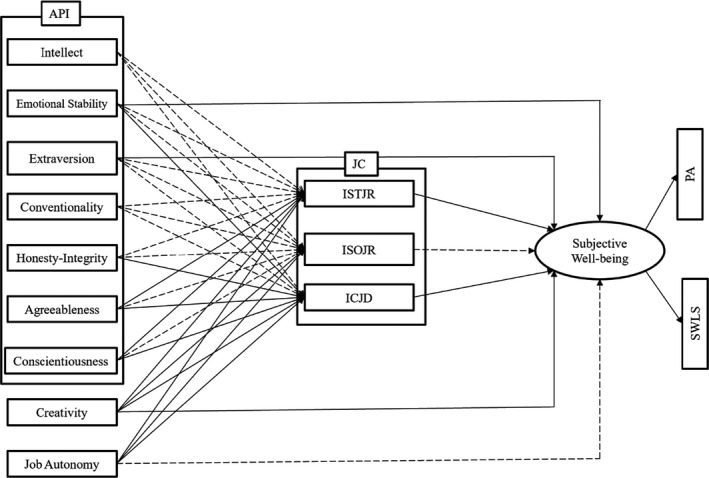
Aim: To better understand the functionality of job crafting and its relationship with personality and job autonomy in the context of non-Western health care as an adaptive problem-solving work behaviour that is related to creativity.
Background: Job crafting could be a strategy nurses use to solve problems as health care organisations become more unpredictable.
Methods: This cross-sectional study sampled 547 nurses from seven hospitals in Lebanon. Data were analysed using structural equation modelling (SEM).
Results: The job crafting dimensions of increasing structural job resources and increasing challenging job demands partially mediated the relationship between creativity and subjective well-being, and they fully mediated the relationship between job autonomy and subjective well-being. Creativity, job autonomy, and agreeableness were related to the approach job crafting dimensions, and two of these job crafting dimensions were in turn related to subjective well-being.
Conclusion: Creative nurses tend to job craft more and this is associated with their subjective well-being. Nurses high on extraversion and emotional stability experienced higher subjective well-being.
Implications for nursing management: Nursing administration and leaders may want to create an environment fostering creativity and encouraging approach-oriented job crafting.
Keywords: Lebanon; creativity; job autonomy; job crafting; nursing; personality; subjective well-being.
© 2021 The Authors. Journal of Nursing Management published by John Wiley & Sons Ltd.
Conflict of interest statement
The authors declare that there is no conflict of interest. They also declare that they agree with the content of this manuscript.
Figures

References
-
- Amabile, T. M. , Barsade, G. , Mueller, S. , & Staw, M. (2005). Affect and creativity at work. Administrative Science Quarterly, 50, 367–403. 10.2189/asqu.2005.50.3.367 - DOI
-
- Bakker, A. B. , Demerouti, E. , & Verbeke, W. (2004). Using the job demands‐resources model to predict burnout and performance. Human Resource Management: Published in Cooperation with the School of Business Administration, the University of Michigan and in Alliance with the Society of Human Resources Management, 43, 83–104. 10.1002/hrm.20004 - DOI
-
- Barrick, M. R. , & Mount, M. K. (1991). The big five personality dimensions and job performance: A meta‐analysis. Personnel Psychology, 44, 1–26. 10.1111/j.1744-6570.1991.tb00688.x - DOI
-
- Bell, C. , & Njoli, N. (2016). The role of big five factors on predicting job crafting propensities amongst administrative employees in a South African tertiary institution. SA Journal of Human Resource Management, 14, 1–11. 10.4102/sajhrm.v14i1.702 - DOI
MeSH terms
LinkOut - more resources
Full Text Sources
Other Literature Sources
