Brain cortical and subcortical morphology in adolescents with depression and a history of suicide attempt
- PMID: 33961355
- PMCID: PMC8327980
- DOI: 10.1503/jpn.200198
Brain cortical and subcortical morphology in adolescents with depression and a history of suicide attempt
Abstract
Background: Suicidal behaviours are a major source of mortality and morbidity among adolescents. Given the maturational changes that occur in cortical and subcortical structures during adolescence, we tested whether atypical brain structural measurements were associated with a history of suicide attempt.
Methods: We assessed 3 groups of adolescents (n = 92; 79% female, mean age 15.9 years, range 11.6-18.1 years): patients with a depressive disorder and a history of suicide attempt (n = 28); patient controls, who had a depressive disorder but no history of suicide attempt (n = 34); and healthy controls (n = 30). We derived regional cortical thickness and surface area, and subcortical volumes, from T1-weighted anatomic MRI scans acquired at 3 T.
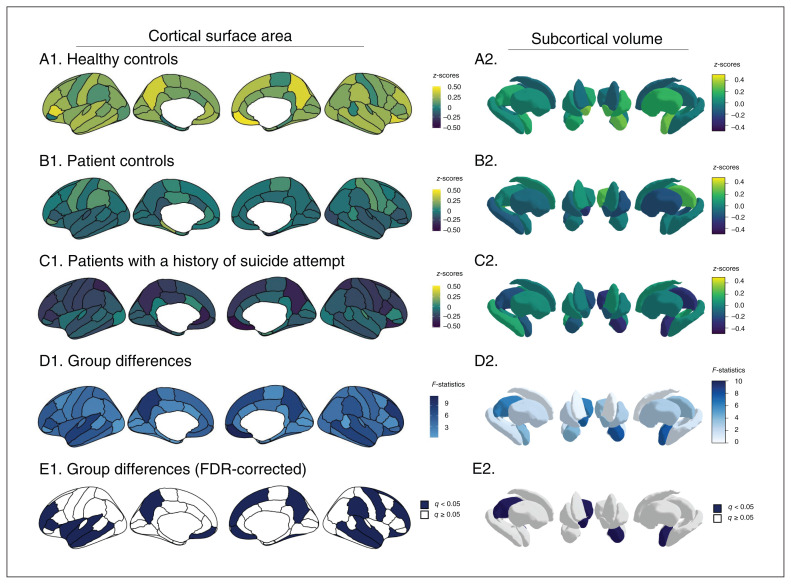
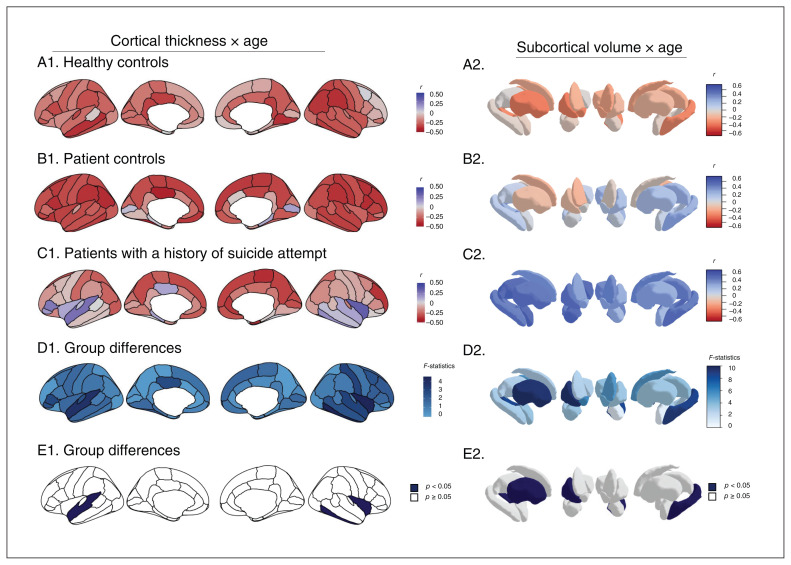
Results: We found significant group differences in surface area in the prefrontal, temporal and parietal regions, as well as in the volume of several subcortical nuclei (pFDR ≤ 0.05), but not in cortical thickness. Post hoc analyses indicated that morphological alterations primarily differentiated patients with a history of suicide attempt from healthy controls, but not from patient controls. However, patients with a history of suicide attempt exhibited positive correlations between age and cortical thickness in the temporal cortices and right insula, and between age and right putamen volume (i.e., thicker regional cortex and larger subcortical volumes with age). These correlations were negative in both patient controls and healthy controls (i.e., thinner regional cortex and smaller subcortical volumes).
Limitations: Sample sizes, cross-sectional findings and psychiatric heterogeneity were limitations of this study.
Conclusion: Macroscopic structural differences in several brain regions differentiated adolescents with a history of suicide attempt from healthy controls, but not from patient controls. However, adolescents with a history of suicide attempt may present with atypical maturation of specific cortical and subcortical regions that might contribute to the risk of suicidal behaviour.
© 2021 CMA Joule Inc. or its licensors.
Conflict of interest statement
M. Chakravarty is an associate editor of JPN; he was not involved in the review or decision to accept this manuscript for publication. M. Lepage reports grants from Otsuka Lundbeck Alliance, diaMentis and Roche, research support from Cogsate and personal fees from Otsuka, all outside the submitted work. No other competing interests declared.
Figures
References
-
- Mokdad AH, Forouzanfar MH, Daoud F, et al. Global burden of diseases, injuries, and risk factors for young people’s health during 1990–2013: a systematic analysis for the Global Burden of Disease Study 2013. Lancet 2016;387:2383–401. - PubMed
-
- Reinherz HZ, Tanner JL, Berger SR, et al. Adolescent suicidal ideation as predictive of psychopathology, suicidal behavior, and compromised functioning at age 30. Am J Psychiatry 2006;163: 1226–32. - PubMed
-
- Kleiman EM, Turner BJ, Fedor S, et al. Examination of real-time fluctuations in suicidal ideation and its risk factors: results from two ecological momentary assessment studies. J Abnorm Psychol 2017;126:726–38. - PubMed
MeSH terms
Grants and funding
LinkOut - more resources
Full Text Sources
Other Literature Sources
Medical