


Premedication with pioglitazone prevents doxorubicin-induced left ventricular dysfunction in mice
- PMID: 33962676
- PMCID: PMC8103594
- DOI: 10.1186/s40360-021-00495-w
Premedication with pioglitazone prevents doxorubicin-induced left ventricular dysfunction in mice
Abstract
Background: Doxorubicin (DOX) is widely used as an effective chemotherapeutic agent for cancers; however, DOX induces cardiac toxicity, called DOX-induced cardiomyopathy. Although DOX-induced cardiomyopathy is known to be associated with a high cumulative dose of DOX, the mechanisms of its long-term effects have not been completely elucidated. Pioglitazone (Pio) is presently contraindicated in patients with symptomatic heart failure owing to the side effects. The concept of drug repositioning led us to hypothesize the potential effects of Pio as a premedication before DOX treatment, and to analyze this hypothesis in mice.
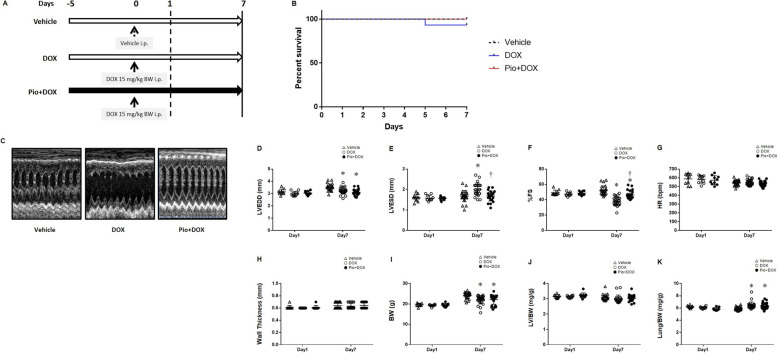
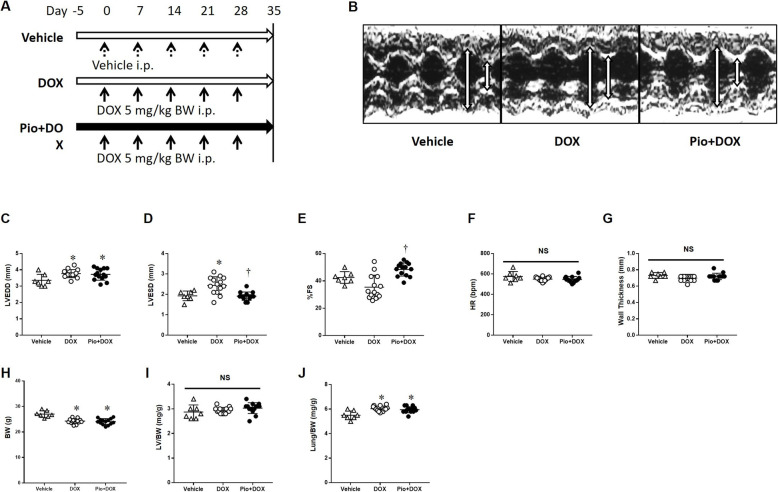
Methods: First, for the hyperacute (day 1) and acute (day 7) DOX-induced dysfunction models, mice were fed a standard diet with or without 0.02% (wt/wt) Pio for 5 days before DOX treatment (15 mg/kg body weight [BW] via intraperitoneal [i.p.] administration). The following 3 treatment groups were analyzed: standard diet + vehicle (Vehicle), standard diet + DOX (DOX), and Pio + DOX. Next, for the chronic model (day 35), the mice were administrated DOX once a week for 5 weeks (5 mg/kg BW/week, i.p.).
Results: In the acute phase after DOX treatment, the percent fractional shortening of the left ventricle (LV) was significantly decreased in DOX mice. This cardiac malfunction was improved in Pio + DOX mice. In the chronic phase, we observed that LV function was preserved in Pio + DOX mice.
Conclusions: Our findings may provide a new pathophysiological explanation by which Pio plays a role in the treatment of DOX-induced cardiomyopathy, but the molecular links between Pio and DOX-induced LV dysfunction remain largely elusive.
Keywords: Anticancer agent; Cardiac toxicity; LV dysfunction; Thiazolidinediones.
Conflict of interest statement
The authors declare that they have no conflicts of interest associated with this manuscript.
Figures
References
-
- Cardinale D, Colombo A, Lamantia G, Colombo N, Civelli M, De Giacomi G, Rubino M, Veglia F, Fiorentini C, Cipolla CM. Anthracycline-induced cardiomyopathy: clinical relevance and response to pharmacologic therapy. J Am Coll Cardiol. 2010;55(3):213–220. doi: 10.1016/j.jacc.2009.03.095. - DOI - PubMed
-
- Zamorano JL, Lancellotti P, Rodriguez Munoz D, Aboyans V, Asteggiano R, Galderisi M, Habib G, Lenihan DJ, Lip GYH, Lyon AR, et al. 2016 ESC position paper on cancer treatments and cardiovascular toxicity developed under the auspices of the ESC Committee for practice guidelines: the task force for cancer treatments and cardiovascular toxicity of the European Society of Cardiology (ESC) Eur Heart J. 2016;37(36):2768–2801. doi: 10.1093/eurheartj/ehw211. - DOI - PubMed
Publication types
MeSH terms
Substances
LinkOut - more resources
Full Text Sources
Other Literature Sources
