


Karyotype of first clinical miscarriage and prognosis of subsequent pregnancy outcome
- PMID: 33962906
- PMCID: PMC8178201
- DOI: 10.1016/j.rbmo.2021.03.021
Karyotype of first clinical miscarriage and prognosis of subsequent pregnancy outcome
Abstract
Research question: Is the karyotype of the first clinical miscarriage in an infertile patient predictive of the outcome of the subsequent pregnancy?
Design: Retrospective cohort study of infertile patients undergoing manual vacuum aspiration with chromosome testing at the time of the first (index) clinical miscarriage with a genetic diagnosis and a subsequent pregnancy. Patients treated at two academic-affiliated fertility centres from 1999 to 2018 were included; those using preimplantation genetic testing for aneuploidy were excluded. Main outcome was live birth in the subsequent pregnancy.
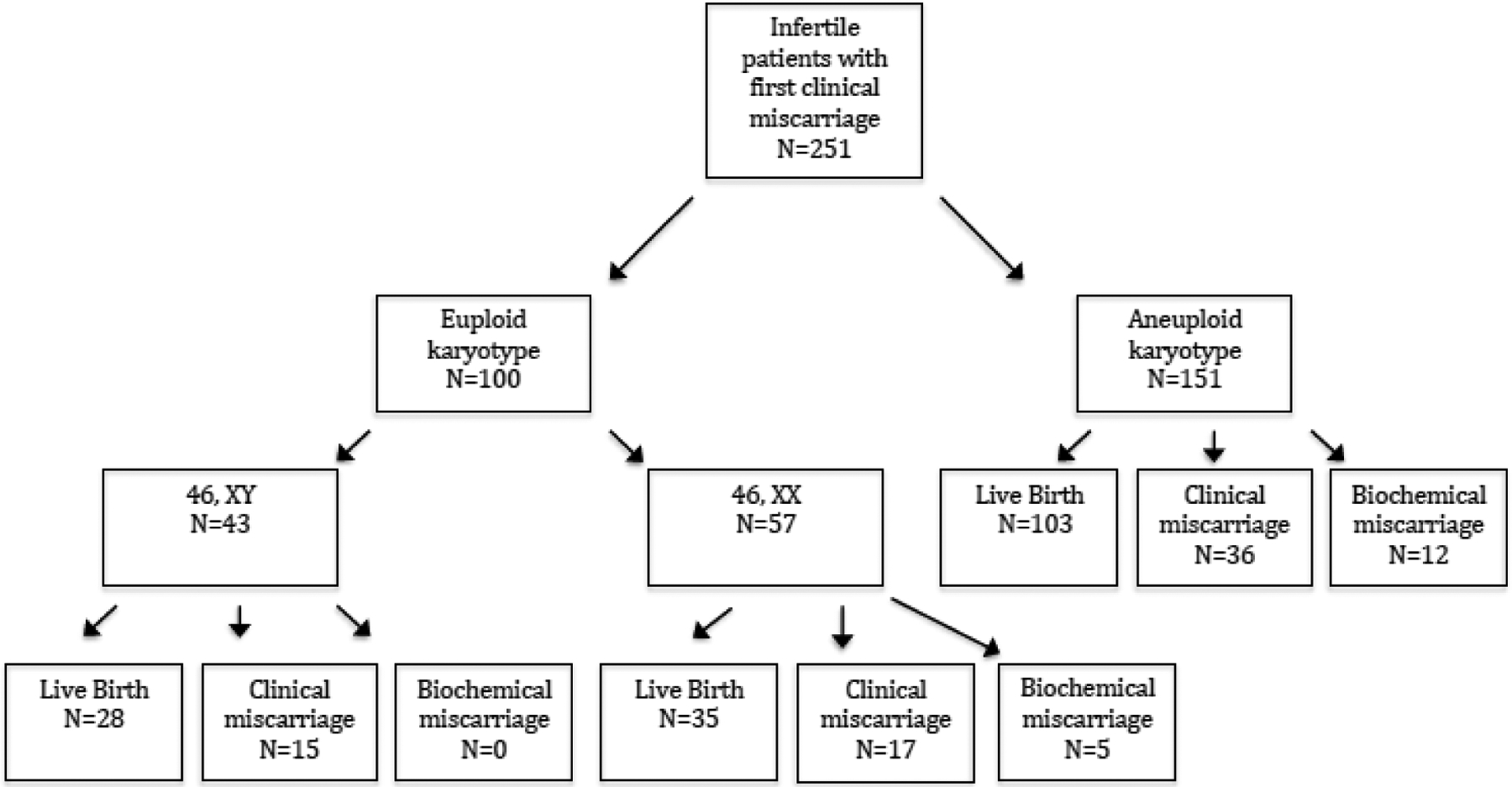
Results: One hundred patients with euploid clinical miscarriage and 151 patients with aneuploid clinical miscarriage in the index pregnancy were included. Patients with euploid clinical miscarriage in the index pregnancy had a live birth rate of 63% in the subsequent pregnancy compared with 68% among patients with aneuploid clinical miscarriage (adjusted odds ratio [aOR] 0.75, 95% CI 0.47-1.39, P = 0.45, logistic regression model adjusting for age, parity, body mass index and mode of conception). In a multinomial logistic regression model with three outcomes (live birth, clinical miscarriage or biochemical miscarriage), euploid clinical miscarriage for the index pregnancy was associated with similar odds of clinical miscarriage in the subsequent pregnancy compared with aneuploid clinical miscarriage for the index pregnancy (32% versus 24%, respectively, aOR 1.49, 95% CI 0.83-2.70, P = 0.19). Euploid clinical miscarriage for the index pregnancy was not associated with likelihood of biochemical miscarriage in the subsequent pregnancy compared with aneuploid clinical miscarriage (5% versus 8%, respectively, aOR 0.46, 95% CI 0.14-1.55, P = 0.21).
Conclusion: Prognosis after a first clinical miscarriage among infertile patients is equally favourable among patients with euploid and aneuploid karyotype, and independent of the karyotype of the pregnancy loss.
Keywords: Biochemical pregnancy; Clinical miscarriage; Genetic testing; Infertility; Karyotype; Pregnancy loss.
Copyright © 2021 Reproductive Healthcare Ltd. Published by Elsevier Ltd. All rights reserved.
Figures
References
-
- Bell KA, Van Deerlin PG, Haddad BR, and Feinberg RF. Cytogenetic diagnosis of “normal 46XX” karyotypes in spontaneous abortions frequently may be misleading. Fertil Steril 1999; 71:334–41. - PubMed
-
- Boué J, Boué A, and Lazar P. Retrospective and prospective epidemiological studies of 1500 karyotyped spontaneous human abortions. Teratology 1975;12:11–26. - PubMed
-
- Carp H, Toder V, Aviram A, Daniely M, Mashiach S and Barkai G. Karyotype of the abortus in recurrent CM. Fertil Steril 2001; 75:678–82. - PubMed
-
- Colley E, Hamilton S, Smith P, Morgan NV, Coomarasamy A and Allen S. Potential genetic causes of CM in euploid pregnancies: a systematic review. Hum Reprod Update 2019; 25:452–72. - PubMed
Publication types
MeSH terms
Grants and funding
LinkOut - more resources
Full Text Sources
Other Literature Sources
Medical
