. 2021 Jun 25;87(14):e0017821.
doi: 10.1128/AEM.00178-21. Epub 2021 Jun 25.

Burkholderia from Fungus Gardens of Fungus-Growing Ants Produces Antifungals That Inhibit the Specialized Parasite Escovopsis

Affiliations

Burkholderia from Fungus Gardens of Fungus-Growing Ants Produces Antifungals That Inhibit the Specialized Parasite Escovopsis

Charlotte B Francoeur et al. Appl Environ Microbiol. .

Abstract

Within animal-associated microbiomes, the functional roles of specific microbial taxa are often uncharacterized. Here, we use the fungus-growing ant system, a model for microbial symbiosis, to determine the potential defensive roles of key bacterial taxa present in the ants' fungus gardens. Fungus gardens serve as an external digestive system for the ants, with mutualistic fungi in the genus Leucoagaricus converting the plant substrate into energy for the ants. The fungus garden is host to specialized parasitic fungi in the genus Escovopsis. Here, we examine the potential role of Burkholderia spp. that occur within ant fungus gardens in inhibiting Escovopsis. We isolated members of the bacterial genera Burkholderia and Paraburkholderia from 50% of the 52 colonies sampled, indicating that members of the family Burkholderiaceae are common inhabitants in the fungus gardens of a diverse range of fungus-growing ant genera. Using antimicrobial inhibition bioassays, we found that 28 out of 32 isolates inhibited at least one Escovopsis strain with a zone of inhibition greater than 1 cm. Genomic assessment of fungus garden-associated Burkholderiaceae indicated that isolates with strong inhibition all belonged to the genus Burkholderia and contained biosynthetic gene clusters that encoded the production of two antifungals: burkholdine1213 and pyrrolnitrin. Organic extracts of cultured isolates confirmed that these compounds are responsible for antifungal activities that inhibit Escovopsis but, at equivalent concentrations, not Leucoagaricus spp. Overall, these new findings, combined with previous evidence, suggest that members of the fungus garden microbiome play an important role in maintaining the health and function of fungus-growing ant colonies. IMPORTANCE Many organisms partner with microbes to defend themselves against parasites and pathogens. Fungus-growing ants must protect Leucoagaricus spp., the fungal mutualist that provides sustenance for the ants, from a specialized fungal parasite, Escovopsis. The ants take multiple approaches, including weeding their fungus gardens to remove Escovopsis spores, as well as harboring Pseudonocardia spp., bacteria that produce antifungals that inhibit Escovopsis. In addition, a genus of bacteria commonly found in fungus gardens, Burkholderia, is known to produce secondary metabolites that inhibit Escovopsis spp. In this study, we isolated Burkholderia spp. from fungus-growing ants, assessed the isolates' ability to inhibit Escovopsis spp., and identified two compounds responsible for inhibition. Our findings suggest that Burkholderia spp. are often found in fungus gardens, adding another possible mechanism within the fungus-growing ant system to suppress the growth of the specialized parasite Escovopsis.

Keywords: antifungal; attine; burkholderia; burkholdine; defensive symbiosis; escovopsis; fungus-growing ant; pyrrolnitrin.


Figures
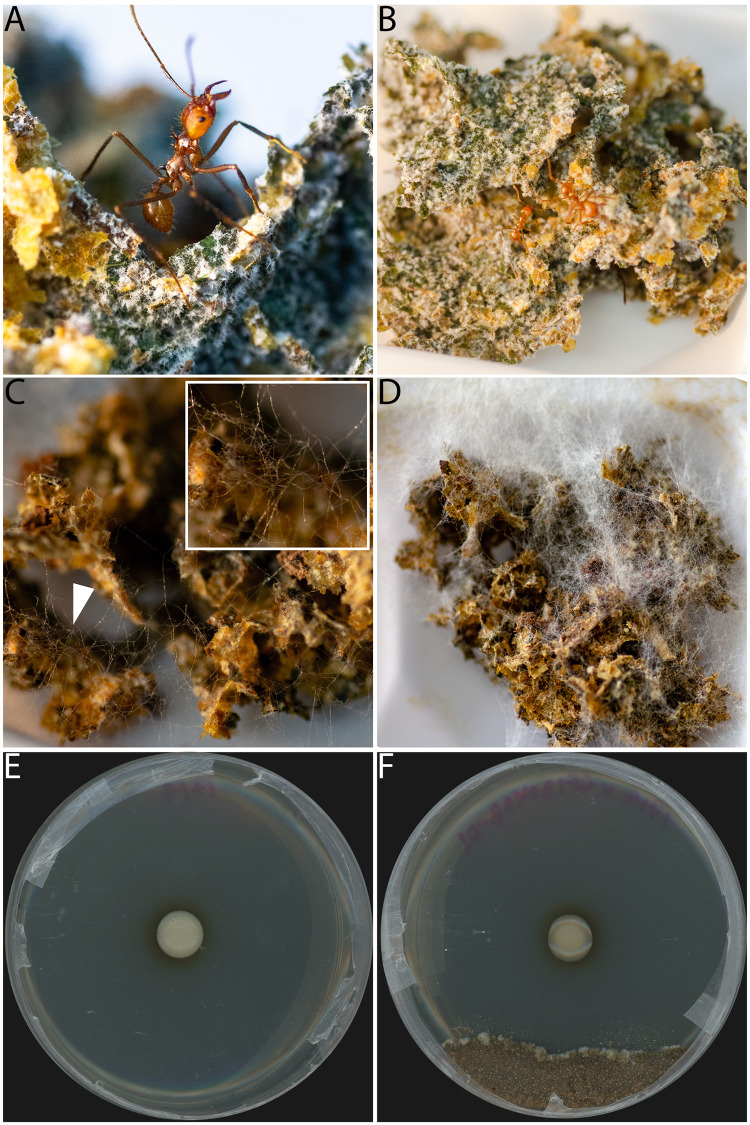
FIG 1
FIG 1
Infection of an Atta cephalotes colony by Escovopsis weberi (CF180408-01) and in vitro petri plate antimicrobial inhibition bioassay with ICBG1719. (A, B) Healthy fungus garden with no Escovopsis infection; (C) day 3 postinfection of fungus garden with Escovopsis; (D) day 7 postinfection of fungus garden with Escovopsis; (E and F) petri plate with only Burkholderia sp. ICBG1719 growing (E) and petri plate inhibition bioassay of ICBG1719 against Escovopsis weberi (CF180408-01), with a clear zone of inhibition (F). Pictures in panels A to D were taken by Caitlin Carlson.
FIG 2
FIG 2
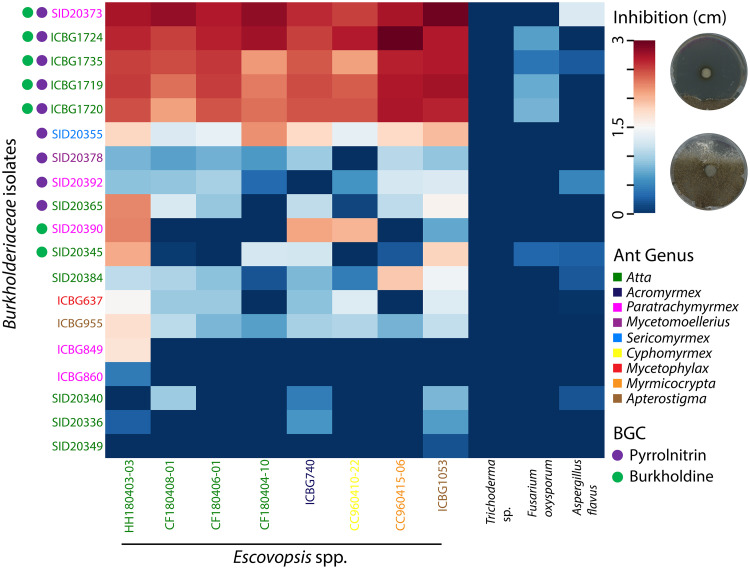
Burkholderiaceae-Escovopsis petri plate antimicrobial inhibition bioassays indicated varied levels of inhibition of Escovopsis spp. Zones of inhibition (ZOIs) were measured 13 days after inoculation with Escovopsis spp. Burkholderiaceae and Escovopsis isolates are color coded by the ant colony from which they were isolated. Circles to the left of the Burkholderiaceae isolates indicate the presence of pyrrolnitrin (purple) or burkholdine (green) biosynthetic gene clusters.
FIG 3
FIG 3
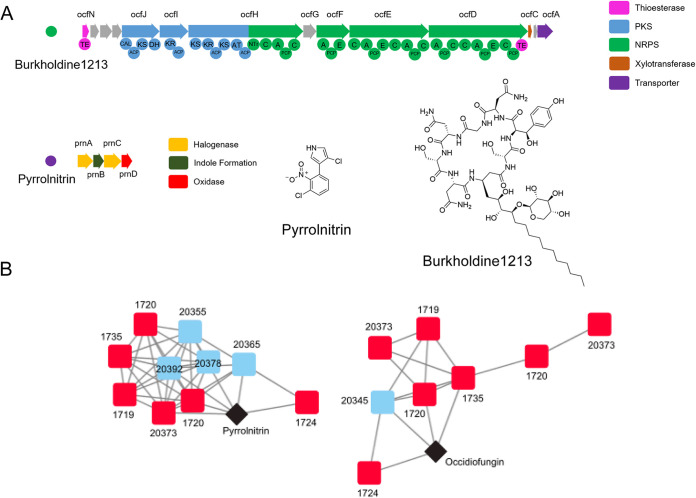
Identification of pyrrolnitrin and burkholdine1213 biosynthetic gene clusters in inhibitory isolates. (A) Genetic architecture of biosynthetic gene clusters encoding the production of burkholdine1213 and pyrrolnitrin identified by AntiSMASH 4.0. Domains of the PKS/NRPS hybrid biosynthetic gene cluster are shown beneath the gene representations for burkholdine1213. PKS, polyketide synthase; NRPS, nonribosomal peptide synthetase. (B) BiG-SCAPE network analysis of the two biosynthetic gene clusters present in Burkholderia isolates. Red squares are strong inhibitory Burkholderia isolates, blue squares are less inhibitory isolates, and black diamonds are database matches to the MIBiG biosynthetic gene cluster database.
FIG 4
FIG 4
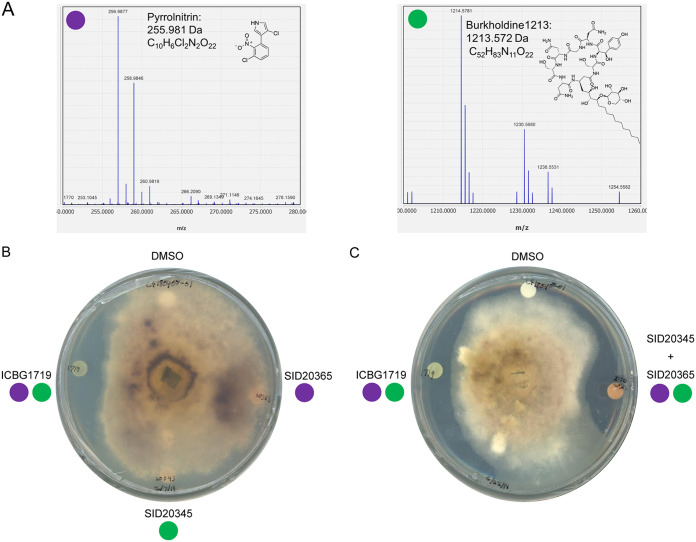
Detection of pyrrolnitrin and burkholdine1213 in organic extracts of inhibitory isolates and demonstration of extract activity. (A) Extracted ion chromatograms of m/z values that match those of pyrrolnitrin and burkholdine1213 from the organic extract of inhibitory Burkholderia isolate ICBG1719. (B) Disc diffusion assay of extracts from ICBG1719 (both pyrrolnitrin and burkholdine1213), SID20345 (burkholdine1213), and SID20365 (pyrrolnitrin) against Escovopsis weberi (CF180408-01). (C) Disc diffusion assay of extracts from ICBG1719 (both pyrrolnitrin and burkholdine1213) and a combined extract of SID20345 and SID20365 (artificially containing both pyrrolnitrin and burkholdine1213) against Escovopsis weberi (CF180408-01), demonstrating that both compounds must be present for inhibition. Additional disc diffusion assays were conducted on Trichoderma, Aspergillus, and Fusarium (Fig. S5).
FIG 5
FIG 5
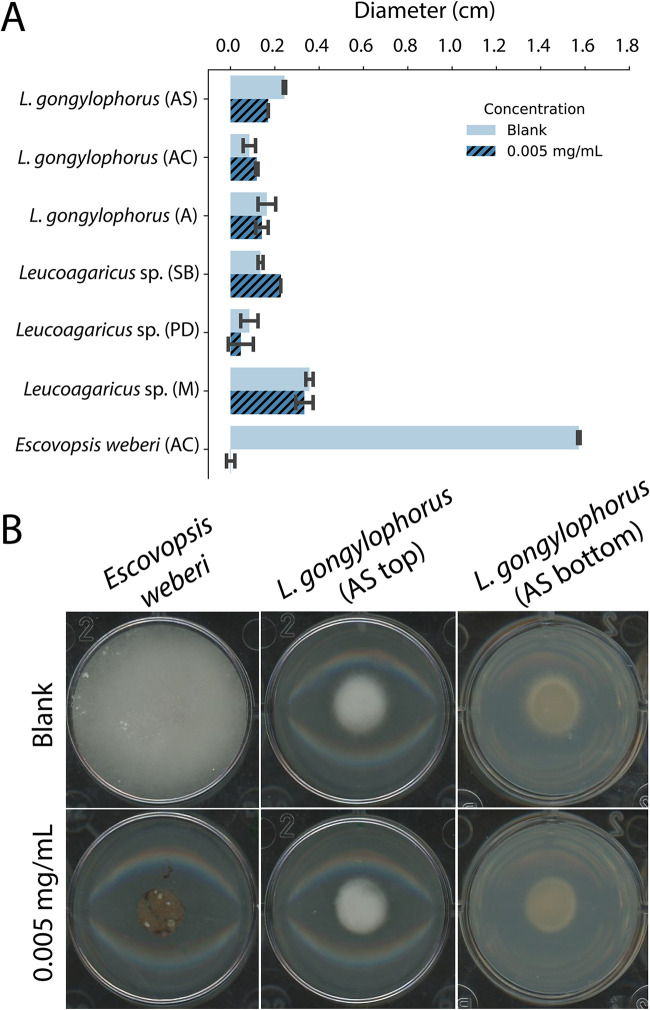
Leucoagaricus spp. grown on agar containing 0.005 mg/ml ICBG1719 extract (both BGCs) grow comparably to agar containing no extract, while Escovopsis weberi (CF180408-01) from an Atta cephalotes colony is inhibited. (A) The bar graph indicates the growth of Leucoagaricus spp. (n = 2 for each strain) and Escovopsis weberi (n = 3) after 6 days of growth on agar containing no extract (blank) or 0.005 mg/ml. For visual representation, the diameter of the fungal plug (0.6 mm) was subtracted from the overall diameter measurement. (B) Photographs represent typical fungal growth of Escovopsis weberi and Leucoagaricus spp. (photo is from Leucoagaricus gongylophorus from an Atta sexdens colony) on agar with no extract (blank) and 0.005 mg/ml extract. Photos include the top of the plate (AS top) and bottom of the plate (AS bottom). AS, Atta sexdens; AC, Atta cephalotes; A, Acromyrmex sp.; SB, Sericomyrmex bondari; PD, Paratrachymyrmex diversus; M, Myrmicocrypta sp.

References

    1. Skelton J, Doak S, Leonard M, Creed RP, Brown BL. 2016. The rules for symbiont community assembly change along a mutualism-parasitism continuum. J Anim Ecol 85:843–853. 10.1111/1365-2656.12498. - DOI - PubMed
    1. Douglas AE. 1998. Nutritional interactions in insect-microbial symbioses: aphids and their symbiotic bacteria Buchnera. Annu Rev Entomol 43:17–37. 10.1146/annurev.ento.43.1.17. - DOI - PubMed
    1. Douglas AE. 2009. The microbial dimension in insect nutritional ecology. Funct Ecol 23:38–47. 10.1111/j.1365-2435.2008.01442.x. - DOI
    1. Flórez LV, Biedermann PHW, Engl T, Kaltenpoth M. 2015. Defensive symbioses of animals with prokaryotic and eukaryotic microorganisms. Nat Prod Rep 32:904–936. 10.1039/c5np00010f. - DOI - PubMed
    1. Van Arnam EB, Currie CR, Clardy J. 2018. Defense contracts: molecular protection in insect-microbe symbioses. Chem Soc Rev 47:1638–1651. 10.1039/c7cs00340d. - DOI - PubMed

Publication types

LinkOut - more resources