. 2021 May 7;12(1):2563.
doi: 10.1038/s41467-021-22920-8.

Subtelomeric assembly of a multi-gene pathway for antimicrobial defense compounds in cereals

Affiliations

Subtelomeric assembly of a multi-gene pathway for antimicrobial defense compounds in cereals

Yan Li et al. Nat Commun. .

Abstract

Non-random gene organization in eukaryotes plays a significant role in genome evolution. Here, we investigate the origin of a biosynthetic gene cluster for production of defence compounds in oat-the avenacin cluster. We elucidate the structure and organisation of this 12-gene cluster, characterise the last two missing pathway steps, and reconstitute the entire pathway in tobacco by transient expression. We show that the cluster has formed de novo since the divergence of oats in a subtelomeric region of the genome that lacks homology with other grasses, and that gene order is approximately colinear with the biosynthetic pathway. We speculate that the positioning of the late pathway genes furthest away from the telomere may mitigate against a 'self-poisoning' scenario in which toxic intermediates accumulate as a result of telomeric gene deletions. Our investigations reveal a striking example of adaptive evolution underpinned by remarkable genome plasticity.


Conflict of interest statement

The authors declare no competing interests.

Figures
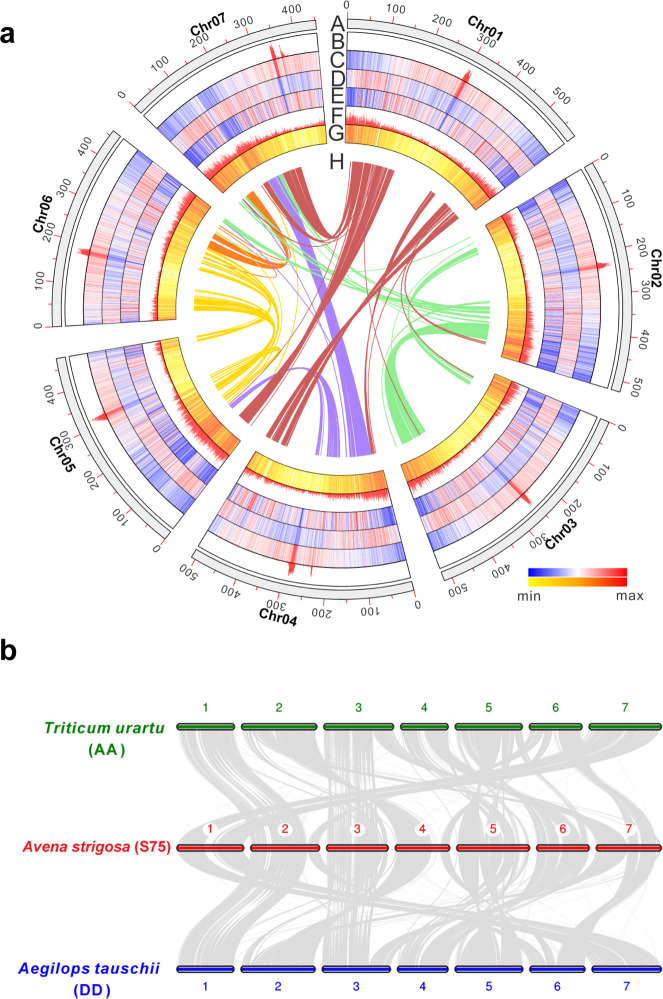
Fig. 1
Fig. 1. Avena strigosa genome features.
a Characteristics of the seven chromosomes of Avena strigosa. The chromosomes are shown in track A (100 Mb intervals indicated). Tracks B–F show the densities of the long terminal repeat (LTR) retrotransposons Cereba (B), Gypsy (C), Copia (D), unclassified LTR retrotransposons (E), and miniature inverted-repeat transposable elements (MITEs) (F) (densities shown as percent nucleotides per 500 kb). Track G indicates the frequency of high-confidence genes (number of genes per 500 kb) and H shows syntenic blocks (1722 gene pairs, 160 blocks). b Synteny with Triticum urartu (diploid, AA) and Aegilops tauschii (diploid, DD).
Fig. 2
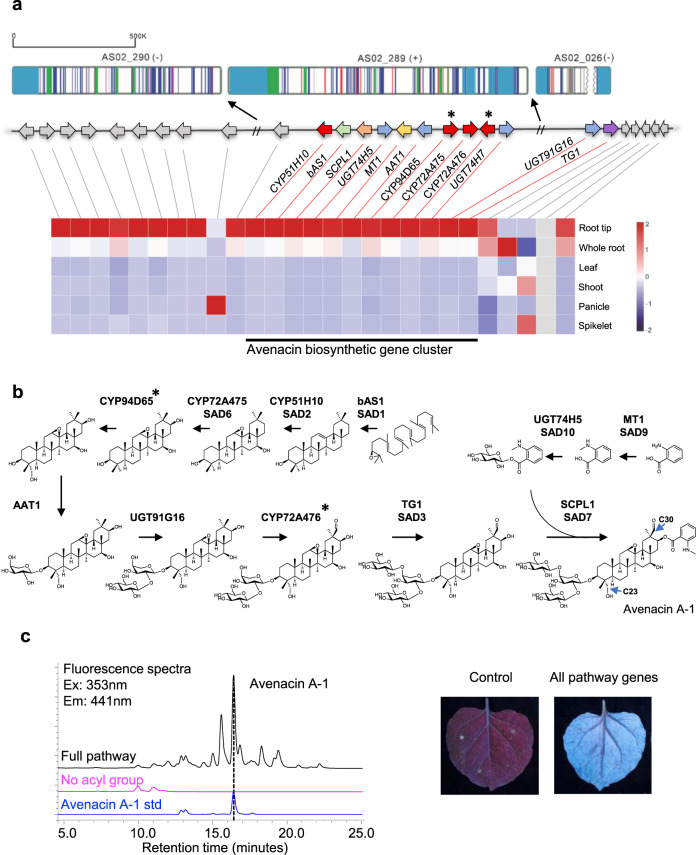
Fig. 2. The complete 12-gene avenacin biosynthetic cluster and full pathway reconstitution by transient expression in Nicotiana benthamiana.
a The region of the A. strigosa genome encompassing the avenacin biosynthetic gene cluster. The genes shown in colour are the nine previously characterised avenacin pathway genes–,, along with two previously uncharacterised CYP genes (asterisked), shown in this work to catalyse the two missing pathway steps (see Supplementary Table 7 for more information about all genes in this region). UGT74H7, which encodes a previously characterised sugar transferase related to UGT74H5 but with low activity towards avenacin acyl precursors, is also indicated. b The complete pathway for the biosynthesis of avenacin A-1, including the newly validated steps catalysed by CYP94D65 and CYP72A476 (asterisked) (Supplementary Figs. 9 and 10; Supplementary Table 8). c Reconstitution of the avenacin pathway in N. benthamiana by transient expression. Full pathway: co-expression of GoldenGate constructs EC80344 (bAS1/Sad1 + CYP51H10/Sad2 + CYP72A475/Sad6 + CYP94D65 + CYP72A476), EC80345 (AAT1 + UGT91G16 + TG1 + P19), EC80379 (MT1/Sad9 + UGT74H5/Sad10 + SCPL1/Sad7). No acyl group control: co-expression of EC80344 and EC80345 only. Leaves were harvested 5 days after agro-infiltration, freeze-dried, and extracts analysed by high-performance liquid chromatography. Avenacin A-1 has strong autofluorescence under ultra-violet illumination. A peak with the same retention time as the avenacin A-1 standard was detected in extracts from leaves co-expressing all of the pathway genes but not in extracts from no acyl group control leaves. Mass spectra in both positive and negative modes confirmed that this peak had the same mass as avenacin A-1 (Supplementary Fig 11). Source data underlying Fig. 2a are provided as a Source Data file.
Fig. 3
Fig. 3. bAS1/Sad1 and TG1/Sad3 are co-located close to the telomere of the long arm of chromosome 1.
a A chromosome set from a mitotic metaphase spread. Chromatin, blue; bAS1/Sad1, green; nucleolus organiser regions (labelled with pTa71), red; 5S rDNA loci (labelled with pTa794), white. The nucleolus organiser regions (pTa71) are localised on chromosomes 2 and 3 and the 5S rDNA loci (pTa794) on chromosome 3. Chromosomes 6 and 7 are the shortest chromosomes in the genome, submetacentric in contrast to the chromosome carrying bAS1/Sad1 and significantly shorter. A comparison of the lengths of the chromosome carrying bAS1/Sad1 and the two other unidentified chromosomes in the genome—metacentric chromosome 4 and submetacentric chromosome 5—showed that the chromosome carrying bAS1/Sad1 was significantly longer than the other two and is therefore chromosome 1 (t-test p values <0.01 and <0.001, respectively, n = 8 for each chromosome). b Meiotic pachytene cell: chromatin, blue; bAS1/Sad1, red; TG1/Sad3, green; telomeres, magenta. Homologous chromosomes are paired at this stage. In the enlarged views (boxed regions on the right), bAS1/Sad1 (red) is visible as one fluorescent focus per homologous chromosome with an additional faint focus caused by bleed through coming from the telomere label (magenta). Scale bars: 5 µm. ce FISH localisation of bAS1/Sad1 (red) and TG1/Sad3 (green) in relation to the telomere (magenta) during meiotic pachytene. Sad1 foci appear closer to the telomere in 28% of the pachytene cells analysed (c); TG1/Sad3 foci appear closer to the telomere in 7% of the cells (d); both foci overlap in 65% of the cells (e). Each pachytene FISH experiment involved 4–5 individual slides, each using a different anther. Scale bars: 10 μm. Source data are provided as a Source Data file.
Fig. 4
Fig. 4. The high complexity 12-gene avenacin cluster has assembled de novo in a region of the A. strigosa genome that does not share synteny with other cereals.
a Alignment of the B. distachyon (BDI), rice (OSA), barley (HVU) and wheat (TAE; DD genome shown) showing lack of synteny in the avenacin cluster region. b DNA sequence identity heatmap of the avenacin pathway genes and the other A. strigosa genes in the region shown in Fig. 2a  with the most closely related sequences in B. distachyon (BDI), rice (OSA), barley (HVU) and wheat (TAE) (Table S8). c Circos plot showing the locations of these closest matches on the chromosomes of B. distachyon (blue), rice (green), barley (purple) and wheat (DD genome) (brown). d Locations of plantiSMASH-predicted biosynthetic gene clusters (yellow lines) in the A. strigosa genome. Cluster density scores for 100 Mb-sized sliding windows are shown in red. The avenacin cluster is asterisked in the enlarged view of the terminal region of chromosome 1. e Schematic showing the number of genes and gene super-families per cluster in putative triterpene biosynthetic clusters predicted by plantiSMASH in the genomes of A. strigosa S75 (AST), wheat (TAE), Brachypodium distachyon (BDI), Brachypodium stacei (BST), barley (HVU), rice (OSA), maize (ZMA), Sorghum bicolor (SBI), Panicum hallii (PHA), wild emmer wheat (WEW), and Setaria italica (SIT). The avenacin cluster is shown at the top.

References

    1. Turner EM. The nature of resistance of oats to the take-all fungus. III. Distribution of the inhibitor in oat seedlings. J. Exp. Bot. 1960;11:403–412. doi: 10.1093/jxb/11.3.403. - DOI
    1. Papadopoulou K, et al. Compromised disease resistance in saponin-deficient plants. Proc. Natl Acad. Sci. USA. 1999;96:12923–12928. doi: 10.1073/pnas.96.22.12923. - DOI - PMC - PubMed
    1. Qi X, et al. A gene cluster for secondary metabolism in oat: Implications for the evolution of metabolic diversity in plants. Proc. Natl Acad. Sci. USA. 2004;101:8233–8238. doi: 10.1073/pnas.0401301101. - DOI - PMC - PubMed
    1. Qi X, et al. A different function for a member of an ancient and highly conserved cytochrome P45- family: From essential sterols to plant defense. Proc. Natl Acad. Sci. USA. 2006;103:18848–18853. doi: 10.1073/pnas.0607849103. - DOI - PMC - PubMed
    1. Mugford ST, et al. A serine carboxypeptidase-like acyltransferase is required for synthesis of antimicrobial compounds and disease resistance in oats. Plant Cell. 2009;21:2473–2484. doi: 10.1105/tpc.109.065870. - DOI - PMC - PubMed

Publication types

LinkOut - more resources