. 2021 May 7;7(1):42.
doi: 10.1038/s41522-021-00212-9.

Compartmentalization of bacterial and fungal microbiomes in the gut of adult honeybees

Affiliations

Compartmentalization of bacterial and fungal microbiomes in the gut of adult honeybees

Matteo Callegari et al. NPJ Biofilms Microbiomes. .

Abstract

The core gut microbiome of adult honeybee comprises a set of recurring bacterial phylotypes, accompanied by lineage-specific, variable, and less abundant environmental bacterial phylotypes. Several mutual interactions and functional services to the host, including the support provided for growth, hormonal signaling, and behavior, are attributed to the core and lineage-specific taxa. By contrast, the diversity and distribution of the minor environmental phylotypes and fungal members in the gut remain overlooked. In the present study, we hypothesized that the microbial components of forager honeybees (i.e., core bacteria, minor environmental phylotypes, and fungal members) are compartmentalized along the gut portions. The diversity and distribution of such three microbial components were investigated in the context of the physico-chemical conditions of different gut compartments. We observed that changes in the distribution and abundance of microbial components in the gut are consistently compartment-specific for all the three microbial components, indicating that the ecological and physiological interactions among the host and microbiome vary with changing physico-chemical and metabolic conditions of the gut.


Conflict of interest statement

The authors declare no competing interests.

Figures
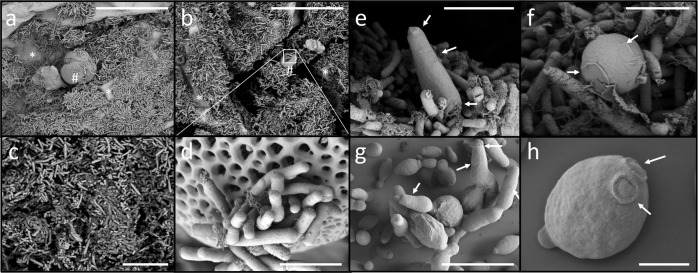
Fig. 1
Fig. 1. Visualization of microorganisms inhabiting honeybee guts.
ad Scanning electron microscope (SEM) micrographs showing bacterial cells present in a honeybee gut (i.e., rod-shape bacteria). Grains of pollen covered by bacteria are shown (see also Supplementary Fig. S1). e, f Fungal cells (i.e., yeast) associated with the gut wall of a honeybee. g, h Culture of yeast cells isolated from the honeybee gut. Cells belong to Hanseniaspora uvarum (strain L18) and Starmerella bombicola (strain L28; see also Supplementary Fig. S9 and Supplementary Table S7). Note the different scales on the SEM photographs. Honeybees used for SEM analysis were A. mellifera jemenitica from Saudi Arabia (Supplementary Table S6). Scale bars correspond to (a, b) 30 µm, (c) 3 µm, (d, f) 2 µm, (e, g) 10 µm, and (h) 1 µm.
Fig. 2
Fig. 2. Bacterial and fungal microbiota of the gut compartments in honeybees.
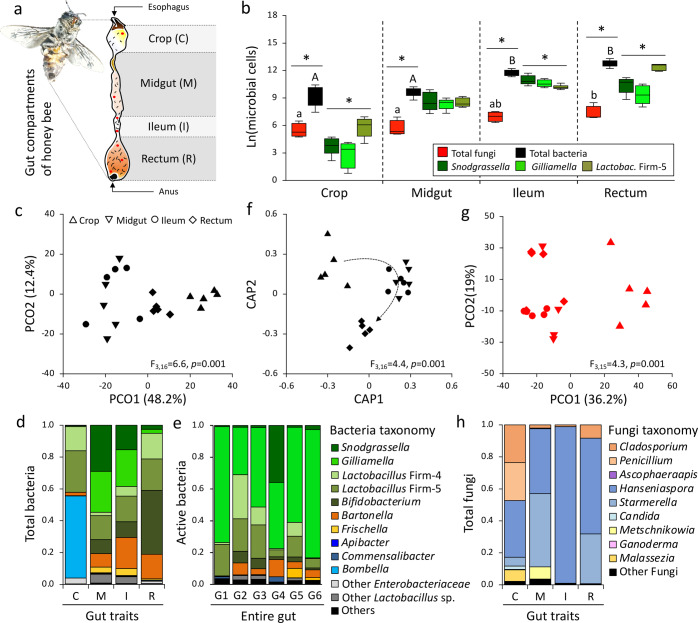
a Schematic representation of honeybee gut compartments (the crop, midgut, ileum, and rectum). Red circles and black rods indicate the relative distribution of total fungi and bacteria, respectively. b The abundance of the bacterial (black bars) and fungal (red bars) members in the honeybee gut compartments are indicated as ln-transformed number of bacterial cells (number of 16S rRNA gene copies measured are normalized for the number of 16S rRNA genes in a bacterial community, n = 4.7) and fungal cells (number of measured internal transcribed spacer [ITS] copies are normalized for the number of ITSs in a fungal community, n = 75.5). Significant differences among the bacterial and fungal cell abundance along gut tracts are indicated with capital and lower-case letters, respectively (Tukey’s multiple comparison test, p < 0.05), whereas the comparison among bacteria and fungi in each trait is indicated by an asterisk (*; t-test, p < 0.05). Abundance (ln-transformed) of Snodgrassella, Lactobacillus Firm-5, and Gilliamella in the different gut compartments are represented by shades of green and are expressed as the number of bacterial cells (number of 16S rRNA gene copies measured are normalized for the number of 16S rRNA gene in these phylotypes, n = 4). Significant differences among the above-mentioned bacterial species for each gut tract are indicated by an asterisk (*; ANOVA, p < 0.05). All the results are expressed per organ. Principal coordinates analysis (PCoA) showing the (c) bacterial and (g) fungal communities per each gut compartment, respectively. f Beta-diversity analysis of the other potential environmental bacteria portion. Samples were distributed following a “horseshoe shape” ordination (indicated by the arrow) in the space of the canonical analysis of principal coordinates (CAP). d, e Taxonomic affiliation of total (DNA) and active (cDNA) bacterial communities inhabiting the honeybee gut, respectively, along with (h) one for fungal communities (DNA). Abundance of bacterial taxa obtained from DNA are expressed as the number of reads normalized for the mean number of bacterial 16S rRNA genes and fungal ITSs available for each genus/class, respectively (for details, see “Material and methods”). bd, fh are referred to the gut compartments’ pools (each pool, n = 10) originating from Italian A. mellifera ligustica forager bees, whereas e is referred to the entire gut of Saudi Arabian A. mellifera jemenitica (n = 6). Compartmentalization of bacterial and fungal communities associated with Saudi Arabian forager bees is reported in Supplementary Fig. S5.
Fig. 3
Fig. 3. Components of the microbial beta-diversity pattern.
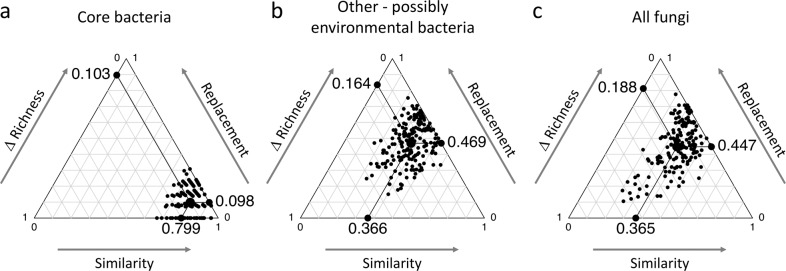
Ternary plots are used to quantify the component of the assembly along the gut compartment for (a) core bacteria, (b) other-possibly environmental bacteria, and (c) fungi; note the dataset presented in Fig. 2c, f, g, respectively, were used to perform this analysis. Each point in the triangle plot was determined by a triplet of values from the similarity, replacement, and richness difference components. In each ternary, large central dots from which the lines start represent the centroid of the points; the lines represent the mean values of the three components (i.e., similarity, replacement, and richness difference).
Fig. 4
Fig. 4. Distribution of other-possibly environmental bacteria along the honeybee gut compartments.
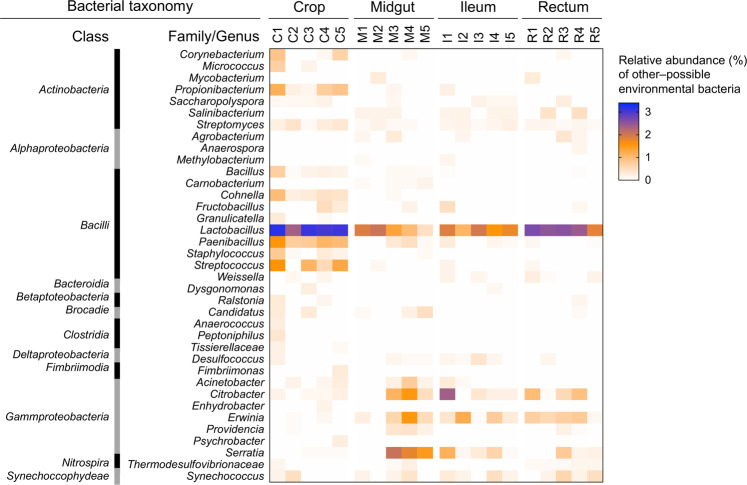
Heat map represent the distribution of other-possibly environmental bacteria classes and families/genera detected from the analysis of the total bacterial communities (i.e., DNA; Fig. 2f) along the four gut compartments (the crop, midgut, ileum, and rectum); values are expressed as the relative abundance (%) of the normalized reads.
Fig. 5
Fig. 5. Physico-chemical and metabolite characterization of the honeybee gut compartments.
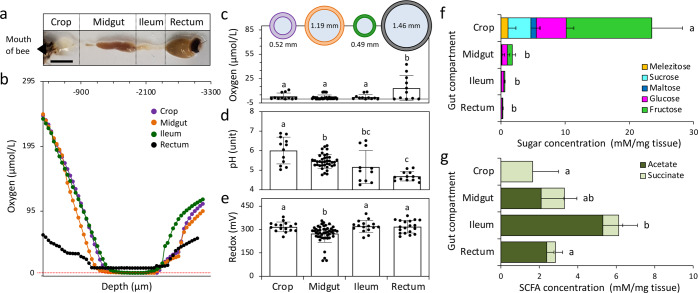
a Honeybee gut compartments (the crop, midgut, ileum, and rectum) are depicted (bar = 0.5 cm). be Physico-chemical parameters measured by microsensors are reported for each gut compartment. b Representative radial profile of the oxygen concentration (μmol/l) along the gut compartments (i.e., the crop, midgut, ileum, and rectum) of honeybees. Depth refers to the distance covered by the electrode tip starting from the agarose surface (details in “Materials and methods”). c Schematic representation of the diameters of the gut compartments (circles at the top of the panel); diameters were expressed in mm, and their mean ± standard deviation (n = 12) are indicated by the internal and external circles, respectively. Details on the organ diameters are reported in Supplementary Table S12. The oxygen concentration measured in the central regions of the gut compartments (n = 11) are expressed as μmol/l. Microelectrode profiles of the (d) pH and (e) redox potential along the honeybee gut compartments (n = 12 and n = 16, respectively); values are expressed as unit and mV, respectively. Concentration (mM/mg of tissue) of (f) sugars and (g) short-chain fatty acids (SCFAs) in the gut compartments (n = 3); values are expressed as mean ± standard deviation. Letters show the results of Tukey’s multiple comparison test. Italian A. mellifera ligustica forager bees were considered for physico-chemical and metabolite analyses.

References

    1. Kešnerová L, et al. Disentangling metabolic functions of bacteria in the honey bee gut. PLoS Biol. 2017;15:e2003467. doi: 10.1371/journal.pbio.2003467. - DOI - PMC - PubMed
    1. Kwong WK, Zheng H, Moran NA. Convergent evolution of a modified, acetate-driven TCA cycle in bacteria. Nat. Microbiol. 2017;2:17067. doi: 10.1038/nmicrobiol.2017.67. - DOI - PMC - PubMed
    1. Kwong WK, Moran NA. Gut microbial communities of social bees. Nat. Rev. Microbiol. 2016;14:374–384. doi: 10.1038/nrmicro.2016.43. - DOI - PMC - PubMed
    1. Lee FJ, Miller KI, McKinlay JB, Newton ILG. Differential carbohydrate utilization and organic acid production by honey bee symbionts. FEMS Microbiol. Ecol. 2018;94:1–10. doi: 10.1093/femsec/fiy113. - DOI - PubMed
    1. Kešnerová L, et al. Gut microbiota structure differs between honeybees in winter and summer. ISME J. 2020;14:801–814. doi: 10.1038/s41396-019-0568-8. - DOI - PMC - PubMed

Publication types