Review
. 2022 Jan;27(1):669-686.
doi: 10.1038/s41380-021-01112-2. Epub 2021 May 7.

Cocaine-induced projection-specific and cell type-specific adaptations in the nucleus accumbens

Affiliations
Review

Cocaine-induced projection-specific and cell type-specific adaptations in the nucleus accumbens

Alexander K Zinsmaier et al. Mol Psychiatry. 2022 Jan.

Abstract

Cocaine craving, seeking, and relapse are mediated, in part, by cocaine-induced adaptive changes in the brain reward circuits. The nucleus accumbens (NAc) integrates and prioritizes different emotional and motivational inputs to the reward system by processing convergent glutamatergic projections from the medial prefrontal cortex, basolateral amygdala, ventral hippocampus, and other limbic and paralimbic brain regions. Medium spiny neurons (MSNs) are the principal projection neurons in the NAc, which can be divided into two major subpopulations, namely dopamine receptor D1- versus D2-expressing MSNs, with complementing roles in reward-associated behaviors. After cocaine experience, NAc MSNs exhibit complex and differential adaptations dependent on cocaine regimen, withdrawal time, cell type, location (NAc core versus shell), and related input and output projections, or any combination of these factors. Detailed characterization of these cellular adaptations has been greatly facilitated by the recent development of optogenetic/chemogenetic techniques combined with transgenic tools. In this review, we discuss such cell type- and projection-specific adaptations induced by cocaine experience. Specifically, (1) D1 and D2 NAc MSNs frequently exhibit differential adaptations in spinogenesis, glutamatergic receptor trafficking, and intrinsic membrane excitability, (2) cocaine experience differentially changes the synaptic transmission at different afferent projections onto NAc MSNs, (3) cocaine-induced NAc adaptations exhibit output specificity, e.g., being different at NAc-ventral pallidum versus NAc-ventral tegmental area synapses, and (4) the input, output, subregion, and D1/D2 cell type may together determine cocaine-induced circuit plasticity in the NAc. In light of the projection- and cell-type specificity, we also briefly discuss ensemble and circuit mechanisms contributing to cocaine craving and relapse after drug withdrawal.


Figures

Figure 1
Figure 1
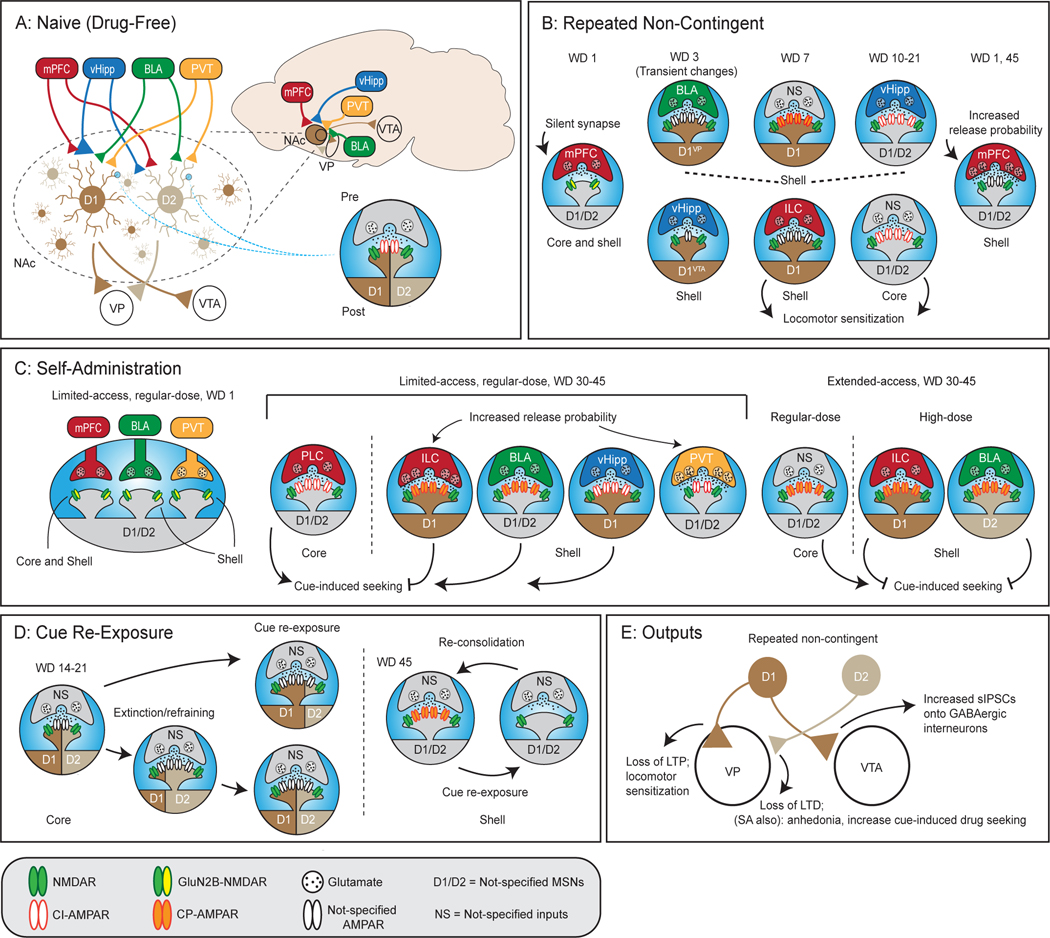
Cocaine-induced projection- and cell type-specific neural adaptations in the NAc circuit. A: Schematic diagram of the NAc circuit. Prior to cocaine exposure, glutamatergic inputs are largely unbiased between D1 and D2 MSNs, with the exception of vHipp inputs which are stronger at D1 than D2 MSN-synapses, . The majority of glutamatergic synapses onto D1 or D2 MSNs contain CI-AMPARs. B: Shortly after repeated non-contingent cocaine exposure, silent synapses are detected in the mixed populations of NAc MSNs, as well as at mPFC inputs. At withdrawal day ~3, an increase of BLA-to-D1 MSNVP transmission and a decrease of vHipp-to-D1VTA transmission are observed in the NAcSh, both of which are likely transient changes, . At withdrawal day ~7 following a single injection protocol, an LTP-like potentiation of IL-to-D1 synapses occurs in the NAcSh, which contributes to the development of locomotor sensitization. At around the same withdrawal time, one study found selective CP-AMPAR potentiation in D1 MSNs when assessed in bulk. At withdrawal day 10–14, vHipp-to-NAcSh synapses show increased AMPAR transmission mediated by CI-AMPARs. Behavioral sensitization on withdrawal day 21 is associated with increased surface expression of GluA1 and GluA2/3 (thus likely CI-AMPARs) in the core, . On both withdrawal day 1 and 45, an increase in presynaptic glutamate release probability is observed at mPFC-to-NAcSh synapses. C: Cocaine SA results in the transient formation of GluN2B-NMDAR-rich “silent synapses” in the core and shell, as examined at mPFC, BLA, and PVT projections, , . Cocaine-induced silent synapses undergoing AMPAR-insertion after withdrawal are likely to be found predominantly on D1 MSNs, with D2 MSNs potentially undergoing a brief or incomplete synapse generation during early withdrawal, , , . Silent synapses undergo maturation in a projection specific manner: PL-to-NAcCo synapses undergo CI-AMPAR insertion, which promotes incubation of cocaine craving. IL-to-NAcSh synapses display CP-AMPAR insertion, most likely on D1 MSNs, which reduces incubation, (but see). Likewise, BLA-to-NAc silent synapse maturation with CP-AMPARs has been demonstrated in rats following limited-access SA and long-term withdrawal, which contributes to incubated cocaine craving. vHipp-to-NAcSh synapses undergo potentiation via the selective insertion of CI-AMPARs in D1 MSNs, and potentiation of this projection facilitates cue-induced cocaine seeking. Both IL-to-NAcSh and PVT-to-NAcSh synapses show increased glutamate release probability after cocaine SA and long-term withdrawal, . Following extended-access to regular-dose cocaine SA and long-term withdrawal, CP-AMPARs are upregulated in the NAcCo MSNs through mGluR1-regulated, protein synthesis-dependent mechanisms, which critically mediates incubation of cocaine craving, –. Following extended-access to high-dose cocaine SA and long-term withdrawal, selective potentiation of mPFC-to-NAcSh D1(but not D2) MSNs is detected, likely mediated by synaptic insertion of CP-AMPARs. By contrast, following the same cocaine regimen and withdrawal, CP-AMPARs are inserted selectively at BLA-D2 MSN synapses, which concurs with incubation and is thought to be related to negative affect and aversion learning. D: Re-exposure to cocaine-associated cues induces additional AMPAR plasticity. For instance, cue re-exposure after withdrawal preferentially potentiates D1 MSNs in the NAcCo, whereas extinction training prior to cue re-exposure preferentially strengthens D2 MSNs. In the NAcSh, cue re-exposure temporarily re-silences cocaine-generated synapses, which can be followed by a re-maturation process accompanying the reconsolidation of cocaine-cue associations. E: Downstream at NAc outputs, VTA GABAergic neurons that receive from NAc D1 MSNs show increased spontaneous IPSCs following repeated non-contingent cocaine, disinhibiting dopaminergic neural activity; D1 MSN-to-VP transmission is strengthened following repeated non-contingent cocaine and withdrawal, while D2 MSN-to-VP transmission is weakened (and/or loses plasticity following non-contingent cocaine or SA and extinction), . Thus, the outcomes of these adaptive changes are potential shifts in the inhibitory network balance established by D1 and D2 MSNs, which are shaped at the NAc inputs, as well as at downstream outputs onto the VP and VTA. PLC, prelimbic PFC; ILC, infralimbic PFC; WD, withdrawal day.

References

    1. Hyman SE. Addiction to cocaine and amphetamine. Neuron 1996; 16(5): 901–904. - PubMed
    1. Hyman SE, Malenka RC, Nestler EJ. Neural mechanisms of addiction: the role of reward-related learning and memory. Annu Rev Neurosci 2006; 29: 565–598. - PubMed
    1. Hyman SE. Addiction: a disease of learning and memory. Am J Psychiatry 2005; 162(8): 1414–1422. - PubMed
    1. Sesack SR, Grace AA. Cortico-Basal Ganglia reward network: microcircuitry. Neuropsychopharmacology 2010; 35(1): 27–47. - PMC - PubMed
    1. Mogenson GJ, Jones DL, Yim CY. From motivation to action: functional interface between the limbic system and the motor system. Progress in neurobiology 1980; 14(2–3): 69–97. - PubMed

Publication types

LinkOut - more resources