


Prognostic and therapeutic role of tumor-infiltrating lymphocyte subtypes in breast cancer
- PMID: 33963482
- PMCID: PMC8424653
- DOI: 10.1007/s10555-021-09968-0
Prognostic and therapeutic role of tumor-infiltrating lymphocyte subtypes in breast cancer
Abstract
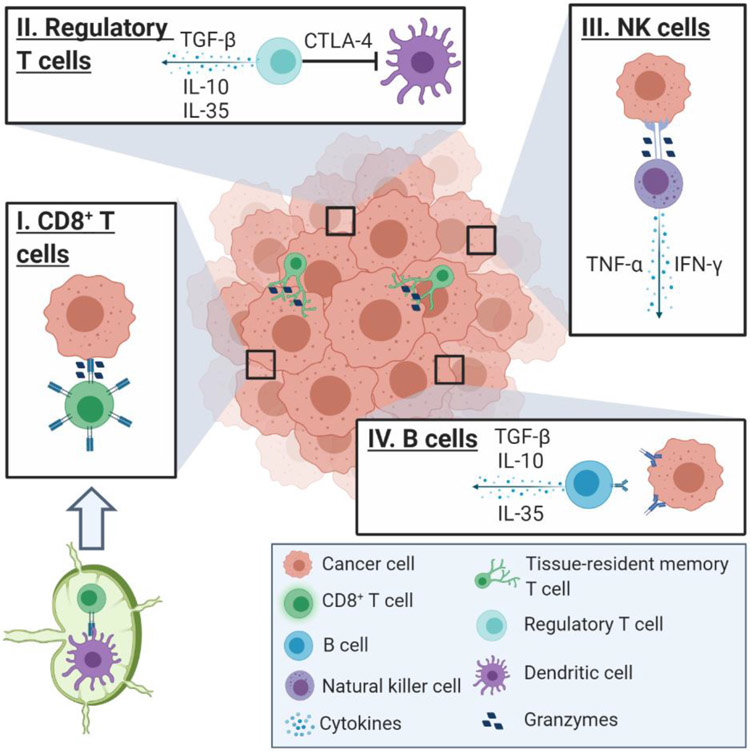
Increased levels of total tumor-infiltrating lymphocytes (TILs) are generally associated with good prognosis in several breast cancer subtypes. Subtypes of TILs impact both tumor cells and immune cells in a variety of different ways, leading to either a pro-tumor or antitumor effect. Tumor-infiltrating CD8+ T cells and natural killer (NK) cells perform as effector cells against tumor cells and are associated with better clinical outcome. Immunotherapy approaches that improve the antitumor activity and proliferation of CD8+ T and NK cells include PD-1/PD-L1 blockade, CAR T cell therapy, or ex vivo-stimulated NK cells. A subset of CD8+ T cells, tissue-resident memory T cells, has also recently been associated with good prognosis in breast cancer patients, and has potential to serve as a predictive biomarker and therapeutic target. Tumor-infiltrating B cells also secrete apoptosis-inducing IgG antibodies and can act as antigen-presenting cells to prime CD4+ and CD8+ T cells. On the other hand, regulatory T and regulatory B cells modulate the immune response from CD8+ T cells and NK cells by secreting immunosuppressive cytokines and inhibiting maturation of antigen-presenting cells (APCs). These regulatory cells are typically associated with poor prognosis, therefore rendering suppression of their regulatory function a key immunotherapeutic strategy.
Keywords: Breast cancer; Immunotherapy; T cells; TILs; Tumor microenvironment.
Conflict of interest statement
Figures
References
-
- The L (2018). GLOBOCAN 2018: counting the toll of cancer. Lancet (London, England), 392(10152), 985. - PubMed
-
- Howlader N, Noone A, Krapcho M. e., Miller D, Brest A, Yu M, et al. (2019). SEER cancer statistics review, 1975–2016. Bethesda, MD: National Cancer Institute, 1423–1437.
-
- American Cancer Society (2020). Cancer Facts and Figures 2020.
-
- Denkert C, Loibl S, Noske A, Roller M, Muller B, Komor M, et al. (2010). Tumor-associated lymphocytes as an independent predictor of response to neoadjuvant chemotherapy in breast cancer. J Clin Oncol, 28(1), 105–113. - PubMed
Publication types
MeSH terms
Substances
Grants and funding
LinkOut - more resources
Full Text Sources
Other Literature Sources
Medical
Research Materials
Miscellaneous
