. 2021 Oct 11;37(19):3343-3348.
doi: 10.1093/bioinformatics/btab325.

Reactome and the Gene Ontology: digital convergence of data resources

Affiliations

Reactome and the Gene Ontology: digital convergence of data resources

Benjamin M Good et al. Bioinformatics. .

Abstract

Motivation: Gene Ontology Causal Activity Models (GO-CAMs) assemble individual associations of gene products with cellular components, molecular functions and biological processes into causally linked activity flow models. Pathway databases such as the Reactome Knowledgebase create detailed molecular process descriptions of reactions and assemble them, based on sharing of entities between individual reactions into pathway descriptions.

Results: To convert the rich content of Reactome into GO-CAMs, we have developed a software tool, Pathways2GO, to convert the entire set of normal human Reactome pathways into GO-CAMs. This conversion yields standard GO annotations from Reactome content and supports enhanced quality control for both Reactome and GO, yielding a nearly seamless conversion between these two resources for the bioinformatics community.

Supplementary information: Supplementary data are available at Bioinformatics online.


Figures

Fig. 1.
Fig. 1.
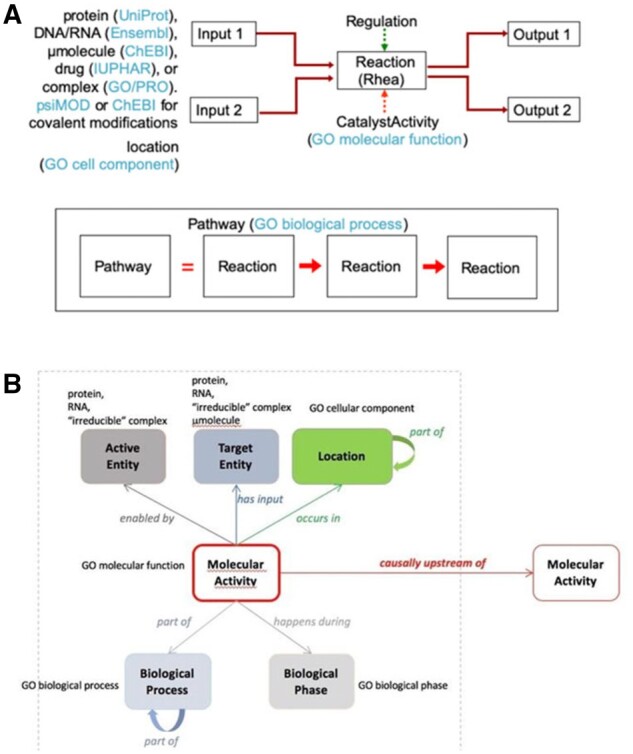
A Reactome reaction (A) is the transformation of input physical entities into output ones through changes in their covalent chemistries, their subcellular locations, or their associations with other entities in complexes. Physical entities may catalyze or regulate a reaction. The blue parenthetical notes identify the external resources and ontologies from which information are drawn to annotate reactions. Sequential reactions are connected to form a pathway where the output of an upstream reaction is an input, catalyst or positive regulator of a downstream reaction. A GO-CAM model (B) centers on a molecular activity enabled by a single gene product or, inspecific cases, a complex (active entity), acting on a target entity, occurring in a subcellularlocation, comprising a part of a biological process, during a biological phase. Arrows are relations from the RO, and all boxes refer to a class from an ontology(or other stable object identifier). Curved ‘part of’ arrows show nesting of smaller processes or cell parts as modules within larger ones
Fig. 2.
Fig. 2.
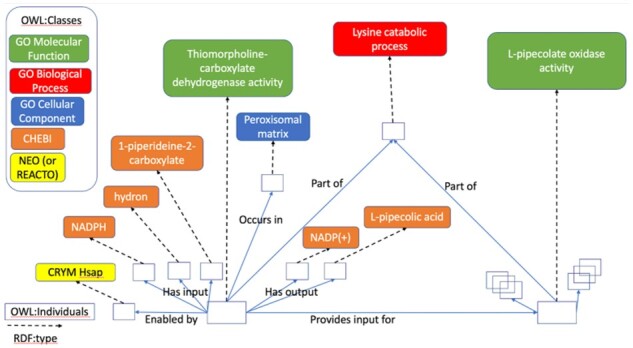
OWL instance graph representing a part of the GO-CAM for the lysine catabolic pathway. Nodes (open rectangular boxes) correspond to OWL: individuals. The ontology term associated with each node and edge in a GO-CAM graph provides its human readable label and its logical definition. The ontologies provide logical definitions for classes and properties that enable use of OWL reasoning to infer new classifications for individuals in GO-CAMs and to check GO-CAMs for logical consistency
Fig. 3.
Fig. 3.
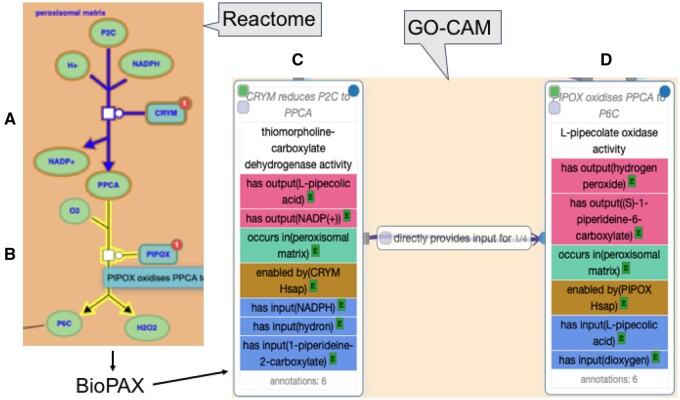
Conversion of the Reactome representation of two reactions, A and B, in the pathway of human lysine catabolism to GO-CAM activity units, C and D, respectively, preserving the type of each reaction, subcellular locations of physical entities and the causal relationship between the two reactions/activities. The BioPAX and .ttl files generated in the course of converting Reactome reaction A (R-HSA-71064) to GO-CAM activity unit C are available here (https://reactome.org/PathwayBrowser/#/R-HSA-71064&DTAB=DT) and (https://github.com/geneontology/noctua-models/blob/master/models/R-HSA-71064.ttl), respectively
Fig. 4.
Fig. 4.
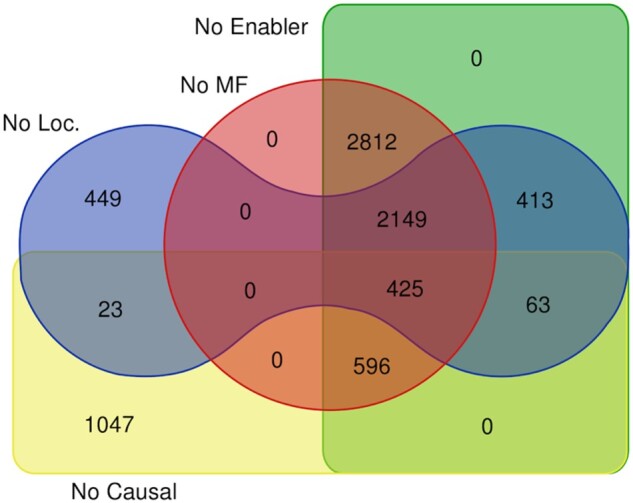
This diagram catalogs classes of missing information in the 7986 incomplete activity units converted from Reactome reactions, specifically: molecular function (MF, red circle), enabling entity (Enabler, green rectangle), location/cell component (Loc, blue toroid), causal connection (Causal, yellow rectangle). Also, 5572 converted reactions could not be assigned a specific GO biological process term but instead were linked to the root term ‘biological process’. All such reactions are parts of Reactome pathways not themselves assigned a specific GO biological process term, a gap in current Reactome curation practice

References

    1. Bader G.D. et al. (2006) Pathguide: a pathway resource list. Nucleic Acids Res., 34, D504–D506. - PMC - PubMed
    1. Balhoff J.P. et al. (2018) Arachne: an OWL RL reasoner applied to Gene Ontology Causal Activity Models (and beyond). In International Semantic Web Conference (P&D/Industry/BlueSky).
    1. Demir E. et al. (2010) The BioPAX community standard for pathway data sharing. Nat. Biotechnol., 28, 935–942. - PMC - PubMed
    1. Demir E. et al. (2013) Using biological pathway data with paxtools. PLoS Comput. Biol., 9, e1003194. - PMC - PubMed
    1. Gaudet P. et al. (2008) An anatomy ontology to represent biological knowledge in Dictyostelium discoideum. BMC Genomics, 9, 130. - PMC - PubMed