


The effect of sleep-wake intraindividual variability in digital cognitive behavioral therapy for insomnia: a mediation analysis of a large-scale RCT
- PMID: 33964166
- PMCID: PMC8503826
- DOI: 10.1093/sleep/zsab118
The effect of sleep-wake intraindividual variability in digital cognitive behavioral therapy for insomnia: a mediation analysis of a large-scale RCT
Abstract
Study objectives: Digital cognitive behavioral therapy for insomnia (dCBT-I) is an effective treatment for insomnia. However, less is known about mediators of its benefits. The aim of the present study was to test if intraindividual variability in sleep (IIV) was reduced with dCBT-I, and whether any identified reduction was a mediator of dCBT-I on insomnia severity and psychological distress.
Methods: In a two-arm randomized controlled trial (RCT), 1720 adults with insomnia (dCBT-I = 867; patient education about sleep = 853) completed the Insomnia Severity Index (ISI), the Hospital Anxiety and Depression Scale (HADS) and sleep diaries, at baseline and 9-week follow-up. Changes in IIV were analyzed using linear mixed modeling followed by mediation analyses of ISI, HADS, and IIV in singular sleep metrics and composite measures (behavioral indices (BI-Z) and sleep disturbance indices (SI-Z)).
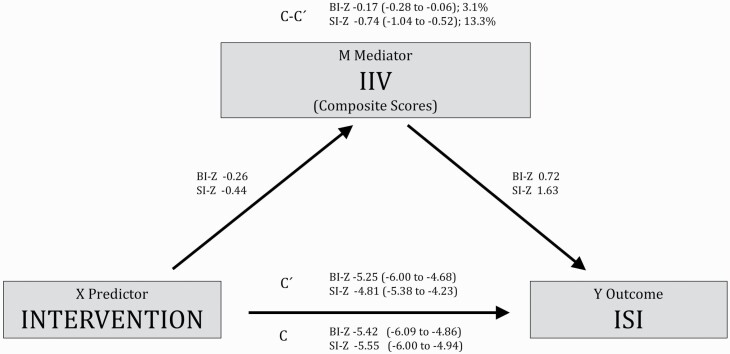
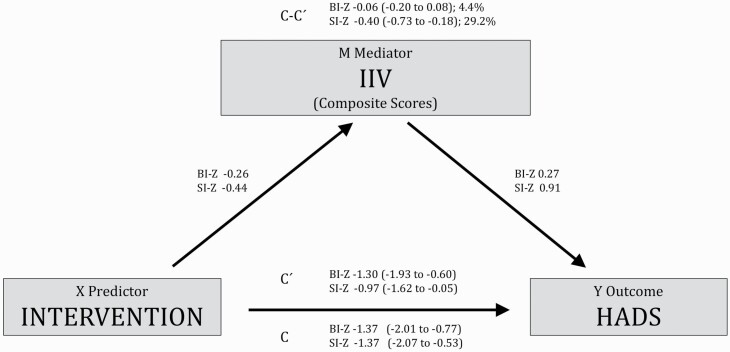
Results: dCBT-I was associated with reduced IIV across all singular sleep metrics, with the largest between-group effect sizes observed for sleep onset latency (SOL). Reduced IIV for SOL and wake after sleep onset had the overall greatest singular mediating effect. For composite measures, SI-Z mediated change in ISI (b = -0.74; 95% confidence interval (CI) -1.04 to -0.52; 13.3%) and HADS (b = -0.40; 95% CI -0.73 to -0.18; 29.2%), while BI-Z mediated minor changes.
Conclusion: Reductions in IIV in key sleep metrics mediate significant changes in insomnia severity and especially psychological distress when using dCBT-I. These findings offer important evidence regarding the therapeutic action of dCBT-I and may guide the future development of this intervention.
Clinical trials: Name: Overcoming Insomnia: Impact on Sleep, Health and Work of Online CBT-I Registration number: NCT02558647 URL: https://clinicaltrials.gov/ct2/show/NCT02558647?cond=NCT02558647&draw=2&rank=1.
Keywords: CBT-I; intraindividual variability; mediation analysis; randomized controlled trial; sleep–wake cycle.
© Sleep Research Society 2021. Published by Oxford University Press on behalf of the Sleep Research Society.
Figures
References
-
- Pallesen S, et al. A 10-year trend of insomnia prevalence in the adult Norwegian population. Sleep Med. 2014;15(2):173–179. - PubMed
-
- Morin CM, et al. Sleep and psychopathology. Appl Prev Psychol. 1996;5(4):211–224.
-
- Ford DE, et al. Epidemiologic study of sleep disturbances and psychiatric disorders. An opportunity for prevention? JAMA. 1989;262(11):1479–1484. - PubMed
-
- World Health Organization. ICD-10: psykiske lidelser og atferdsforstyrrelser: kliniske beskrivelser og diagnostiske retningslinjer. Oslo: Universitetsforlaget; 1999.
-
- Okajima I, et al. A meta-analysis on the treatment effectiveness of cognitive behavioral therapy for primary insomnia. Sleep Biol Rhythms. 2011;9(1):24–34.
Publication types
MeSH terms
Associated data
LinkOut - more resources
Full Text Sources
Other Literature Sources
Medical
