Review
. 2021 Jul;191(7):1154-1164.
doi: 10.1016/j.ajpath.2021.04.010. Epub 2021 May 6.

ACE2 Down-Regulation May Act as a Transient Molecular Disease Causing RAAS Dysregulation and Tissue Damage in the Microcirculatory Environment Among COVID-19 Patients

Affiliations
Review

ACE2 Down-Regulation May Act as a Transient Molecular Disease Causing RAAS Dysregulation and Tissue Damage in the Microcirculatory Environment Among COVID-19 Patients

Simone Gusmão Ramos et al. Am J Pathol. 2021 Jul.

Abstract

Severe acute respiratory syndrome coronavirus 2, the etiologic agent of coronavirus disease 2019 (COVID-19) and the cause of the current pandemic, produces multiform manifestations throughout the body, causing indiscriminate damage to multiple organ systems, particularly the lungs, heart, brain, kidney, and vasculature. The aim of this review is to provide a new assessment of the data already available for COVID-19, exploring it as a transient molecular disease that causes negative regulation of angiotensin-converting enzyme 2, and consequently, deregulates the renin-angiotensin-aldosterone system, promoting important changes in the microcirculatory environment. Another goal of the article is to show how these microcirculatory changes may be responsible for the wide variety of injury mechanisms observed in different organs in this disease. The new concept of COVID-19 provides a unifying pathophysiological picture of this infection and offers fresh insights for a rational treatment strategy to combat this ongoing pandemic.


Figures

Figure 1
Figure 1
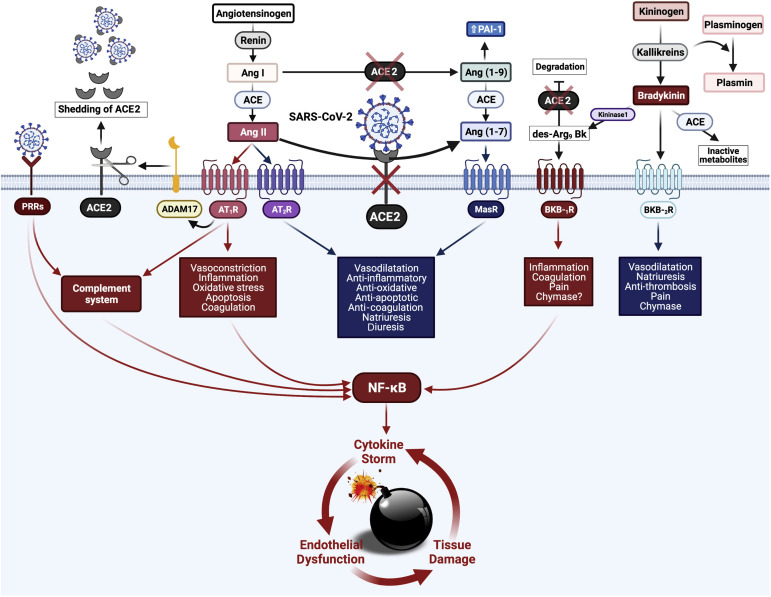
Schematic representation of the dysregulation in the renin-angiotensin-aldosterone system caused by severe acute respiratory syndrome coronavirus 2 (SARS-CoV-2). Renin converts angiotensinogen into angiotensin I (Ang I). Angiotensin-converting enzyme (ACE) converts Ang I into angiotensin II (Ang II), which binds to its receptors Ang II type 1 receptor (AT1R) and Ang II type 2 receptor (AT2R). Ang II exerts most of its harmful cardiovascular effects through the ACE/Ang II/AT1R axis. Usually, the major part of Ang II is converted by angiotensin-converting enzyme 2 (ACE2) to become Ang 1-7, which activates the Mas receptor signaling pathway with protective effects in the microcirculatory environment. In coronavirus disease 2019, after the attachment of SARS-CoV-2 spike protein to ACE2, its intracellular binding site down-regulates ACE2. Disintegrin and metalloproteinase domain-containing protein 17 (ADAM17), cleaving the ACE2 terminal, also contributes to the negative regulation of ACE2 by spreading it along with the attached virus through bloodstream. The down-regulation of ACE2 culminates in Ang II upregulation, corroborating to a pro-inflammatory milieu. The kallikrein-kinin system is intensively interwoven with the renin-angiotensin-aldosterone system through many pathways with complex reciprocal interaction metabolites, especially des-Arg9 bradykinin (DABK). ACE2 cleaves terminal residue of DABK, resulting in its deactivation. The derangement ACE2/DABK/bradykinin B1 receptor (BKB-1R) axis activation creates a proinflammatory synergistic effect for SARS-CoV-2 in association with ACE/Ang II/AT1R axis activation. The complement system is activated both by the Ang II/ACE2 axis and by recognizing SARS-CoV-2 by pattern recognition receptors (PRRs). The interaction of ACE2 with the coagulation system is indirect and occurs by inhibiting fibrinolysis. In this context, the NF-κB pathway receives stimuli along three different axes: Ang II/AT1R, DABK/BKB-1R, and SARS-CoV-2/PRRs/complement. NF-κB hyperactivation then promotes a positive feedback cycle between cytokine storm, endothelial dysfunction, and tissue damage in the microcirculatory environment. BKB-2R, bradykinin B2 receptor; MasR, Ang 1-7 receptor Mas; PAI-1, plasminogen activator inhibitor-1. Created with BioRender.com.
Figure 2
Figure 2
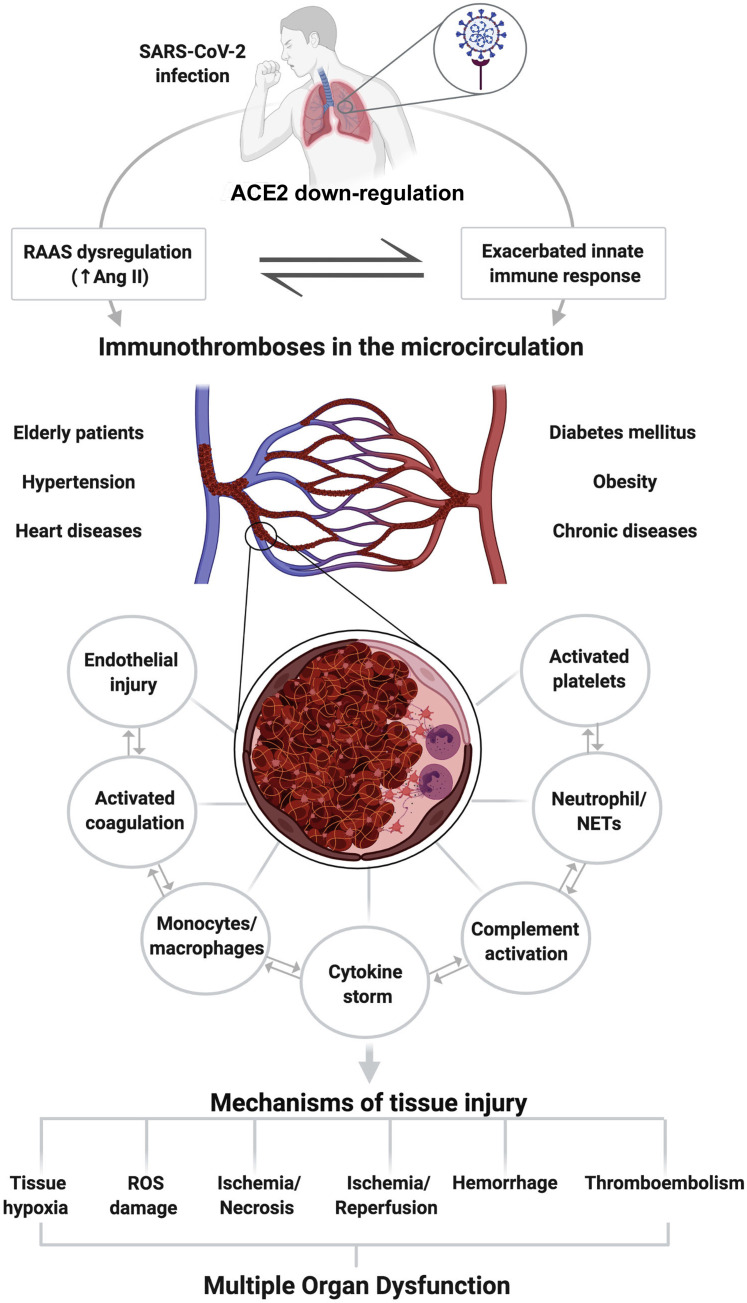
Schematic representation showing the pathologic consequences of negative regulation of angiotensin-converting enzyme 2 (ACE2) in coronavirus disease 19. After entering the body, severe acute respiratory syndrome coronavirus 2 (SARS-CoV-2) infects the alveolar epithelial by engaging ACE2 and promoting its negative regulation. The down-regulation of ACE2 leads to renin-angiotensin-aldosterone system (RAAS) dysregulation, which associated with the exacerbated innate immunity response, favors the appearance of immunothromboses in the microcirculation. These immunothrombi result from the activation of inflammatory and coagulation pathways through a cytokine storm, resulting in endothelial dysregulation, leukocyte activation, neutrophil extracellular trap (NET) generation, complement deposition, and platelet consumption. Pre-existing dysregulation of the RAAS in elderly patients and patients with heart disease, hypertension, diabetes mellitus, chronic diseases, and obesity may contribute to an unfavorable outcome in SARS-CoV-2. Tissue damage can occur through a wide range of mechanisms, including tissue hypoxia, damage by reactive oxygen species (ROS), ischemia/necrosis, ischemia-reperfusion injury, hemorrhage, and/or thromboembolism. These changes, if left untreated, can lead to multiorgan dysfunction and death. Ang II, angiotensin II. Created with BioRender.com (Toronto, Canada).

References

    1. Wu Z., McGoogan J.M. Characteristics of and important lessons from the coronavirus disease 2019 (COVID-19) outbreak in China: summary of a report of 72 314 cases from the Chinese Center for Disease Control and Prevention. JAMA. 2020;323:1239–1242. - PubMed
    1. Gustine J.N., Jones D. Immunopathology of hyperinflammation in COVID-19. Am J Pathol. 2021;191:4–17. - PMC - PubMed
    1. Walls A.C., Xiong X., Park Y.J., Tortorici M.A., Snijder J., Quispe J., Cameroni E., Gopal R., Dai M., Lanzavecchia A., Zambon M., Rey F.A., Corti D., Veesler D. Unexpected receptor functional mimicry elucidates activation of coronavirus fusion. Cell. 2019;176:1026–1039. - PMC - PubMed
    1. Ziegler C.G.K., Allon S.J., Nyquist S.K., Mbano I.M., Miao V.N., Tzouanas C.N., et al. SARS-CoV-2 receptor ACE2 is an interferon-stimulated gene in human airway epithelial cells and is detected in specific cell subsets across tissues. Cell. 2020;181:1016–1035.e19. - PMC - PubMed
    1. Verdecchia P., Cavallini C., Spanevello A., Angeli F. COVID-19: ACE2centric infective disease? Hypertension. 2020;76:294–299. - PubMed

Publication types

MeSH terms

Substances