


Comment
doi: 10.1038/s41392-021-00585-5.
Fecal microbiota transplantation: can it circumvent resistance to PD-1 blockade in melanoma?
Affiliations
- PMID: 33966043
- PMCID: PMC8106675
- DOI: 10.1038/s41392-021-00585-5
Item in Clipboard
Comment
Fecal microbiota transplantation: can it circumvent resistance to PD-1 blockade in melanoma?
Signal Transduct Target Ther.
.
No abstract available
Figures
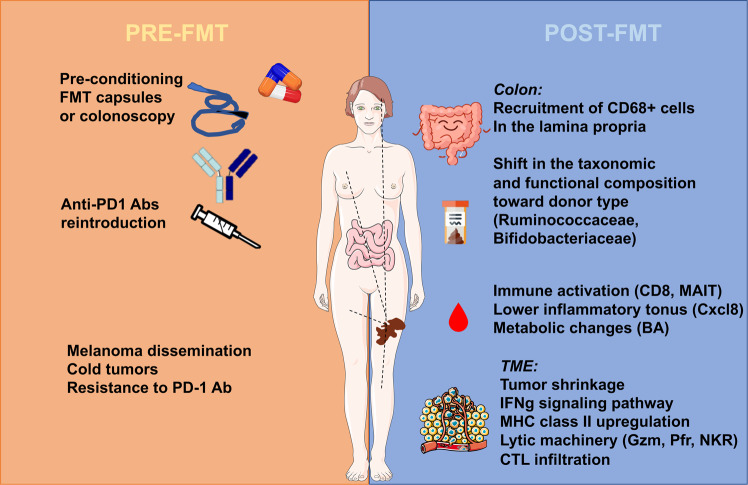
First proof-of-concept of the curative potential of FMT combined to reintroduction of anti-PD-1 Ab in cancer patients resistant to immunotherapy in two independent study. Nine different donors diagnosed with metastatic melanoma in partial or complete remission donated their stools for FMT (via oral or colonoscopic delivery) into 26 metastatic melanoma patients refractory to PD-1 blockade. The fecal product of distinct donors successfully engrafted in recipients who benefited the FMT and reprogrammed the local mucosae, reinstated tumor immunosurveillance, and induced changes in the metabolic, immune, and inflammatory tonus in nine patients who experienced long-term responses to this combinatorial regimen. Abbreviations: BA: biliary acids; CTL: cytotoxic T lymphocyte; FMT: fecal microbial transplantation; Gzm: granzymes; IFNγ: interferon gamma; MAIT: mucosal-associated invariant T cells; MHC: major histocompatibility complex; NKR: killer activating receptors; Pfr: perforin; TME: tumor microenvironment
Comment on
-
Fecal microbiota transplant promotes response in immunotherapy-refractory melanoma patients.Science. 2021 Feb 5;371(6529):602-609. doi: 10.1126/science.abb5920. Epub 2020 Dec 10. Science. 2021. PMID: 33303685 Clinical Trial.
-
Fecal microbiota transplant overcomes resistance to anti-PD-1 therapy in melanoma patients.Science. 2021 Feb 5;371(6529):595-602. doi: 10.1126/science.abf3363. Science. 2021. PMID: 33542131 Free PMC article. Clinical Trial.
References
-
- Baruch, E. N. et al. Fecal microbiota transplant promotes response in immunotherapy-refractory melanoma patients. Science10.1126/science.abb5920 (2020). - PubMed
Publication types
MeSH terms
Substances
LinkOut - more resources
Full Text Sources
Other Literature Sources
Medical
