


Defining important canine zoonotic pathogens within the Prairie Provinces of Canada
- PMID: 33967286
- PMCID: PMC8048239
Defining important canine zoonotic pathogens within the Prairie Provinces of Canada
Abstract
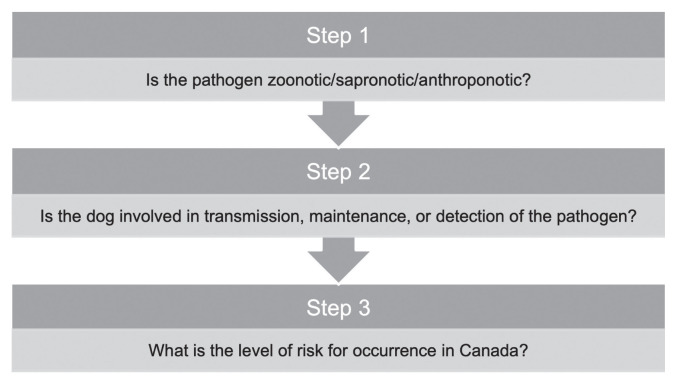
The goal of this study was to establish a short list of zoonotic pathogens involving the domestic dog that can be prioritized for a companion animal surveillance program specific to the Prairie Provinces of Canada. A list of pathogens documented in dogs was created through a comprehensive review of infectious disease textbooks for the following taxonomical categories: bacteria, ectoparasites, fungi, helminths, protozoa, rickettsia, and viruses. This created an initial list of 594 pathogens that was then pared down through an extensive review of the literature using the following criteria: i) the pathogen is zoonotic/sapronotic/anthroponotic; ii) the dog is involved in transmission to humans, maintenance, or detection of the pathogen; and iii) there is a level of risk for occurrence of the pathogen in Canada. This process yielded a final list of 84 pathogens and 3 supplementary lists of canine zoonotic/sapronotic/anthroponotic pathogens that may become relevant to future surveillance programs.
Définition des agents pathogènes zoonotiques canins importants dans les provinces des Prairies du Canada. Le but de cette étude était d’établir une courte liste d’agents pathogènes zoonotiques impliquant le chien domestique qui peuvent être priorisés pour un programme de surveillance des animaux de compagnie propre aux provinces des Prairies du Canada. Une liste d’agents pathogènes documentés chez les chiens a été créée grâce à un examen complet des manuels sur les maladies infectieuses pour les catégories taxonomiques suivantes : bactéries, ectoparasites, champignons, helminthes, protozoaires, rickettsies et virus. Cela a créé une liste initiale de 594 agents pathogènes qui a ensuite été réduite grâce à un examen approfondi de la littérature en utilisant les critères suivants : i) l’agent pathogène est zoonotique/sapronotique/anthroponotique; ii) le chien est impliqué dans la transmission à l’homme, le maintien ou la détection de l’agent pathogène; et iii) il existe un niveau de risque d’apparition de l’agent pathogène au Canada. Ce processus a donné une liste finale de 84 agents pathogènes et trois listes supplémentaires d’agents pathogènes zoonotiques/sapronotiques/anthroponotiques canins qui pourraient devenir pertinents pour les futurs programmes de surveillance.(Traduit par Dr Serge Messier).
Copyright and/or publishing rights held by the Canadian Veterinary Medical Association.
Figures


References
-
- Day MJ, Breitschwerdt E, Cleaveland S, et al. Surveillance of zoonotic infectious disease transmitted by small companion animals. Emerg Infect Dis. 2012;18:e1.
-
- [Last accessed March 18, 2021];Latest Canadian Pet Population Figures Released: Press Releases. Latest Canadian Pet Population Figures Released | Press Releases | Canadian Animal Health Institute (CAHI). [Internet] 2019 [cited 2020 Apr 16]. Available from: https://www.cahi-icsa.ca/press-releases/latest-canadian-pet-population-f....
-
- Moore GE, Lund E. Disease reporting and surveillance: Where do companion animal diseases fit in? Vet Clin North Am Small Anim Pract. 2009;39:225–240. - PubMed
-
- Sykes J, Greene C. Infectious Diseases of the Dog and Cat. 4th ed. Philadelphia, Pennsylvania: Saunders; 2011.
Publication types
MeSH terms
LinkOut - more resources
Full Text Sources
Medical