


Determination of COVID-19 pneumonia based on generalized convolutional neural network model from chest X-ray images
- PMID: 33967405
- PMCID: PMC8093008
- DOI: 10.1016/j.eswa.2021.115141
Determination of COVID-19 pneumonia based on generalized convolutional neural network model from chest X-ray images
Abstract
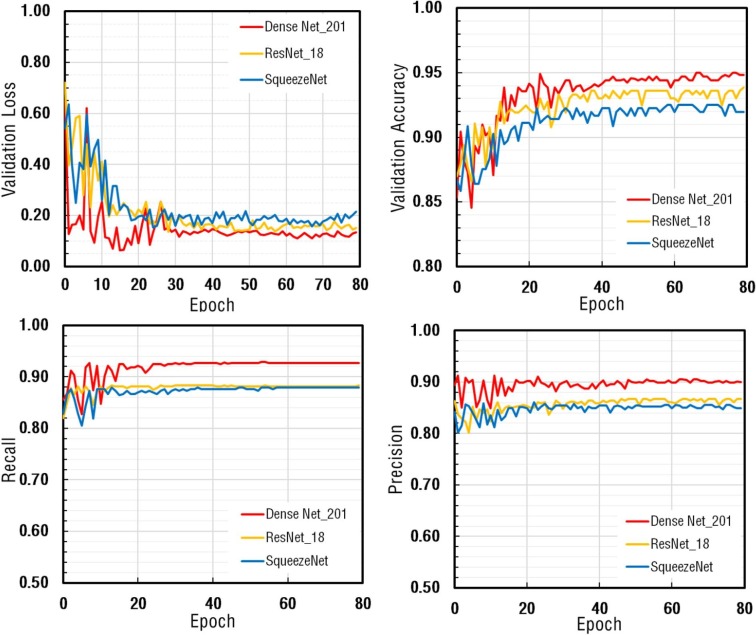
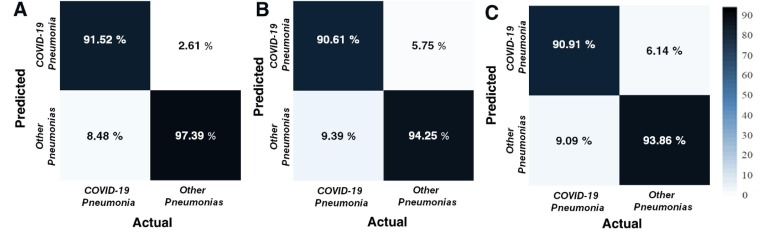
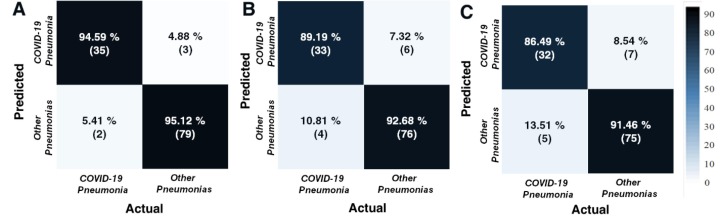
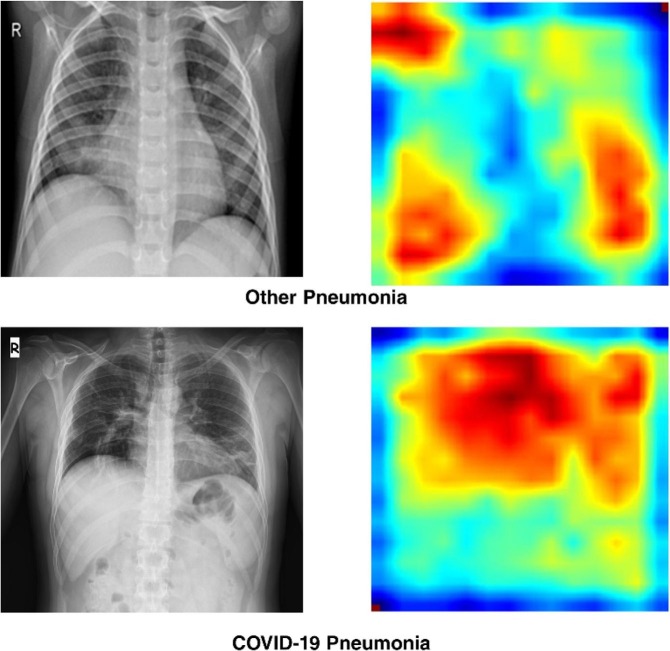
X-ray units have become one of the most advantageous candidates for triaging the new Coronavirus disease COVID-19 infected patients thanks to its relatively low radiation dose, ease of access, practical, reduced prices, and quick imaging process. This research intended to develop a reliable convolutional-neural-network (CNN) model for the classification of COVID-19 from chest X-ray views. Moreover, it is aimed to prevent bias issues due to the database. Transfer learning-based CNN model was developed by using a sum of 1,218 chest X-ray images (CXIs) consisting of 368 COVID-19 pneumonia and 850 other pneumonia cases by pre-trained architectures, including DenseNet-201, ResNet-18, and SqueezeNet. The chest X-ray images were acquired from publicly available databases, and each individual image was carefully selected to prevent any bias problem. A stratified 5-fold cross-validation approach was utilized with a ratio of 90% for training and 10% for the testing (unseen folds), in which 20% of training data was used as a validation set to prevent overfitting problems. The binary classification performances of the proposed CNN models were evaluated by the testing data. The activation mapping approach was implemented to improve the causality and visuality of the radiograph. The outcomes demonstrated that the proposed CNN model built on DenseNet-201 architecture outperformed amongst the others with the highest accuracy, precision, recall, and F1-scores of 94.96%, 89.74%, 94.59%, and 92.11%, respectively. The results indicated that the reliable diagnosis of COVID-19 pneumonia from CXIs based on the CNN model opens the door to accelerate triage, save critical time, and prioritize resources besides assisting the radiologists.
Keywords: Chest X-ray images; Convolutional Neural Network (CNN); Corona Virus (COVID-19); Deep learning.
© 2021 Elsevier Ltd. All rights reserved.
Conflict of interest statement
The authors declare that they have no known competing financial interests or personal relationships that could have appeared to influence the work reported in this paper.
Figures
References
-
- Bassi, P.R., Attux, R., (2020). A deep convolutional neural network for COVID-19 detection using chest X-rays. arXiv preprint:2005.01578.
-
- Che Azemin M.Z., Hassan R., Mohd Tamrin M.I., Md Ali M.A. COVID-19 deep learning prediction model using publicly available radiologist-adjudicated chest X-ray images as training data: Preliminary findings. Journal of Biomedical Imaging & Bioengineering. 2020;2020:1–7. doi: 10.1155/2020/8828855. - DOI - PMC - PubMed
-
- Cohen, J.P., Morrison, P., & Dao, L. (2020). COVID-19 image data collection, https://github.com/ieee8023/covid-chestxray-dataset.
LinkOut - more resources
Full Text Sources
Other Literature Sources