


Pleiotropic Effects of Tetracyclines in the Management of COVID-19: Emerging Perspectives
- PMID: 33967777
- PMCID: PMC8103613
- DOI: 10.3389/fphar.2021.642822
Pleiotropic Effects of Tetracyclines in the Management of COVID-19: Emerging Perspectives
Abstract
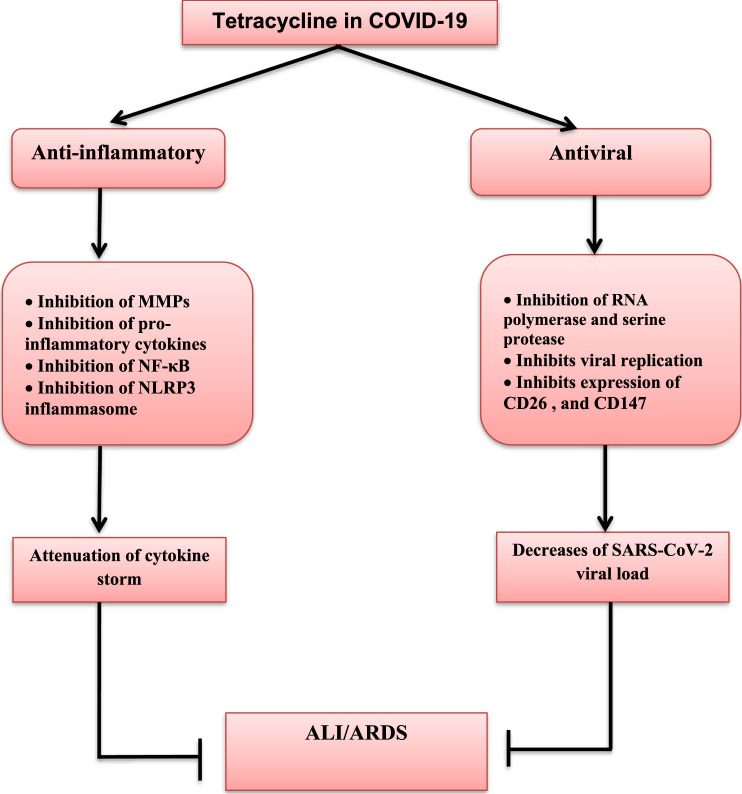
Coronavirus disease 2019 (COVID-19) is a global infectious disease caused by severe acute respiratory syndrome coronavirus 2 (SARS-CoV-2). Approximately 15% of severe cases require an intensive care unit (ICU) admission and mechanical ventilation due to development of acute respiratory distress syndrome (ARDS). Tetracyclines (TCs) are a group of bacteriostatic antibiotics, like tetracycline, minocycline, and doxycycline, effective against aerobic and anaerobic bacteria as well as Gram-positive and Gram-negative bacteria. Based on available evidences, TCs may be effective against coronaviruses and thus useful to treat COVID-19. Thus, this review aims to provide a brief overview on the uses of TCs for COVID-19 management. SARS-CoV-2 and other coronaviruses depend mainly on the matrix metalloproteinases (MMPs) for their proliferation, cell adhesion, and infiltration. The anti-inflammatory mechanisms of TCs are linked to different pathways. Briefly, TCs inhibit mitochondrial cytochrome c and caspase pathway with improvement of lymphopenia in early COVID-19. Specifically, minocycline is effective in reducing COVID-19-related complications, through attenuation of cytokine storm as apparent by reduction of interleukin (IL)-6, IL-1, and tumor necrosis factor (TNF)-α. Different clinical trials recommend the replacement of azithromycin by minocycline in the management of COVID-19 patients at high risk due to two main reasons: 1) minocycline does not prolong the QT interval and even inhibits ischemia-induced arrhythmia; 2) minocycline displays synergistic effect with chloroquine against SARS-CoV-2. Taken together, the data presented here show that TCs, mainly doxycycline or minocycline, may be potential partners in COVID-19 management, derived pneumonia, and related complications, such as acute lung injury (ALI) and ARDS.
Keywords: COVID-19; SARS-CoV-2; acute respiratory distress syndrome; coronavirus disease 2019; tetracyclines.
Copyright © 2021 Al-kuraishy, Al-Gareeb, Alqarni, Cruz-Martins and El-Saber Batiha.
Conflict of interest statement
The authors declare that the research was conducted in the absence of any commercial or financial relationships that could be construed as a potential conflict of interest.
Figures
References
-
- Al-kuraishy H. M., Al-Maiahy T. J., Al-Gareeb A. I., Musa R. A., Ali Z. H. (2020b). COVID-19 Pneumonia in an Iraqi Pregnant Woman With Preterm Delivery. Asian Pac. J. Reprod. 9 (3), 156–158. 10.4103/2305-0500.282984 - DOI
-
- Bhowmik D., Nandi R., Jagadeesan R., Kumar N., Prakash A., Kumar D. (2020). Identification of Potential Inhibitors against SARS-CoV-2 by Targeting Proteins Responsible for Envelope Formation and Virion Assembly Using Docking Based Virtual Screening, and Pharmacokinetics Approaches. Infect. Genet. Evol. 84, 104451. 10.1016/j.meegid.2020.104451 - DOI - PMC - PubMed
Publication types
LinkOut - more resources
Full Text Sources
Miscellaneous
