


Developing Resilience During the COVID-19 Pandemic: Yoga and Mindfulness for the Well-Being of Student Musicians in Spain
- PMID: 33967904
- PMCID: PMC8097029
- DOI: 10.3389/fpsyg.2021.642992
Developing Resilience During the COVID-19 Pandemic: Yoga and Mindfulness for the Well-Being of Student Musicians in Spain
Abstract
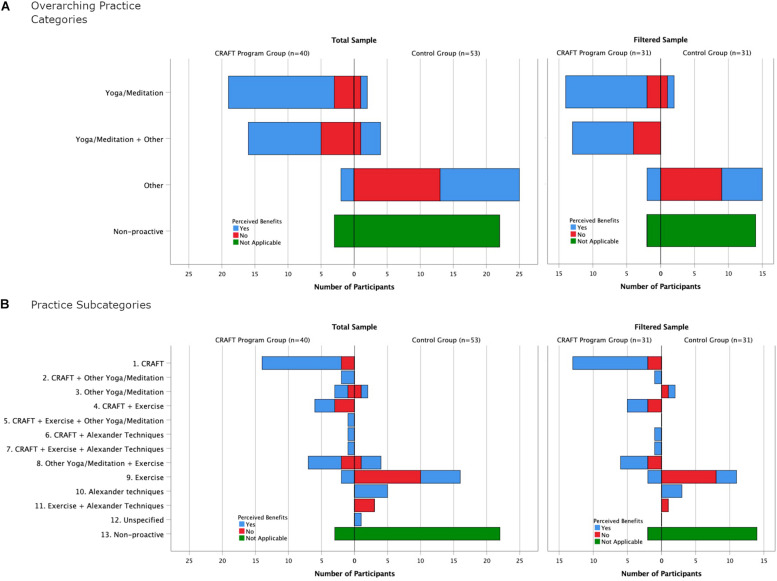
Here, we report on a quasi-experimental study to explore the applicability and perceived benefits of the CRAFT program, which is based on mindfulness, yoga, positive psychology, and emotional intelligence, to improve higher education student musicians' health and well-being during the lockdown. A subset of student musicians at a Higher Conservatory of Music in Spain followed the CRAFT program during the academic year 2019/2020, 1 h per week as part of their curriculum. Students enrolled in CRAFT-based elective subjects formed the CRAFT program group (n = 40), while other students represented the control group (n = 53). The onset of the national lockdown elicited by the COVID-19 pandemic occurred halfway through the program, which was subsequently delivered in an online format. We administered an online survey to explore the effect that the exposure to the CRAFT program had in terms of how participants dealt with various health and well-being concerns arising from the COVID-19 lockdown. There was a significantly higher proportion of proactive participants in the CRAFT program group, 92%, than in the control group, 58%, in terms of implementing practices to improve their health and well-being during the lockdown. Additionally, significantly more participants acknowledged perceived benefits from their practices in the CRAFT program group, 78%, than in the control group, 52%. Among proactive participants, yoga/meditation was the most implemented in the CRAFT program group, followed by exercise, and other yoga/meditation practices, whereas in the control group, exercise and Alexander technique-based practices were the most applied. In the CRAFT program group, the highest rate of perceived benefits was from yoga/meditation CRAFT-based practices, 51%, followed by exercise, 32%, and other yoga/meditation practices, 27%, whereas in the control group, benefits were reported by 29% of exercising participants and 16% for those having practiced the Alexander technique. A similar pattern was observed when excluding participants with previous yoga/meditation experience. This study revealed how participants can independently apply learned skills from the CRAFT program in response to a naturally occurring life event of unprecedented global impact, suggesting that previous exposure to mindfulness and yoga is likely to have a beneficial effect on how young adults react towards exceptionally stressful conditions.
Keywords: emotional intelligence; higher education student musicians; lockdown; mindfulness; physical activity; yoga.
Copyright © 2021 Bartos, Funes, Ouellet, Posadas and Krägeloh.
Conflict of interest statement
We acknowledge that one of the authors (MP) developed the CRAFT program. However, as stated in the author contributions, MP did not conceive this particular study and also was not responsible for both the data collection and analysis stages of this investigation, which was also a way to manage this particular potential conflict of interest. The remaining authors declare that the research was conducted in the absence of any commercial or financial relationships that could be construed as a potential conflict of interest.
Figures
References
-
- Altena E., Baglioni C., Espie C. A., Ellis J., Gavriloff D., Holzinger B., et al. (2020). Dealing with sleep problems during home confinement due to the COVID-19 outbreak: practical recommendations from a task force of the European CBT-I academy. J. Sleep Res. 29:e13052. 10.1111/jsr.13052 - DOI - PubMed
LinkOut - more resources
Full Text Sources
Other Literature Sources
