. 2021 Apr 23:12:655884.
doi: 10.3389/fpsyg.2021.655884. eCollection 2021.

EEG Signal Diversity Varies With Sleep Stage and Aspects of Dream Experience

Affiliations

EEG Signal Diversity Varies With Sleep Stage and Aspects of Dream Experience

Arnfinn Aamodt et al. Front Psychol. .

Abstract

Several theories link consciousness to complex cortical dynamics, as suggested by comparison of brain signal diversity between conscious states and states where consciousness is lost or reduced. In particular, Lempel-Ziv complexity, amplitude coalition entropy and synchrony coalition entropy distinguish wakefulness and REM sleep from deep sleep and anesthesia, and are elevated in psychedelic states, reported to increase the range and vividness of conscious contents. Some studies have even found correlations between complexity measures and facets of self-reported experience. As suggested by integrated information theory and the entropic brain hypothesis, measures of differentiation and signal diversity may therefore be measurable correlates of consciousness and phenomenological richness. Inspired by these ideas, we tested three hypotheses about EEG signal diversity related to sleep and dreaming. First, diversity should decrease with successively deeper stages of non-REM sleep. Second, signal diversity within the same sleep stage should be higher for periods of dreaming vs. non-dreaming. Third, specific aspects of dream contents should correlate with signal diversity in corresponding cortical regions. We employed a repeated awakening paradigm in sleep deprived healthy volunteers, with immediate dream report and rating of dream content along a thought-perceptual axis, from exclusively thought-like to exclusively perceptual. Generalized linear mixed models were used to assess how signal diversity varied with sleep stage, dreaming and thought-perceptual rating. Signal diversity decreased with sleep depth, but was not significantly different between dreaming and non-dreaming, even though there was a significant positive correlation between Lempel-Ziv complexity of EEG recorded over the posterior cortex and thought-perceptual ratings of dream contents.

Keywords: EEG; complexity; consciousness; dream; entropy; experience; signal diversity; sleep.


Conflict of interest statement

The authors declare that the research was conducted in the absence of any commercial or financial relationships that could be construed as a potential conflict of interest.

Figures
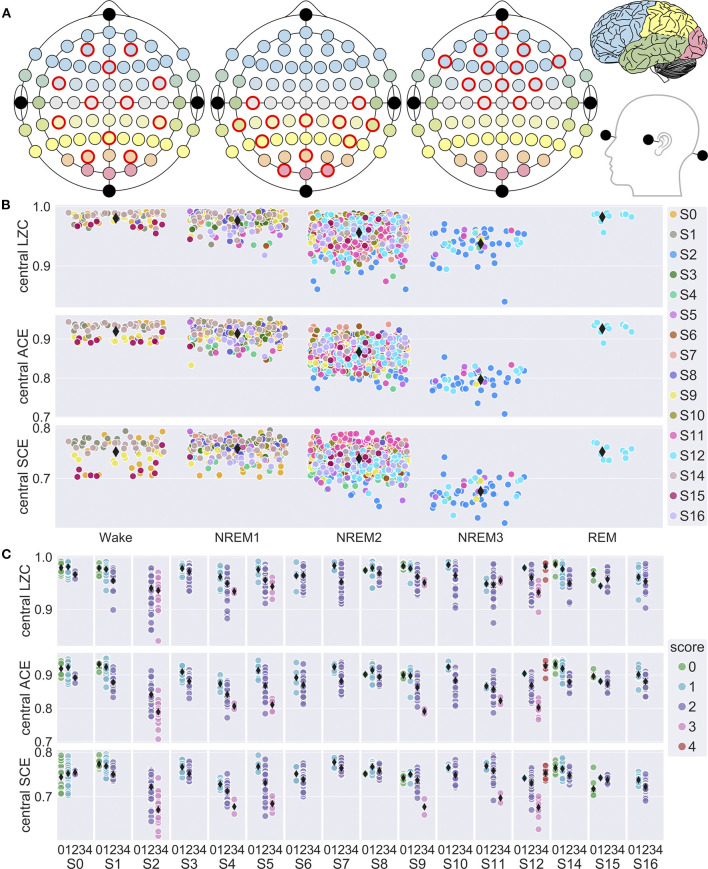
Figure 1
Figure 1
EEG channel selection and variation in signal diversity with sleep stage. (A) Central, posterior and frontal channel selections. Electrode fill color indicates associated cortical lobe [adapted from illustration by Laurens R. Krol, distributed under a CC0 1.0 license (Krol, 2020)]. (B) Mean LZC, ACE and SCE for all 30 s sleep epochs vs. sleep stage for the central channel selection. Observations are randomly jittered along x-axis to reduce overlap, and participant number (S0, …, S16) is indicated by marker fill color. Grand mean values for each sleep stage is indicated by black diamond markers. Most of the data is from NREM2 sleep, because we prioritized the within-state analysis of dream-reports from NREM2. In particular, all REM sleep epochs are from a single sleep trial for Participant 12. (C) Mean central LZC, ACE and SCE for the 30 s sleep epochs vs. sleep stage (0 = W, 1 = NREM1, 2 = NREM2, 3 = NREM3, 4 = REM), plotted separately for each study participant (S0, …, S16). Fill color indicates sleep stage, and diamond markers indicates participant mean values for each stage.
Figure 2
Figure 2
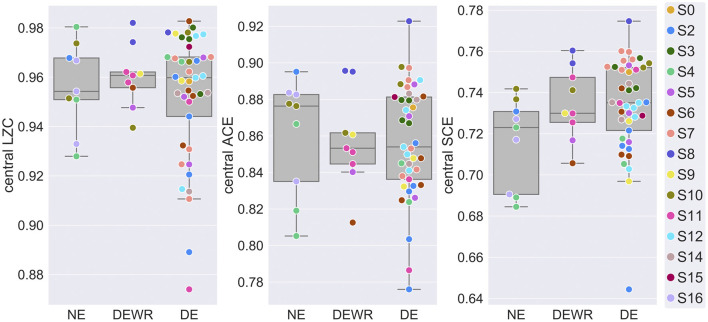
EEG signal diversity vs. dream experience classification. Mean central LZC, ACE and SCE of the last 30 s sleep epoch before NREM2 awakenings, vs. experience classification of subsequent dream reports (DE = dream experience, DEWR = dream experience without recall of contents, NE = non-experience). Observations plotted on top of corresponding boxplots. Participant number (S0, …, S16) is indicated by marker fill color, and observations are displaced slightly along x-axis to avoid overlap.
Figure 3
Figure 3
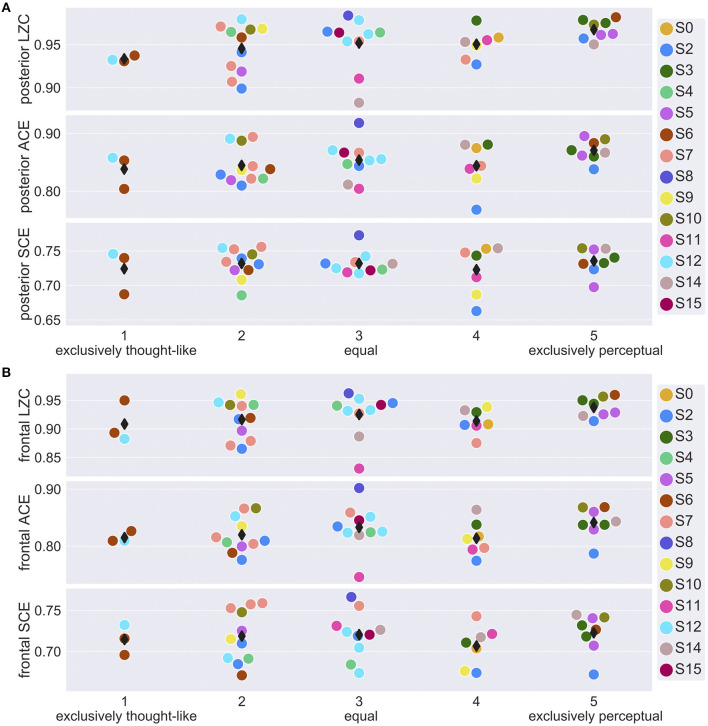
EEG signal diversity vs. thought-perceptual ratings of dream experience. (A) Mean posterior (see Figure 1A) signal diversity of the last 30 s sleep epoch before NREM2 awakenings with recalled dream experience, vs. thought-perceptual ratings of dream contents (1 = exclusively thought-like, 5 = exclusively perceptual). Participant number (S0, …, S16) is indicated by marker fill color, and observations are displaced slightly along x-axis to avoid overlap. (B) Mean frontal (see Figure 1A) signal diversity of the last 30 s sleep epoch before NREM2 awakenings with recalled dream experience, vs. thought-perceptual ratings of dream contents.

References

    1. Abásolo D., Simons S., Morgado da Silva R., Tononi G., Vyazovskiy V. V. (2015). Lempel-Ziv complexity of cortical activity during sleep and waking in rats. J. Neurophysiol. 113, 2742–2752. 10.1152/jn.00575.2014 - DOI - PMC - PubMed
    1. Andrillon T., Poulsen A. T., Hansen L. K., Léger D., Kouider S. (2016). Neural markers of responsiveness to the environment in human sleep. J. Neurosci. 36, 6583–6596. 10.1523/JNEUROSCI.0902-16.2016 - DOI - PMC - PubMed
    1. Aru J., Siclari F., Phillips W. A., Storm J. F. (2020). Apical drive-A cellular mechanism of dreaming? Neurosci. Biobehav. Rev. 119, 440–455. 10.1016/j.neubiorev.2020.09.018 - DOI - PubMed
    1. Baars B. J. (1988). A Cognitive Theory of Consciousness. Cambridge: Cambridge University Press.
    1. Baars B. J., Franklin S., Ramsoy T. Z. (2013). Global workspace dynamics: cortical “binding and propagation” enables conscious contents. Front. Psychol. 4:200. 10.3389/fpsyg.2013.00200 - DOI - PMC - PubMed