


Narcissism and Entrepreneurship: A Systematic Review and an Agenda for Future Research
- PMID: 33967921
- PMCID: PMC8096986
- DOI: 10.3389/fpsyg.2021.657681
Narcissism and Entrepreneurship: A Systematic Review and an Agenda for Future Research
Abstract
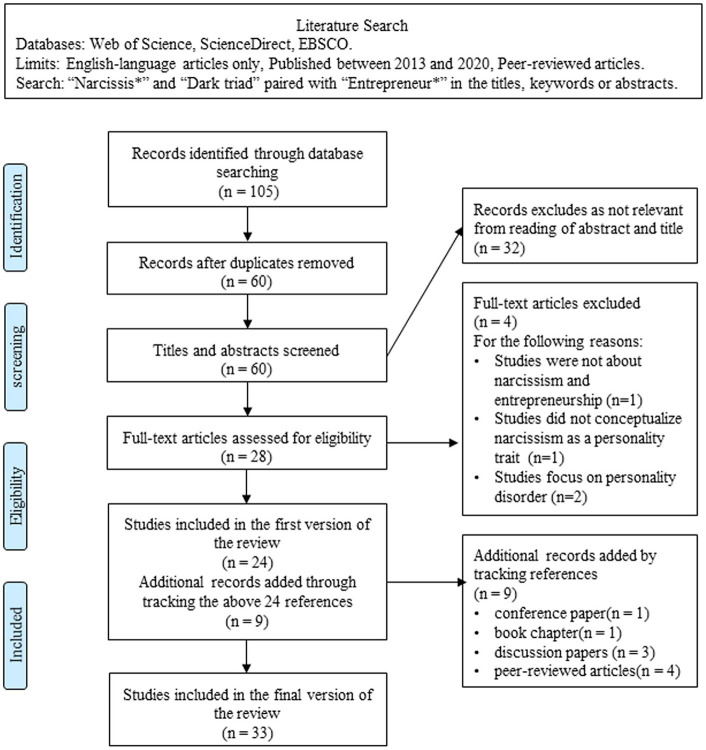
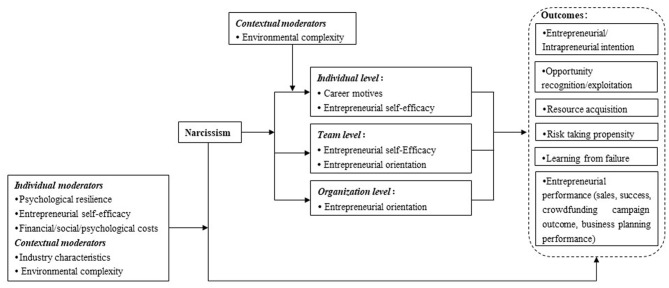
Although narcissism is an important factor influencing entrepreneurial activity and outcomes, not much research has been conducted on the relationship between narcissism and entrepreneurship. To summarize the current literature on this relationship and provide an agenda for further in-depth research, a systematic review was conducted based on the PRISMA guidelines using Web of Science, Elsevier ScienceDirect, and EBSCO host databases. Accordingly, 33 articles have been identified as being eligible for the final synthesis. The findings of the present study showed, in general, that (1) life history theory, person-environment fit theory (P-E theory), and career choice theory were mostly used to explore the topic of narcissism and entrepreneurial intention, social exchange theory was used to analyze narcissistic entrepreneurs' entrepreneurial motives and attitudes, and upper echelons theory (UET) was applied to research on the relationship between narcissism and entrepreneurial outcomes, (2) Narcissistic Personality Inventory (NPI) and narcissistic sub-dimension of the Dark Triad were frequently used self-report scales among 23 identified empirical studies, and (3) narcissism has both bright and dark sides to entrepreneurial activities and outcomes. While narcissism makes potential entrepreneurs have higher entrepreneurial intentions and greater willingness to take risks, it also prevents entrepreneurs from discovering opportunities, acquiring resources, and learning from failure. Besides, results also showed that relations between narcissism and entrepreneurial intentions and performance are more complex. For a deeper understanding of this complex relations and advancing research on narcissism and entrepreneurship, more research is necessary to explore the relations between narcissism and entrepreneurship-related variables from a temporal perspective and at the team level, examine the relationship between narcissism and entrepreneurship ethics, and investigate the interaction effects of narcissism and other personalities.
Keywords: entrepreneurial process; entrepreneurship; entrepreneurship theory; narcissism; personality.
Copyright © 2021 Liu, Zhu, Huang, Wang and Huang.
Conflict of interest statement
The authors declare that the research was conducted in the absence of any commercial or financial relationships that could be construed as a potential conflict of interest.
Figures
References
-
- Ahsan M. (2017). The right people at the right time–the place does not matter. Acad. Manage. Rev. 42, 145–148. 10.5465/amr.2015.0276 - DOI
-
- Ahsan M. (2018). Entrepreneurship and ethics in the sharing economy: a critical perspective. J. Bus. Ethics 161, 19–33. 10.1007/s10551-018-3975-2 - DOI
-
- Al-Ghazali B. M., Afsar B. (2020). Narcissism and entrepreneurial intentions: the roles of entrepreneurial self-efficacy and environmental complexity. J. High Technol. Manage. Res. 2020:100395. 10.1016/j.hitech.2020.100395 - DOI
-
- Ames D. R., Rose P., Anderson C. P. (2006). The NPI-16 as a short measure of narcissism. J. Res. Pers. 40, 440–450. 10.1016/j.jrp.2005.03.002 - DOI
-
- Anglin A. H., Wolfe M. T., Short J. C., McKenny A. F., Pidduck R. J. (2018). Narcissistic rhetoric and crowdfunding performance: a social role theory perspective. J. Bus. Ventur. 33, 780–812. 10.1016/j.jbusvent.2018.04.004 - DOI
Publication types
LinkOut - more resources
Full Text Sources
Other Literature Sources
