Laryngopharyngeal Reflux: Symptoms, Signs, and Presence of Pepsin in Saliva - A Reliable Diagnostic Triad
- PMID: 33968232
- PMCID: PMC8096499
- DOI: 10.1055/s-0040-1709987
Laryngopharyngeal Reflux: Symptoms, Signs, and Presence of Pepsin in Saliva - A Reliable Diagnostic Triad
Abstract
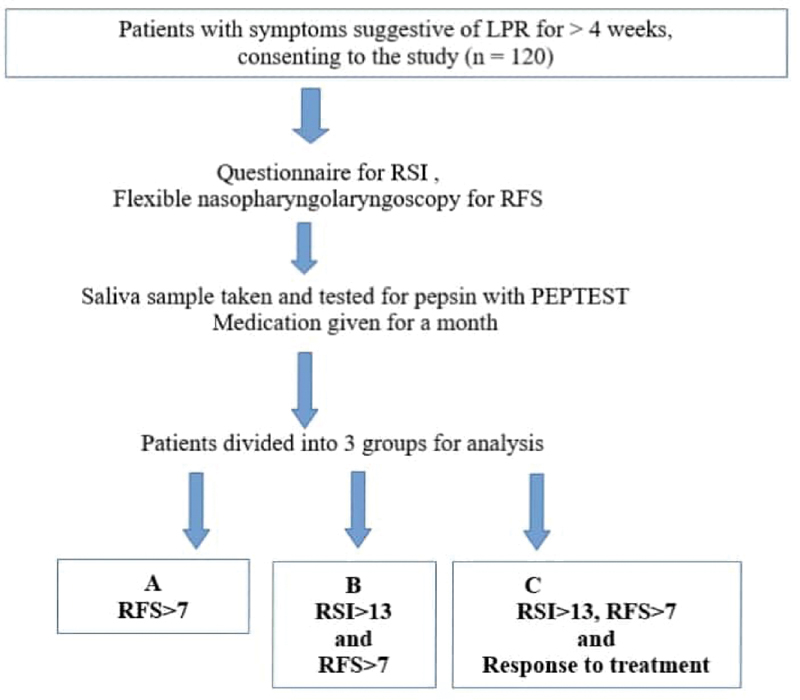
Introduction Twenty-four-hour multichannel intraluminal impedance with double probe pH monitoring (MII-pH), though considered the most sensitive tool for the diagnosis of gastroesophageal reflux disease (GERD), is invasive, time consuming, not widely available, and unable to detect non-acid reflux. In contrast, the presence of pepsin in the saliva would act as a marker for reflux, considering that pepsin is only produced in the stomach. Objective To evaluate the predictive value of salivary pepsin in diagnosing laryngopharyngeal reflux (LPR) as suggested by the results of reflux symptom index (RSI > 13), reflux finding score (RFS > 7), and positive response to treatment with a 4-week course of proton-pump inhibitors. Methods This prospective study was done at a tertiary care hospital on 120 adult patients attending ENT OPD with clinical diagnosis of LPR. The presence of pepsin in their pharyngeal secretions and saliva using a lateral flow device, the Peptest, was compared with RSI, RFS, and with the response to medical treatment using the Chi-squared test. Results Salivary pepsin was found to be positive in 68% of the patients, with 87.5% of them showing positive response to treatment. Chi-squared analysis showed a significant association between positive salivary pepsin and RFS > 7, RSI >13, a combination of RFS > 7 and RSI > 13 as well as with response to treatment ( p < 0.0001). Conclusion When considered along with the clinical indicators of RFS and RSI of more than 7 and 13, respectively, and/or with a response to treatment, a positive salivary pepsin test indicates statistically significant chance of presence of LPR.
Keywords: laryngopharyngeal reflux; pepsin; reflux findings score; reflux symptoms index; saliva.
Fundação Otorrinolaringologia. This is an open access article published by Thieme under the terms of the Creative Commons Attribution-NonDerivative-NonCommercial License, permitting copying and reproduction so long as the original work is given appropriate credit. Contents may not be used for commecial purposes, or adapted, remixed, transformed or built upon. ( https://creativecommons.org/licenses/by-nc-nd/4.0/ ).
Conflict of interest statement
Conflict of Interests The authors have no conflict of interests to declare.
References
-
- Koufman J A.The otolaryngologic manifestations of gastroesophageal reflux disease (GERD): a clinical investigation of 225 patients using ambulatory 24-hour pH monitoring and an experimental investigation of the role of acid and pepsin in the development of laryngeal injury Laryngoscope 1991101(4 Pt 2, Suppl 53):1–78. - PubMed
-
- Koufman J A, Aviv J E, Casiano R R, Shaw G Y. Laryngopharyngeal reflux: position statement of the committee on speech, voice, and swallowing disorders of the American Academy of Otolaryngology-Head and Neck Surgery. Otolaryngol Head Neck Surg. 2002;127(01):32–35. - PubMed
-
- Bulmer D M, Ali M S, Brownlee I A, Dettmar P W, Pearson J P. Laryngeal mucosa: its susceptibility to damage by acid and pepsin. Laryngoscope. 2010;120(04):777–782. - PubMed
-
- Jiang A, Liang M, Su Z. Immunohistochemical detection of pepsin in laryngeal mucosa for diagnosing laryngopharyngeal reflux. Laryngoscope. 2011;121(07):1426–1430. - PubMed
LinkOut - more resources
Full Text Sources
Research Materials
Miscellaneous