


Fine-Gray subdistribution hazard models to simultaneously estimate the absolute risk of different event types: Cumulative total failure probability may exceed 1
- PMID: 33969508
- PMCID: PMC8360146
- DOI: 10.1002/sim.9023
Fine-Gray subdistribution hazard models to simultaneously estimate the absolute risk of different event types: Cumulative total failure probability may exceed 1
Abstract
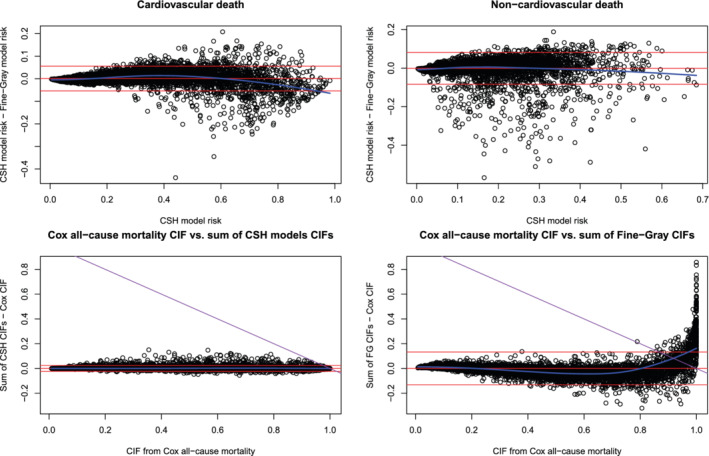
The Fine-Gray subdistribution hazard model has become the default method to estimate the incidence of outcomes over time in the presence of competing risks. This model is attractive because it directly relates covariates to the cumulative incidence function (CIF) of the event of interest. An alternative is to combine the different cause-specific hazard functions to obtain the different CIFs. A limitation of the subdistribution hazard approach is that the sum of the cause-specific CIFs can exceed 1 (100%) for some covariate patterns. Using data on 9479 patients hospitalized with acute myocardial infarction, we estimated the cumulative incidence of both cardiovascular death and non-cardiovascular death for each patient. We found that when using subdistribution hazard models, approximately 5% of subjects had an estimated risk of 5-year all-cause death (obtained by combining the two cause-specific CIFs obtained from subdistribution hazard models) that exceeded 1. This phenomenon was avoided by using the two cause-specific hazard models. We provide a proof that the sum of predictions exceeds 1 is a fundamental problem with the Fine-Gray subdistribution hazard model. We further explored this issue using simulations based on two different types of data-generating process, one based on subdistribution hazard models and other based on cause-specific hazard models. We conclude that care should be taken when using the Fine-Gray subdistribution hazard model in situations with wide risk distributions or a high cumulative incidence, and if one is interested in the risk of failure from each of the different event types.
Keywords: cause-specific hazard function; competing risks; cumulative incidence function; subdistribution hazard; survival analysis.
© 2021 The Authors. Statistics in Medicine published by John Wiley & Sons Ltd.
Figures


References
-
- Fine JP, Gray RJ. A proportional hazards model for the subdistribution of a competing risk. J Am Stat Assoc. 1999;94:496‐509.
-
- Putter H, Fiocco M, Geskus RB. Tutorial in biostatistics: competing risks and multi‐state models. Stat Med. 2007;26(11):2389‐2430. - PubMed
-
- Kalbfleisch JD, Prentice RL. The Statistical Analysis of Failure Time Data. Vol 2. New York: John Wiley and Sons; 2002.
-
- Therneau T, Crowson C, Atkinson E. Multi‐state models and competing risks. 2020. https://cran.r‐project.org/web/packages/survival/vignettes/compete.pdf. Accessed January 6, 2021.
Publication types
MeSH terms
Grants and funding
LinkOut - more resources
Full Text Sources
Other Literature Sources