Case Reports
. 2021 Sep;7(5):425-431.
doi: 10.1002/cjp2.219. Epub 2021 May 9.

MYC amplifications are common events in childhood osteosarcoma

Affiliations
Case Reports

MYC amplifications are common events in childhood osteosarcoma

Solange De Noon et al. J Pathol Clin Res. 2021 Sep.

Abstract

Osteosarcoma, the most common primary malignant tumour of bone, affects both children and adults. No fundamental biological differences between paediatric and adult osteosarcoma are known. Here, we apply multi-region whole-genome sequencing to an index case of a 4-year-old child whose aggressive tumour harboured high-level, focal amplifications of MYC and CCNE1 connected by translocations. We reanalysed copy number readouts of 258 cases of high-grade osteosarcoma from three different cohorts and identified a significant enrichment of focal MYC, but not CCNE1, amplifications in children. Furthermore, we identified four additional cases of MYC and CCNE1 coamplification, highlighting a rare driver event which warrants further investigation. Our findings indicate that amplification of the MYC oncogene is a major driver of childhood osteosarcoma, while CCNE1 appears recurrently amplified independent of age.

Keywords: CCNE1; MYC; copy number variants; genomics; osteosarcoma.


Figures

Figure 1
Figure 1
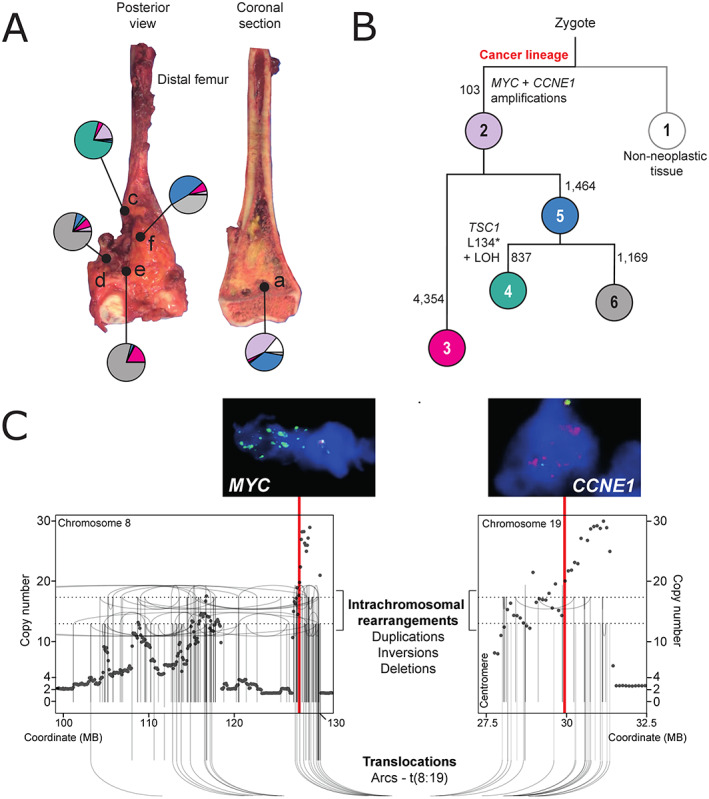
Multi‐sample whole‐genome analysis of the index case. (A) Image of resected tumour highlighting sampled tumour regions with pie charts (colouring as per B) demonstrating the relative proportion of clones comprising each region, as identified through phylogenetic analysis (Canopy algorithm). Letters refer to sample IDs. (B) Tumour phylogeny. Each circle represents a clone (number in circle = clone ID). The number next to each branch represents branch defining substitutions. The lengths of branches represent these only qualitatively. Driver events are highlighted next to each branch. (C) Consensus rearrangements and copy number across tumour samples with corresponding FISH validation. Vertical red lines highlight the position of MYC and CCNE1. Each dot represents the copy number (y‐axis) of a specific genomic coordinate (x‐axis). Lines and arc show the position and relationship of breakpoints.
Figure 2
Figure 2
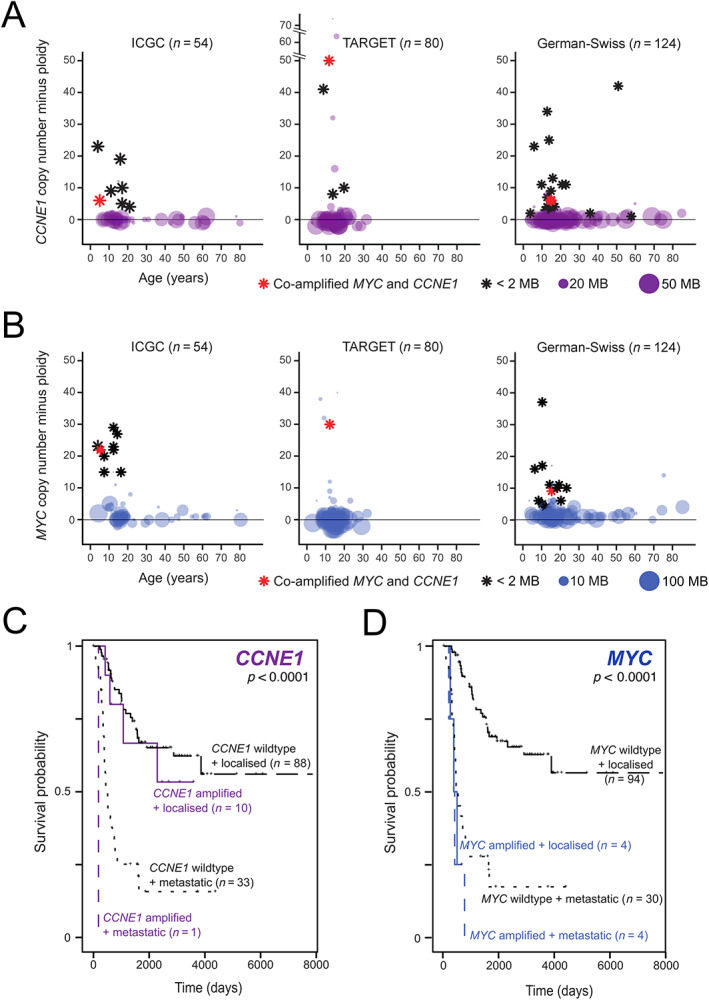
MYC and CCNE1 amplifications in osteosarcoma. Genomic segments harbouring (A) CCNE1 or (B) MYC are shown across three independent cohorts. In each plot, circles or stars represent data from an individual tumour. The position on the x‐axis shows the age. The y‐axis position represents absolute gene copy number minus tumour ploidy. The sizes of circles represent the segment size with focal amplifications (total copy number to ploidy ratio > 2 and amplicon size ≤2 Mb) represented by black stars. Red stars identify tumours with coamplification of MYC and CCNE1. Effects of (C) CCNE1 or (D) MYC amplification on survival (Kaplan–Meier analysis) by metastatic status. Survival analysis performed on ICGC and TARGET‐OS cohorts only.

References

    1. Haddox CL, Han G, Anijar L, et al. Osteosarcoma in pediatric patients and young adults: a single institution retrospective review of presentation, therapy, and outcome. Sarcoma 2014; 2014: 402509. - PMC - PubMed
    1. Collins M, Wilhelm M, Conyers R, et al. Benefits and adverse events in younger versus older patients receiving neoadjuvant chemotherapy for osteosarcoma: findings from a meta‐analysis. J Clin Oncol 2013; 31: 2303–2312. - PubMed
    1. Janeway KA, Barkauskas DA, Krailo MD, et al. Outcome for adolescent and young adult patients with osteosarcoma: a report from the Children's Oncology Group. Cancer 2012; 118: 4597–4605. - PMC - PubMed
    1. Behjati S, Tarpey PS, Haase K, et al. Recurrent mutation of IGF signalling genes and distinct patterns of genomic rearrangement in osteosarcoma. Nat Commun 2017; 8: 15936. - PMC - PubMed
    1. Suehara Y, Alex D, Bowman A, et al. Clinical genomic sequencing of pediatric and adult osteosarcoma reveals distinct molecular subsets with potentially targetable alterations. Clin Cancer Res 2019; 25: 6346–6356. - PMC - PubMed

Publication types

LinkOut - more resources