Randomized Controlled Trial
. 2021 May 3;4(5):e219041.
doi: 10.1001/jamanetworkopen.2021.9041.

Patient-Reported Outcomes of Treatment of Opioid Dependence With Weekly and Monthly Subcutaneous Depot vs Daily Sublingual Buprenorphine: A Randomized Clinical Trial

Affiliations
Randomized Controlled Trial

Patient-Reported Outcomes of Treatment of Opioid Dependence With Weekly and Monthly Subcutaneous Depot vs Daily Sublingual Buprenorphine: A Randomized Clinical Trial

Nicholas Lintzeris et al. JAMA Netw Open. .

Abstract

Importance: Patient-reported outcomes in the treatment of opioid dependence may differ between subcutaneously administered depot buprenorphine and daily sublingual buprenorphine.

Objective: To compare patient satisfaction between depot buprenorphine and sublingual buprenorphine in adult outpatients with opioid dependence.

Design, setting, and participants: This open-label, randomized clinical trial was conducted among adult patients with opioid dependence at 6 outpatient clinical sites in Australia from October 2018 to September 2019. Data analysis was conducted from October 2019 to May 2020.

Interventions: Participants were randomized to receive treatment with weekly or monthly depot buprenorphine or daily sublingual buprenorphine over 24 weeks.

Main outcomes and measures: The primary end point was the difference in global treatment satisfaction, assessed by the Treatment Satisfaction Questionnaire for Medication (TSQM) version 1.4 (range, 0-100; higher score indicates greater satisfaction) at week 24. Secondary end points included other patient-reported outcomes, including quality of life, treatment burden, and health-related outcomes, as well as measures of opioid use, retention in treatment, and safety.

Results: A total of 119 participants (70 [58.8%] men; mean [SD] age, 44.4 [10.5] years) were enrolled, randomized to, and received either depot buprenorphine (60 participants [50.4%]) or sublingual buprenorphine (59 participants [49.6%]). From the initial sample of 120, a participant (0.8%) in the sublingual buprenorphine group withdrew consent and did not receive study treatment. All participants were receiving sublingual buprenorphine when enrolled. The mean TSQM global satisfaction score was significantly higher for the depot group compared with the sublingual group at week 24 (mean [SE] score, 82.5 [2.3] vs 74.3 [2.3]; difference, 8.2; 95% CI, 1.7 to 14.6; P = .01). Improved outcomes were also observed for several secondary end points after treatment with depot buprenorphine (eg, mean [SE] treatment burden assessed by the Treatment Burden Questionnaire global score, on which lower scores indicate lower burden: 13.2 [2.6] vs 28.6 [2.5]; difference, -15.4; 95% CI, -22.6 to -8.2; P < .001). Thirty-nine participants (65.0%) in the depot buprenorphine group experienced 117 adverse drug reactions, mainly injection site reactions of mild intensity following subcutaneous administration, and 12 participants (20.3%) in the sublingual buprenorphine group experienced 21 adverse drug reactions. No participants withdrew from the trial medication or the trial due to adverse events.

Conclusions and relevance: In this study, participants receiving depot buprenorphine reported improved treatment satisfaction compared with those receiving sublingual buprenorphine. The results highlight the application of patient-reported outcomes as alternative end points to traditional markers of substance use in addiction treatment outcome studies.

Trial registration: anzctr.org.au Identifier: ANZCTR12618001759280.


Conflict of interest statement

Conflict of Interest Disclosures: Dr Lintzeris reported serving on the advisory boards for GW Pharmaceuticals, Indivior, and Mundipharma; receiving speakers’ honoraria from Chiesi Pharmaceuticals and Mundipharma; and receiving funding for research-related expenses from Braeburn Pharmaceuticals/Camurus outside the submitted work. Dr Dunlop reported serving on the advisory board for Mundipharma, receiving funding for research-related expenses from Braeburn Pharmaceuticals/Camurus, and serving as an honorary investigator on an Indivior-funded study of buprenorphine-naloxone products outside the submitted work. Dr Haber reported serving on advisory boards for Indivior, Sequiris, Gilead, and AbbVie and receiving funding for research from Braeburn Pharmaceuticals/Camurus and the Australian Medical Research Future Fund Next Generation Fellowship outside the submitted work. Dr Lubman reported serving as a consultant for Lundbeck and Indivior and receiving travel support and speaker honoraria from AstraZeneca, Camurus, Indivior, Janssen Pharmaceuticals, Lundbeck, Servier, and Shire outside the submitted work. Dr Graham reported receiving speaker honoraria from Camurus outside the submitted work. Dr Arunogiri reported receiving speaker honoraria from Camurus, Cilag, and Gilead outside the submitted work. Dr Hayes reported receiving speaker honoraria from Camurus and Viiv outside the submitted work. Dr Peterson reported being a statistical consultant to Camurus outside the submitted work. Drs Hjelmström and Tiberg and Ms Svedberg reported being employees of Camurus. No other disclosures were reported.

Figures

Figure 1.
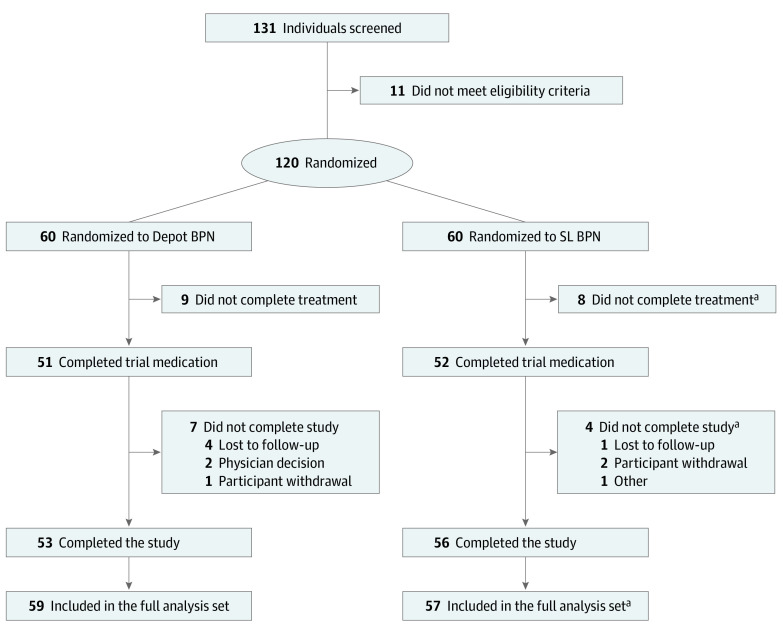
Figure 1.. Trial Flowchart
aOne participant in the SL buprenorphine group was randomized and attended the day 1, week 0 (baseline) visit but discontinued from the trial without receiving treatment and was reported as lost to follow-up. This participant was not included in the largest full analysis set (ie, modified intention-to-treat analysis). Participants could remain in the study after discontinuing trial medication and complete the trial assessments until week 24 for completion of the study. The full analysis set for the primary end point comprised all randomized participants who were administered at least 1 dose of trial medication and had at least 1 postbaseline assessment of the primary outcome efficacy end point.
Figure 2.
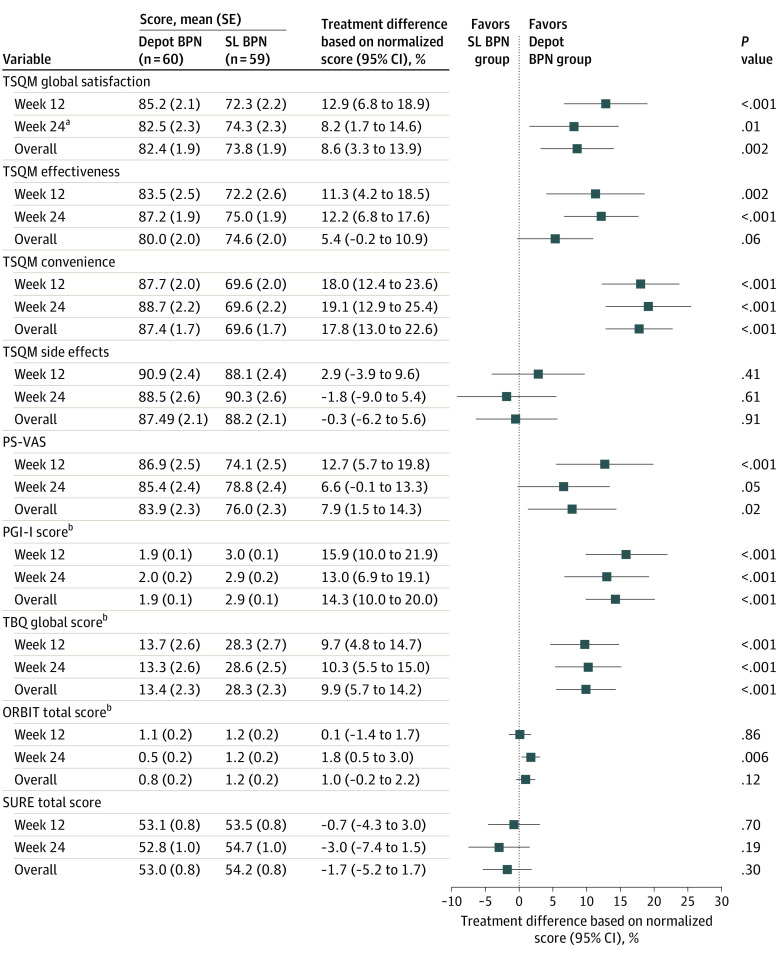
Figure 2.. Overview of Treatment Satisfaction Questionnaire for Medication (TSQM), Patient Satisfaction–Visual Analog Scale (PS-VAS), Patient Global Impression of Improvement (PGI-I), Treatment Burden Questionnaire (TBQ), Opioid-Related Behaviors in Treatment (ORBIT), and Substance Use Recovery Evaluator (SURE) Results
Summary of results from the mixed model for repeated measures, in which the 95% CIs in the forest plot have been normalized by the maximal possible score by instrument to give a range in percentages for ease of comparability. Analysis by week was performed by mixed model for repeated measures and overall by analysis of covariance. aPrimary variable. bThe 95% CIs in the forest plot graph were sign-reversed to achieve comparability.
Figure 3.
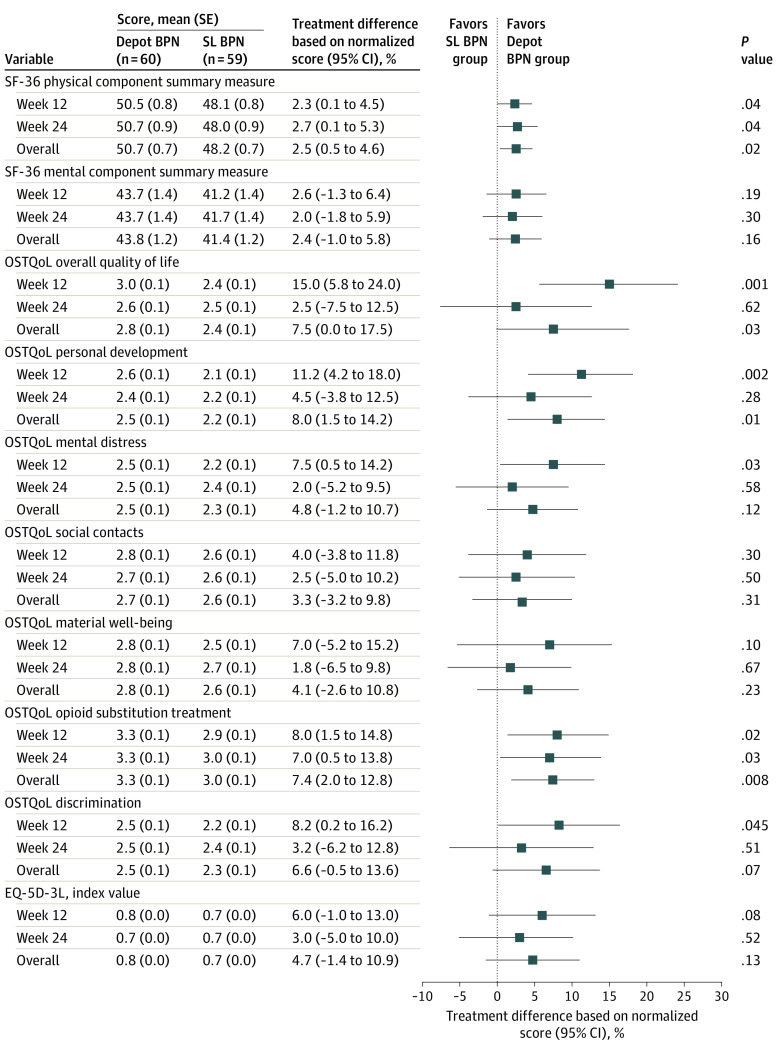
Figure 3.. Overview of 36-Item Health Survey Short Form (SF-36), Opioid Substitution Quality of Life (OSTQoL), and EuroQol 5-Dimensions 3-Levels (EQ-5D-3L) Results
Summary of results from mixed model for repeated measures, in which the 95% CIs in the forest plot have been normalized by the maximal possible score by instrument to give a range in percentages for ease of comparability. Analysis by week was performed by mixed model for repeated measures and overall by analysis of covariance.

Comment in

References

    1. Strang J, Volkow ND, Degenhardt L, et al. . Opioid use disorder. Nat Rev Dis Primers. 2020;6(1):3. doi:10.1038/s41572-019-0137-5 - DOI - PubMed
    1. Degenhardt L, Grebely J, Stone J, et al. . Global patterns of opioid use and dependence: harms to populations, interventions, and future action. Lancet. 2019;394(10208):1560-1579. doi:10.1016/S0140-6736(19)32229-9 - DOI - PMC - PubMed
    1. Blanco C, Volkow ND. Management of opioid use disorder in the USA: present status and future directions. Lancet. 2019;393(10182):1760-1772. doi:10.1016/S0140-6736(18)33078-2 - DOI - PubMed
    1. Volkow ND, Blanco C. Medications for opioid use disorders: clinical and pharmacological considerations. J Clin Invest. 2020;130(1):10-13. doi:10.1172/JCI134708 - DOI - PMC - PubMed
    1. World Health Organization . World Health Organization model list of essential medicines: 21st list 2019. Published 2019. Accessed April 1, 2021. https://apps.who.int/iris/handle/10665/325771

Publication types