


Digital Biomarkers of Cognitive Frailty: The Value of Detailed Gait Assessment Beyond Gait Speed
- PMID: 33971647
- PMCID: PMC8578566
- DOI: 10.1159/000515939
Digital Biomarkers of Cognitive Frailty: The Value of Detailed Gait Assessment Beyond Gait Speed
Abstract
Background: Cognitive frailty (CF), defined as the simultaneous presence of cognitive impairment and physical frailty, is a clinical symptom in early-stage dementia with promise in assessing the risk of dementia. The purpose of this study was to use wearables to determine the most sensitive digital gait biomarkers to identify CF.
Methods: Of 121 older adults (age = 78.9 ± 8.2 years, body mass index = 26.6 ± 5.5 kg/m2) who were evaluated with a comprehensive neurological exam and the Fried frailty criteria, 41 participants (34%) were identified with CF and 80 participants (66%) were identified without CF. Gait performance of participants was assessed under single task (walking without cognitive distraction) and dual task (walking while counting backward from a random number) using a validated wearable platform. Participants walked at habitual speed over a distance of 10 m. A validated algorithm was used to determine steady-state walking. Gait parameters of interest include steady-state gait speed, stride length, gait cycle time, double support, and gait unsteadiness. In addition, speed and stride length were normalized by height.
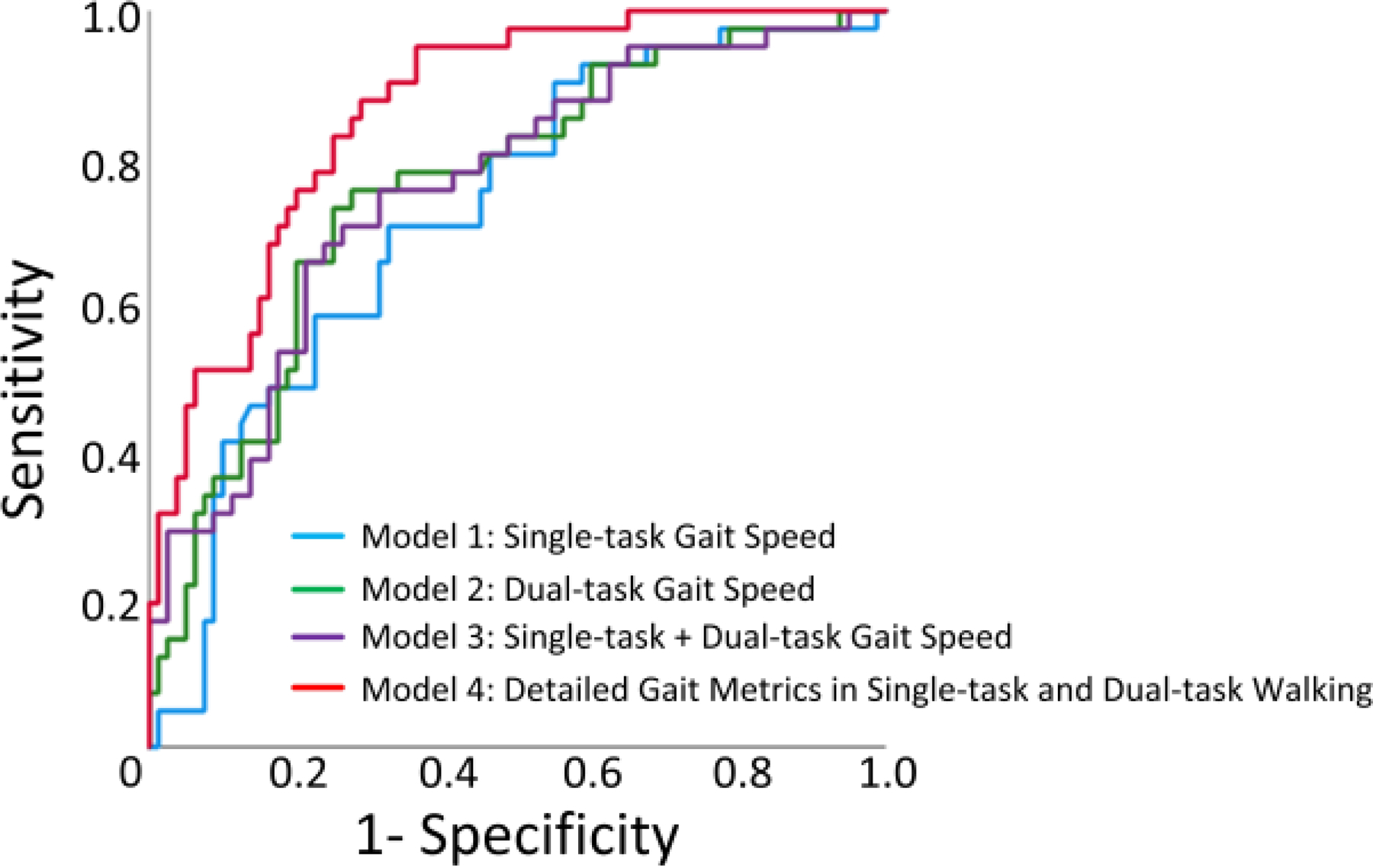
Results: Our results suggest that compared to the group without CF, the CF group had deteriorated gait performances in both single-task and dual-task walking (Cohen's effect size d = 0.42-0.97, p < 0.050). The largest effect size was observed in normalized dual-task gait speed (d = 0.97, p < 0.001). The use of dual-task gait speed improved the area under the curve (AUC) to distinguish CF cases to 0.76 from 0.73 observed for the single-task gait speed. Adding both single-task and dual-task gait speeds did not noticeably change AUC. However, when additional gait parameters such as gait unsteadiness, stride length, and double support were included in the model, AUC was improved to 0.87.
Conclusions: This study suggests that gait performances measured by wearable sensors are potential digital biomarkers of CF among older adults. Dual-task gait and other detailed gait metrics provide value for identifying CF above gait speed alone. Future studies need to examine the potential benefits of gait performances for early diagnosis of CF and/or tracking its severity over time.
Keywords: Alzheimer’s disease; Cognitive decline; Cognitive frailty; Cognitive motoric syndrome; Dementia; Digital biomarker; Digital health; Dual-task walking; Gait; Older adults; Wearable.
© 2021 S. Karger AG, Basel.
Conflict of interest statement
Conflict of Interest Statement
H.Z is now with BioSensics LLC, the company that manufactured the wearable technologies used in this study. H.Z. has however completed the study before joining BioSensics and do not claim any financial conflict of interest relevant to this study.
Statement of Ethics:
All participants signed an approved consent form before participation in this study. This study was approved by the local institutional review boards including Baylor College of Medicine (H-42521) and at the Banner Sun Health Research Institute (1146563).
Figures


References
-
- WHO. World Health Organization. Mental health and older adults 2016.
-
- Kelaiditi E, Cesari M, Canevelli M, van Kan GA, Ousset PJ, Gillette-Guyonnet S, et al. Cognitive frailty: rational and definition from an (I.A.N.A./I.A.G.G.) international consensus group. J Nutr Health Aging 2013. Sep;17(9):726–34. - PubMed
Publication types
MeSH terms
Substances
Grants and funding
LinkOut - more resources
Full Text Sources
Other Literature Sources
