. 2021 May 10;22(1):340.
doi: 10.1186/s13063-021-05295-5.

Accessing routinely collected health data to improve clinical trials: recent experience of access

Affiliations

Accessing routinely collected health data to improve clinical trials: recent experience of access

Archie Macnair et al. Trials. .

Abstract

Background: Routinely collected electronic health records (EHRs) have the potential to enhance randomised controlled trials (RCTs) by facilitating recruitment and follow-up. Despite this, current EHR use is minimal in UK RCTs, in part due to ongoing concerns about the utility (reliability, completeness, accuracy) and accessibility of the data. The aim of this manuscript is to document the process, timelines and challenges of the application process to help improve the service both for the applicants and data holders.

Methods: This is a qualitative paper providing a descriptive narrative from one UK clinical trials unit (MRC CTU at UCL) on the experience of two trial teams' application process to access data from three large English national datasets: National Cancer Registration and Analysis Service (NCRAS), National Institute for Cardiovascular Outcomes Research (NICOR) and NHS Digital to establish themes for discussion. The underpinning reason for applying for the data was to compare EHRs with data collected through case report forms in two RCTs, Add-Aspirin (ISRCTN 74358648) and PATCH (ISRCTN 70406718).

Results: The Add-Aspirin trial, which had a pre-planned embedded sub-study to assess EHR, received data from NCRAS 13 months after the first application. In the PATCH trial, the decision to request data was made whilst the trial was recruiting. The study received data after 8 months from NICOR and 15 months for NHS Digital following final application submission. This concluded in May 2020. Prior to application submission, significant time and effort was needed particularly in relation to the PATCH trial where negotiations over consent and data linkage took many years.

Conclusions: Our experience demonstrates that data access can be a prolonged and complex process. This is compounded if multiple data sources are required for the same project. This needs to be factored in when planning to use EHR within RCTs and is best considered prior to conception of the trial. Data holders and researchers are endeavouring to simplify and streamline the application process so that the potential of EHR can be realised for clinical trials.

Keywords: Clinical trials; Data accessibility; Electronic health records; Routinely collected data.


Conflict of interest statement

All authors have completed the ICMJE uniform disclosure form at www.icmje.org/coi_disclosure.pdf and declare no support from any organisation for the submitted work; however, MS reports grants from Health Data Research UK, during the conduct of the study; personal fees from Lilly Oncology; personal fees from Janssen; grants and non-financial support from Astellas; grants and non-financial support from Clovis Oncology; grants and non-financial support from Janssen; grants and non-financial support from Novartis; grants and non-financial support from Pfizer; and grants and non-financial support from Sanofi-Aventis, outside the submitted work; FC reports receipt of research grants for the Add-Aspirin trial from Cancer Research UK and the National Institute of Health Research, as well as study drug provision from Bayer Pharmaceuticals. REL reports grants from Cancer Research UK; grants from UK Medical Research Council, during the conduct of the study; and personal fees from Aspirin Foundation, outside the submitted work.

Figures

Fig. 1
Fig. 1
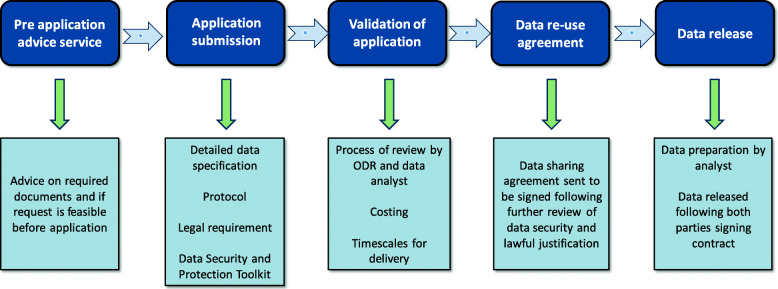
Flow diagram of data access via the Office for Data Release (ODR) for National Cancer Registration and Analysis Service (NCRAS) data, adapted from Public Health England (PHE) [14]
Fig. 2
Fig. 2
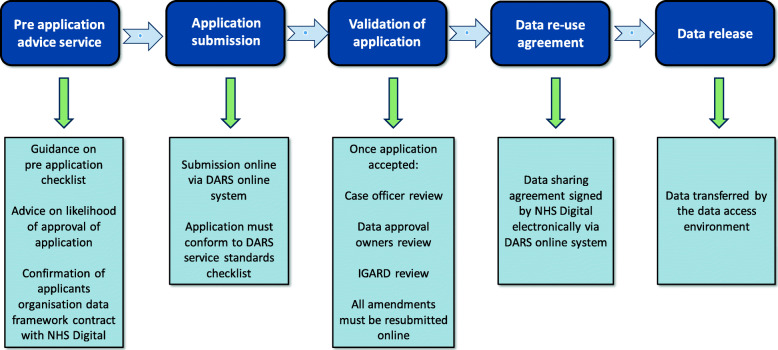
Flow diagram of the Data Access Request Service (DARS) for NHS Digital data, adapted from NHS Digital [17]. IGARD, Independent Group Advising on the Release of Data
Fig. 3
Fig. 3
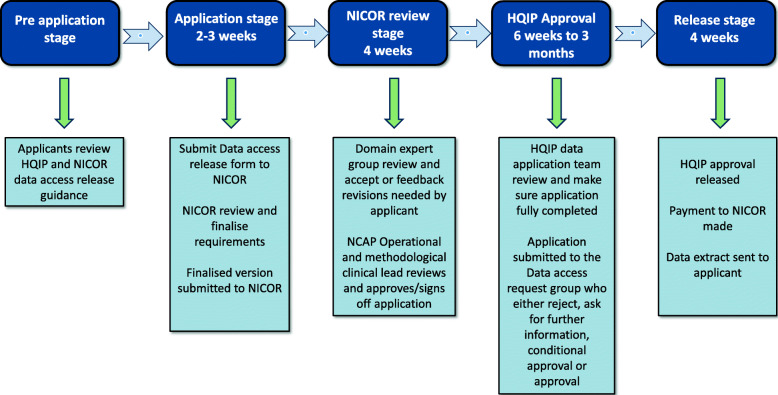
Data access request for access to National Institute for Cardiovascular Outcomes Research (NICOR) data adapted from [18]. HQIP, Health Quality Improvement Partnership; NCAP, National Cardiac Audit Programme
Fig. 4
Fig. 4
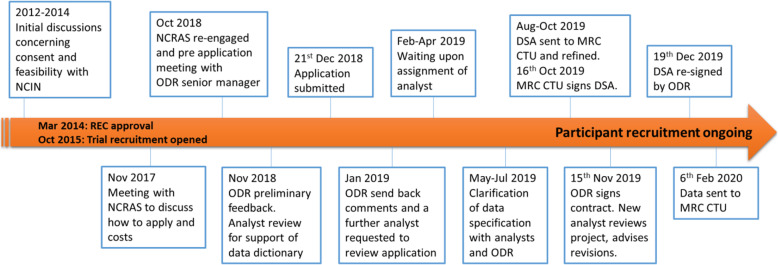
Flow diagram of the Add-Aspirin National Cancer Registration and Analysis Service (NCRAS) application. (Please note that timeline is not proportional) REC approval for Add-Aspirin March 2014. Recruitment opened in October 2015 and is ongoing. CTU, clinical trials unit; DSA, data sharing agreement; NCIN, National Cancer Intelligence Network; ODR, Office for Data Release; REC, Research Ethics Committee
Fig. 5
Fig. 5
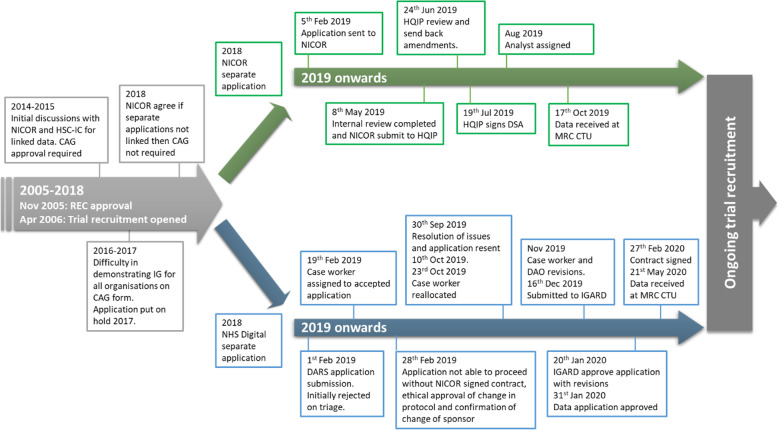
Flow diagram of the PATCH joint application to NHS Digital and National Institute for Cardiovascular Outcomes Research (NICOR) and subsequently handled as separate applications in 2018. (Please note that timeline is not proportional) REC approval for PATCH November 2005. Recruitment opened in April 2006 and is ongoing. CAG, Confidentiality Advisory Group; DAO, data approvals officer; DARS, Data Access Request Service; HQIP, Health Quality Improvement Partnership; HSC-IC, Health and Social Care Information Centre; IGARD, Independent Group Advising on the Release of Data; REC, Research Ethics Committee

References

    1. Lauer MS, D’Agostino RB. The randomized registry trial — the next disruptive technology in clinical research? New Engl J Med. 2013;369(17):1579–1581. doi: 10.1056/NEJMp1310102. - DOI - PubMed
    1. Mc Cord KA, Al-Shahi Salman R, Treweek S, Gardner H, Strech D, Whiteley W, et al. Routinely collected data for randomized trials: promises, barriers, and implications. Trials. 2018;19(1):29. doi: 10.1186/s13063-017-2394-5. - DOI - PMC - PubMed
    1. Appleyard SE, Gilbert DC. Innovative solutions for clinical trial follow-up: adding value from nationally held UK data. Clin Oncol. 2017;29(12):789–795. doi: 10.1016/j.clon.2017.10.003. - DOI - PubMed
    1. Lagerqvist B, Fröbert O, Olivecrona GK, Gudnason T, Maeng M, Alström P, Andersson J, Calais F, Carlsson J, Collste O, Götberg M, Hårdhammar P, Ioanes D, Kallryd A, Linder R, Lundin A, Odenstedt J, Omerovic E, Puskar V, Tödt T, Zelleroth E, Östlund O, James SK. Outcomes 1 year after thrombus aspiration for myocardial infarction. New Engl J Med. 2014;371(12):1111–1120. doi: 10.1056/NEJMoa1405707. - DOI - PubMed
    1. Shore BJ, Nasreddine AY, Kocher MS. Overcoming the funding challenge: the cost of randomized controlled trials in the next decade. JBJS. 2012;94(Supplement_1):101–106. doi: 10.2106/JBJS.L.00193. - DOI - PubMed

LinkOut - more resources