Review
. 2021 Jun;42(6):536-550.
doi: 10.1016/j.it.2021.04.006. Epub 2021 May 8.

Cytokine-skewed Tfh cells: functional consequences for B cell help

Affiliations
Review

Cytokine-skewed Tfh cells: functional consequences for B cell help

Adesola C Olatunde et al. Trends Immunol. 2021 Jun.

Abstract

CD4+ follicular helper T (Tfh) cells play a vital role in providing help for B cells undergoing selection and differentiation into activated antibody-secreting cells in mammalian germinal centers (GCs). Increasing evidence suggests that Tfh cells are a heterogeneous population that generates cytokine-skewed immune responses - a reflection of the microenvironment during differentiation. This has important ramifications for Tfh-mediated B cell help. Because Tfh subsets can have opposing effects on GC B cell responses, we discuss current findings regarding the differentiation and functions of cytokine-skewed Tfh cells in modulating GC B cell differentiation. Antibodies are important weapons against infectious diseases but can also be pathogenic mediators in some autoimmune conditions. Since cytokine-skewed Tfh cells can influence the magnitude and quality of the humoral response, we address the roles of cytokine-skewed Tfh cells in disease.


Conflict of interest statement

Declaration of interests The authors declare no conflicts of interest.

Figures
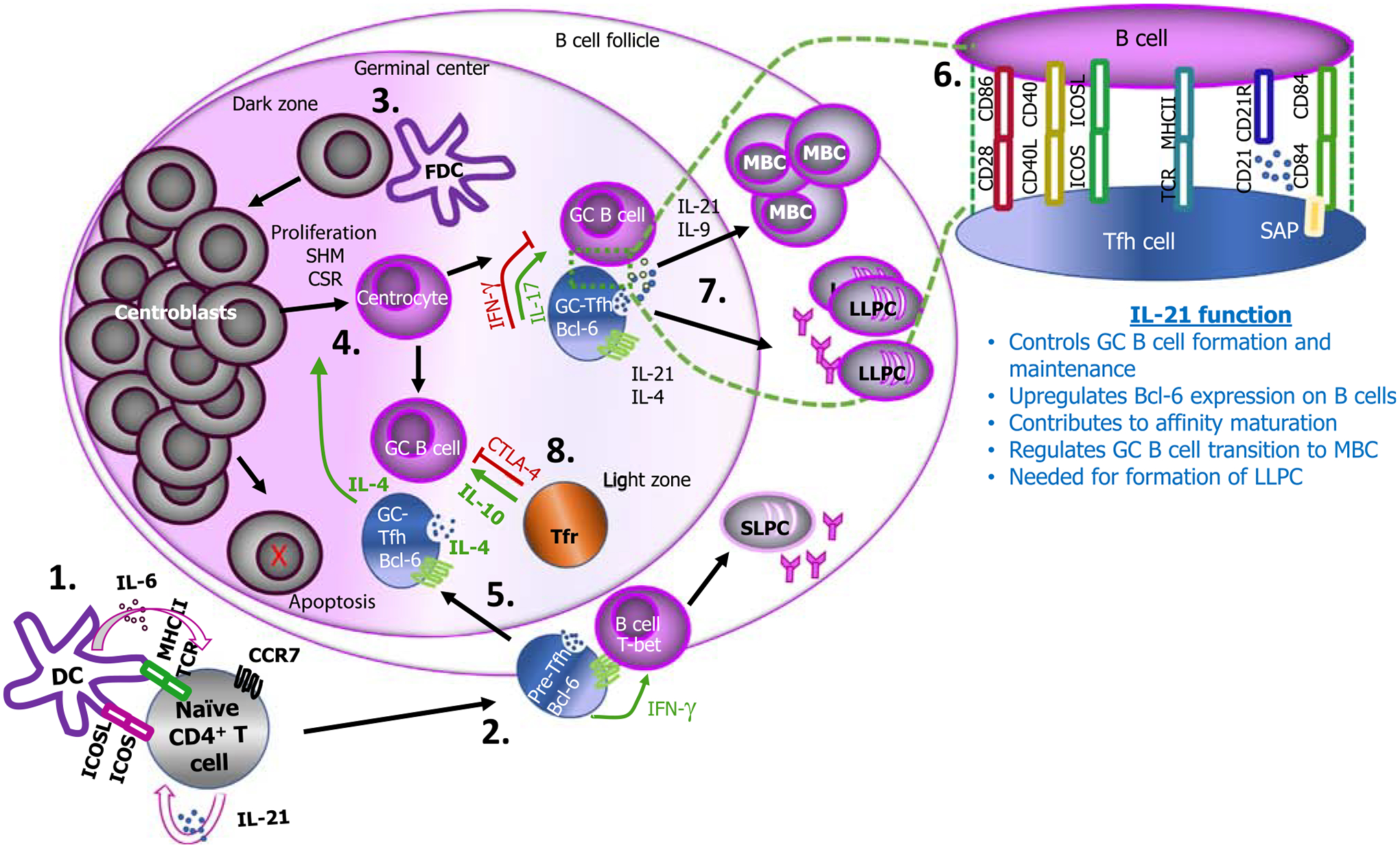
Figure 1.
Figure 1.. T follicular helper (Tfh) cell roles in mammalian B cell differentiation.
Dendritic cells (DCs) induce initial priming of naïve CD4+ T cells in the presence of interleukin (IL)-6 and through inducible T cell co-stimulator (ICOS)/ICOS-L (ligand) interactions. This process is accompanied by antigen recognition through peptide-loaded MHC-II on DCs and differentiation of T cells into pre-Tfh cells, characterized by upregulation of B cell lymphoma 6 protein (Bcl-6) and C-X-C chemokine receptor 5 (CXCR5), while downregulating CCR7 (1). Autocrine signaling of IL-21 on Tfh cells enhances their development and maintenance. Expression of CXCR5 enables Tfh cells to migrate to B cell follicles where they interact with B cells, leading to B cell differentiation into short-lived extrafollicular plasma cells (SLPCs) (2). Follicular dendritic cells (FDCs) interact with follicular B cells, and this allows B cells to migrate to the dark zone where they differentiate into centroblasts (3). Centroblasts undergo somatic hypermutation (SHM), class-switch recombination (CSR), and proliferation, and subsequently migrate to the light zone to form centrocytes (4). In addition, IL-4 produced by Tfh cells may mediate centrocyte differentiation. B cell clones in the dark zone with low affinity or that are autoreactive can undergo additional SHM or die because of apoptosis. The cognate interaction between pre-Tfh cell and B cells allows full differentiation of Tfh cells, and these migrate to the GC (5) where they provide help to B cells activated by FDCs via cytokines that in some cases may include IL-17. CD28/CD86, CD40L/CD40, ICOS/ICOS-L, TCR/MHCII, CD21/CD21R, and SAP-associated receptor (CD84)/CD84, mediate cognate interactions between T and B cells (6). This GC reaction between Tfh and B cells results in memory B cell (MBC) and long-lived plasma cell (LLPC) formation supported by IL21, IL-9, and IL-4 (7). Regulatory T follicular (Tfr) cells can suppress T–B cell interactions through cytotoxic T lymphocyte-associated protein 4 (CTLA-4) but enhance B cell maturation via IL-10 (8). Arrows in green signify a positive signal for B cell maturation; arrows in red signify a negative signal.
Figure 2.
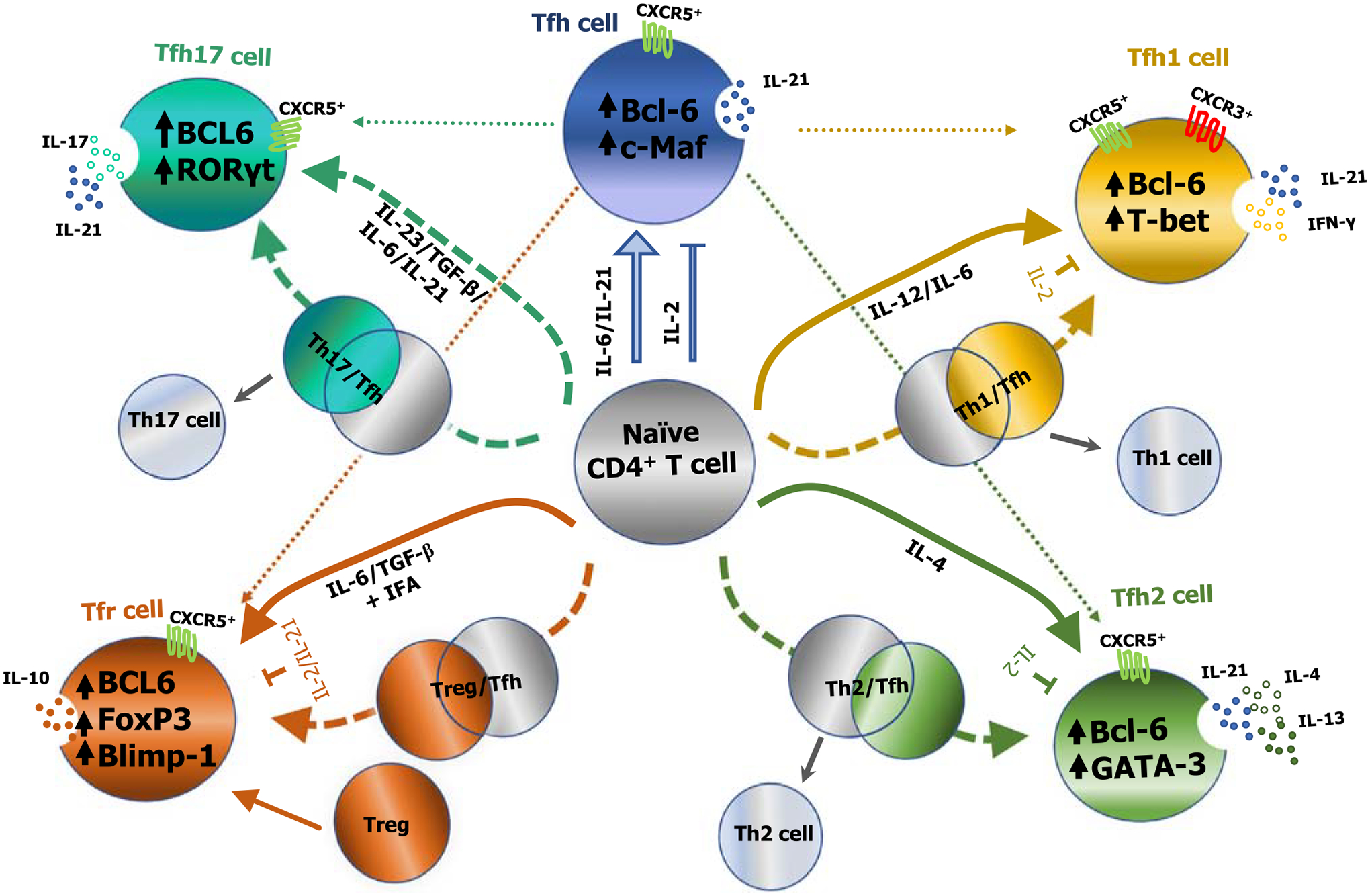
Figure 2.. Proposed models for the differentiation of cytokine-skewed T follicular helper (Tfh) cell subsets in mice and humans.
A schematic representation of the differentiation of cytokine-skewed Tfh cells from naïve CD4+ T cells is shown. External stimuli including the cytokine milieu, as well as intrinsic factors such as lineage-specific transcription factors (TFs), induce the differentiation of naïve CD4+ T cells into subsets of cytokine-skewed Tfh cell subsets. Polarizing cytokines can induce Tfh cells to coexpress transcriptional programming that is typical of other CD4+ helper T cells, in addition to Bcl-6 that is typically expressed by Tfh cells. It is possible that a partial ‘hybrid’ [T helper (Th)1/Tfh, Th2/Tfh, Th17/Tfh, and T regulatory cell (Treg)/Tfh] state occurs before maturing into different cytokine-skewed germinal center (GC)-Tfh cells. In view of this, Tfh cells can produce limited quantities of canonical cytokines that have been used to identify other T helper subsets, in addition to interleukin (IL)-21, typically associated with classical Tfh cells. The majority of T follicular regulatory (Tfr) cells arise via differentiation from infiltrating Tregs, although some also differentiate from naïve CD4+ T cells. Broken lines indicate hypothesized differentiation pathways for cytokine-skewed Tfh subsets [12]. Abbreviations: Bcl-6, B cell lymphoma-6; Blimp-1, B lymphocyte-induced maturation protein-1; c-Maf, c-musculoaponeurotic fibrosarcoma oncogene homolog; CXCR5, C-X-C chemokine receptor 5; FoxP3, forkhead box protein 3; GATA-3, GATA-binding protein 3; IFN-γ, interferon γ; RORγt, RAR-related orphan receptor γ; T-bet, T-box expressed in T cells; Tfh1, Th1-like Tfh cells; Tfh2, Th2-like Tfh cells; Tfh17, Th17-like Tfh cells.
Figure 3.
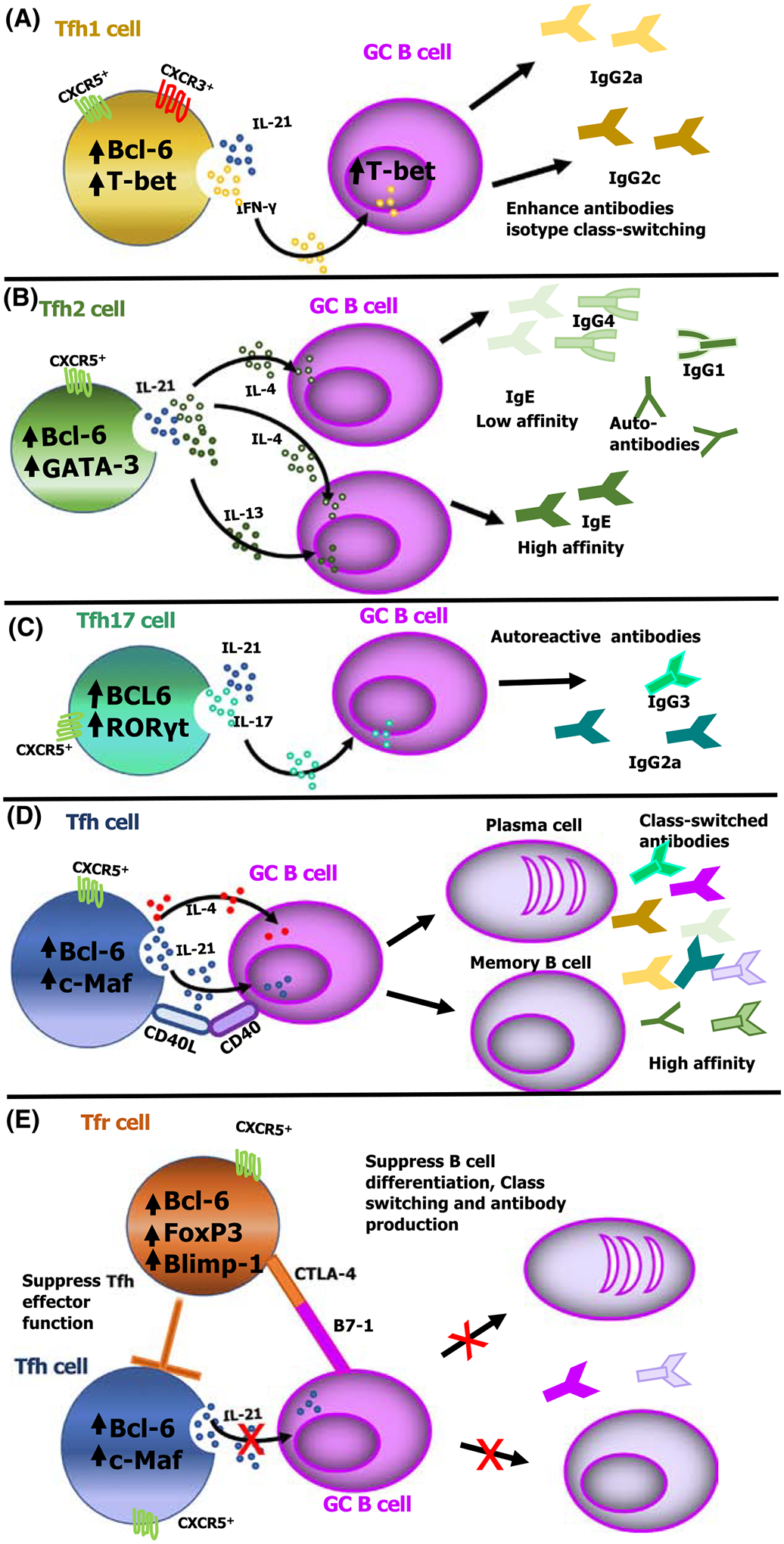
Figure 3.. Cytokine-skewed T follicular helper (Tfh) cell subsets may play varied roles in modulating antibody isotype class switching and affinity maturation in both mice and humans.
(A) Interferon (IFN)-γ produced by Th1-like Tfh (Tfh1) cells induces the expression of T-box expressed in T cells (T-bet) on B cells that promotes IgG2a isotype class switching in response to lymphocytic choriomeningitis virus (LCMV) or Zika viral infection and IgG2c isotype class switching in response to Plasmodium parasites, albeit by limiting the overall germinal center (GC) B cell response [73,75,78]. (B) Cytokines secreted from Th2-like Tfh (Tfh2) cells influence the affinity of the antibody produced, where IL-4 from Tfh2 cells promotes low-affinity IgG1 and IgE, whereas coproduction of interleukin (IL)-4 and IL-13 induces high-affinity IgE. (C) IL-17 is produced by Th17-like Tfh (Tfh17) cells that induce antibody isotype class switching to IgG2a and IgG3, and induction of autoreactive antibodies. (D) Conventional Tfh cells produce effector molecules such as IL-21 and IL-4 that induce B cell differentiation into plasma and memory B cells. (E) T follicular regulatory (Tfr) cells mediate regulatory functions by expressing cytotoxic T-lymphocyte-associated protein 4 (CTLA-4), a coinhibitory receptor that interacts with B7–1/B7–2 on B cells, resulting in direct suppression of IL-21 production by Tfh cells, and disrupting cognate interactions between Tfh and B cells. This suppressive function of Tfr cells on either B or Tfh cells subsequently limits B cell differentiation into memory or plasma cells [57,124]. Abbreviations: Bcl-6, B cell lymphoma 6 protein; c-Maf, cellular musculoaponeurotic fibrosarcoma oncogene homolog; CXCR, C-X-C chemokine receptor; GATA-3, GATA-binding protein 3; RORγt, RAR-related orphan receptor γ.

References

    1. Oracki SA et al. (2010) Plasma cell development and survival. Immunol. Rev 237, 140–159 - PubMed
    1. Lee SK et al. (2011) B cell priming for extrafollicular antibody responses requires Bcl-6 expression by T cells. J. Exp. Med 208, 1377–1388 - PMC - PubMed
    1. Zotos D et al. (2010) IL-21 regulates germinal center B cell differentiation and proliferation through a B cell-intrinsic mechanism. J. Exp. Med 207, 365–378 - PMC - PubMed
    1. Kim CH et al. (2001) Subspecialization of CXCR5+ T cells: B helper activity is focused in a germinal center–localized subset of CXCR5+ T cells. J. Exp. Med 193, 1373–1382 - PMC - PubMed
    1. Haynes NM et al. (2007) Role of CXCR5 and CCR7 in follicular Th cell positioning and appearance of a programmed cell death gene-1high germinal center-associated subpopulation. J. Immunol 179, 5099–5108 - PubMed

Publication types