


Epidemiology of Carbapenem Resistance Determinants Identified in Meropenem-Nonsusceptible Enterobacterales Collected as Part of a Global Surveillance Program, 2012 to 2017
- PMID: 33972241
- PMCID: PMC8218680
- DOI: 10.1128/AAC.02000-20
Epidemiology of Carbapenem Resistance Determinants Identified in Meropenem-Nonsusceptible Enterobacterales Collected as Part of a Global Surveillance Program, 2012 to 2017
Abstract
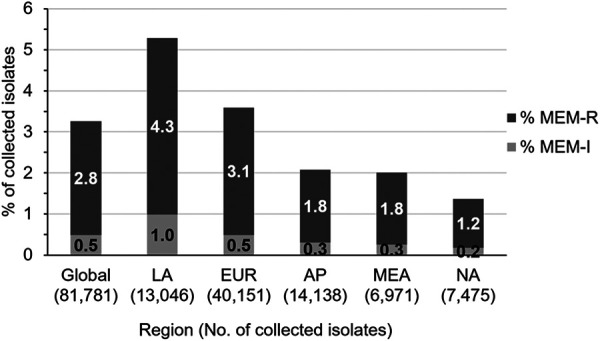
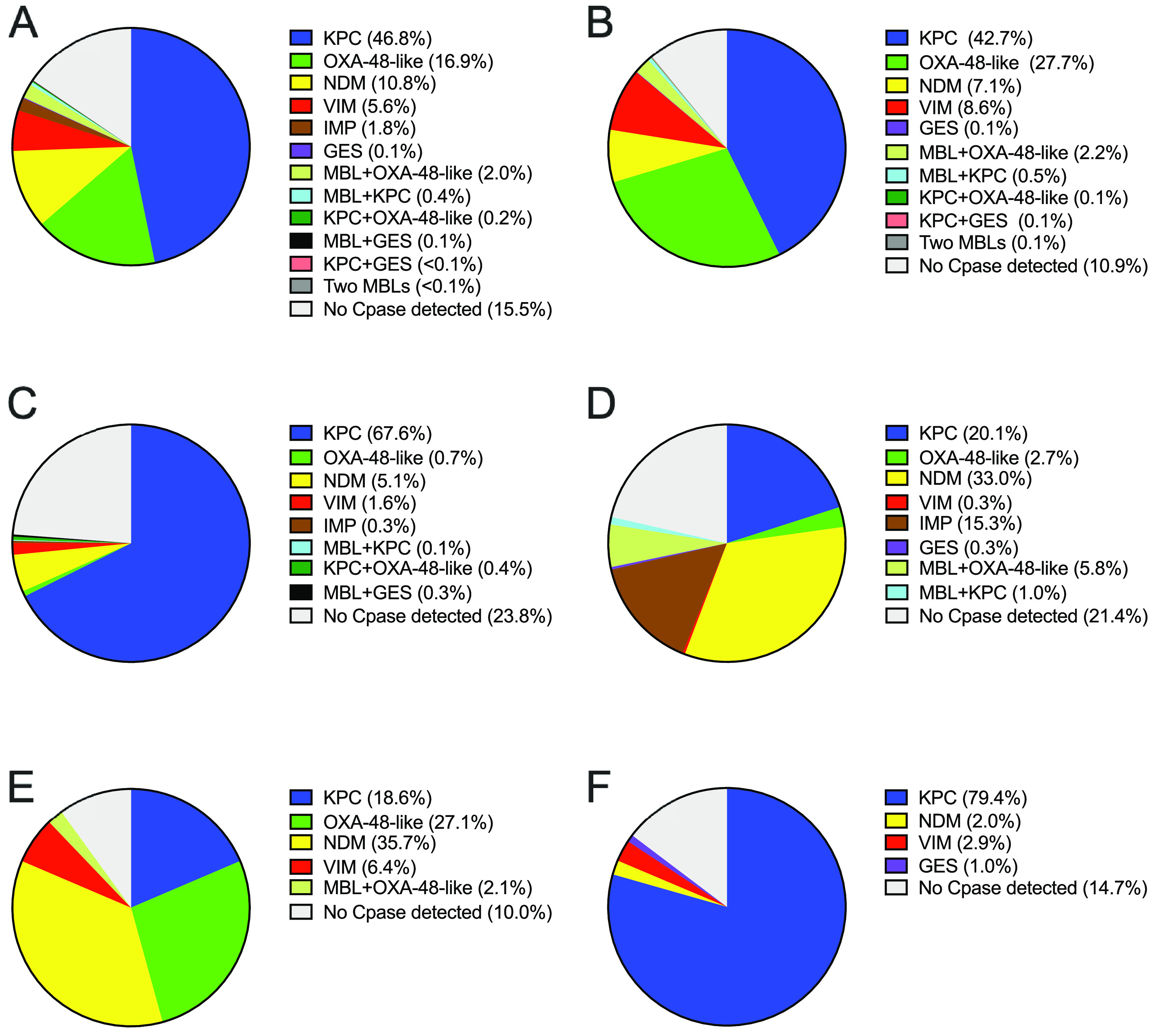
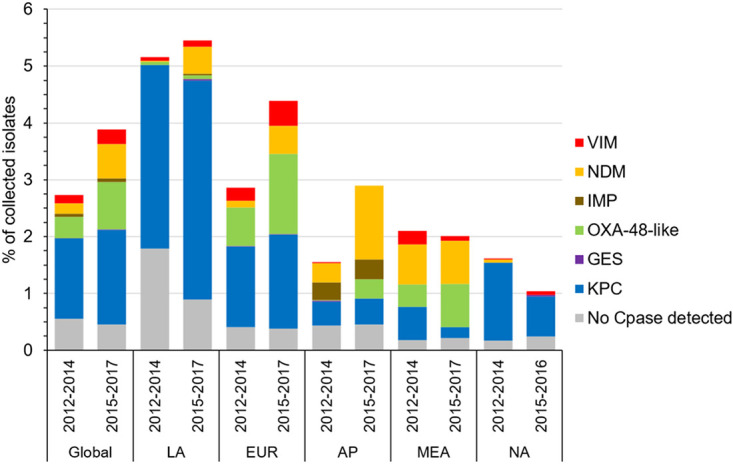
To estimate the incidence of carbapenem-resistant Enterobacterales (CRE), a global collection of 81,781 surveillance isolates of Enterobacterales collected from patients in 39 countries in five geographic regions from 2012 to 2017 was studied. Overall, 3.3% of isolates were meropenem-nonsusceptible (MIC ≥2 μg/ml), ranging from 1.4% (North America) to 5.3% (Latin America) of isolates by region. Klebsiella pneumoniae accounted for the largest number of meropenem-nonsusceptible isolates (76.7%). The majority of meropenem-nonsusceptible Enterobacterales carried KPC-type carbapenemases (47.4%), metallo-β-lactamases (MBLs; 20.6%) or OXA-48-like β-lactamases (19.0%). Forty-three carbapenemase sequence variants (8 KPC-type, 4 GES-type, 7 OXA-48-like, 5 NDM-type, 7 IMP-type, and 12 VIM-type) were detected, with KPC-2, KPC-3, OXA-48, NDM-1, IMP-4, and VIM-1 identified as the most common variants of each carbapenemase type. The resistance mechanisms responsible for meropenem-nonsusceptibility varied by region. A total of 67.3% of all carbapenemase-positive isolates identified carried at least one additional plasmid-mediated or intrinsic chromosomally encoded extended-spectrum β-lactamase, AmpC β-lactamase, or carbapenemase. The overall percentage of meropenem-nonsusceptible Enterobacterales increased from 2.7% in 2012 to 2014 to 3.8% in 2015 to 2017. This increase could be attributed to the increasing proportion of carbapenemase-positive isolates that was observed, most notably among isolates carrying NDM-type MBLs in Asia/South Pacific, Europe, and Latin America; OXA-48-like carbapenemases in Europe, Middle East/Africa, and Asia/South Pacific; VIM-type MBLs in Europe; and KPC-type carbapenemases in Latin America. Ongoing CRE surveillance combined with a global antimicrobial stewardship strategy, sensitive clinical laboratory detection methods, and adherence to infection control practices will be needed to interrupt the spread of CRE.
Keywords: Enterobacterales; carbapenem resistant; carbapenem-resistant Enterobacterales; surveillance.
Figures
References
-
- Canton R, Akova M, Carmeli Y, Giske CG, Glupczynski Y, Gniadkowski M, Livermore DM, Miriagou V, Naas T, Rossolini GM, Samuelsen O, Seifert H, Woodford N, Nordmann P, The European Network on Carbapenemases. 2012. Rapid evolution and spread of carbapenemases among Enterobacteriaceae in Europe. Clin Microbiol Infect 18:413–431. 10.1111/j.1469-0691.2012.03821.x. - DOI - PubMed
Publication types
MeSH terms
Substances
LinkOut - more resources
Full Text Sources
Other Literature Sources
Medical
Miscellaneous
