


Evaluating quality in adolescent mental health services: a systematic review
- PMID: 33972340
- PMCID: PMC8112446
- DOI: 10.1136/bmjopen-2020-044929
Evaluating quality in adolescent mental health services: a systematic review
Abstract
Objectives: To evaluate the quality of adolescent mental health service provision globally, according to the WHO Global Standards of adolescent mental health literacy, appropriate package of services and provider competencies.
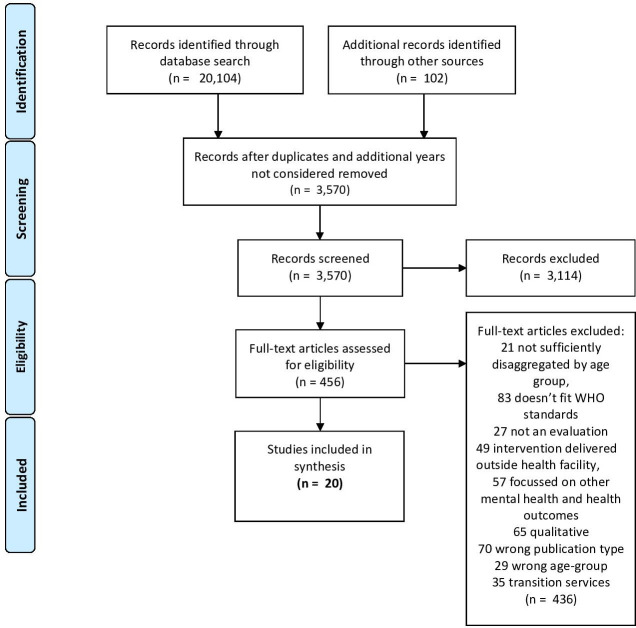
Design and data sources: Systematic review of 5 databases, and screening of eligible articles, from 1 January 2008 to 31 December 2020.
Study eligibility criteria: We focused on quantitative and mixed-method studies that evaluated adolescent mental health literacy, appropriate package of services and provider competencies in mental health services, and that targeted depression, anxiety and post-traumatic stress disorder among adolescents (10-19 years). This included adolescents exposed to interventions or strategies within mental health services.
Study appraisal and synthesis methods: Study quality was assessed using the National Institutes for Health Study Quality Assessment Tools. Data were extracted and grouped based on WHO quality Standards.
Results: Of the 20 104 studies identified, 20 articles were included. The majority of studies came from high-income countries, with one from a low-income country. Most of the studies did not conceptualise quality. Results found that an online decision aid was evaluated to increase adolescent mental health literacy. Studies that targeted an appropriate package of services evaluated the quality of engagement between the therapist and adolescent, patient-centred communication, mental health service use, linkages to mental health services, health facility culture and intensive community treatment. Provider competencies focused on studies that evaluated confidence in managing and referring adolescents, collaboration between health facility levels, evidence-based practices and technology use.
Conclusions and implications: There is limited evidence on quality measures in adolescent mental health services (as conforms to the WHO Global Standards), pointing to a global evidence gap for adolescent mental health services. There are several challenges to overcome, including a need to develop consensus on quality and methods to measure quality in mental health settings.
Prospero registration number: CRD42020161318.
Keywords: child & adolescent psychiatry; international health services; mental health; quality in health care.
© Author(s) (or their employer(s)) 2021. Re-use permitted under CC BY-NC. No commercial re-use. See rights and permissions. Published by BMJ.
Conflict of interest statement
Competing interests: None declared.
References
-
- WHO . Health for the world’s adolescents: A second chance in the second decade. Geneva: World Health Organization, 2014.
Publication types
MeSH terms
LinkOut - more resources
Full Text Sources
Other Literature Sources
Medical
Miscellaneous
