


CYK-1/Formin activation in cortical RhoA signaling centers promotes organismal left-right symmetry breaking
- PMID: 33972425
- PMCID: PMC8157923
- DOI: 10.1073/pnas.2021814118
CYK-1/Formin activation in cortical RhoA signaling centers promotes organismal left-right symmetry breaking
Abstract
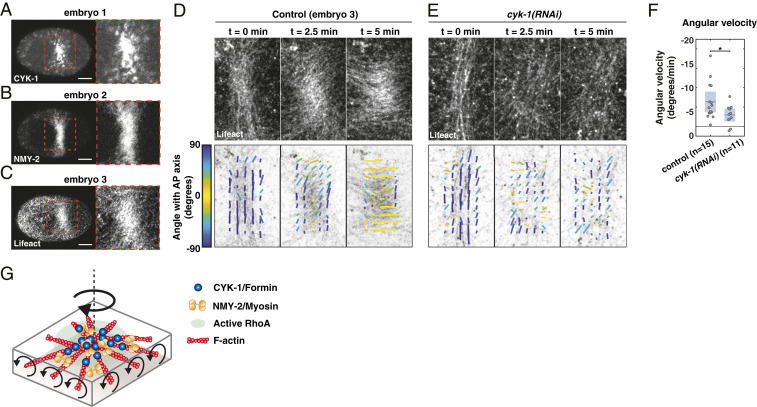
Proper left-right symmetry breaking is essential for animal development, and in many cases, this process is actomyosin-dependent. In Caenorhabditis elegans embryos active torque generation in the actomyosin layer promotes left-right symmetry breaking by driving chiral counterrotating cortical flows. While both Formins and Myosins have been implicated in left-right symmetry breaking and both can rotate actin filaments in vitro, it remains unclear whether active torques in the actomyosin cortex are generated by Formins, Myosins, or both. We combined the strength of C. elegans genetics with quantitative imaging and thin film, chiral active fluid theory to show that, while Non-Muscle Myosin II activity drives cortical actomyosin flows, it is permissive for chiral counterrotation and dispensable for chiral symmetry breaking of cortical flows. Instead, we find that CYK-1/Formin activation in RhoA foci is instructive for chiral counterrotation and promotes in-plane, active torque generation in the actomyosin cortex. Notably, we observe that artificially generated large active RhoA patches undergo rotations with consistent handedness in a CYK-1/Formin-dependent manner. Altogether, we conclude that CYK-1/Formin-dependent active torque generation facilitates chiral symmetry breaking of actomyosin flows and drives organismal left-right symmetry breaking in the nematode worm.
Keywords: C. elegans; Formin; RhoA signaling; left–right asymmetry.
Copyright © 2021 the Author(s). Published by PNAS.
Conflict of interest statement
The authors declare no competing interest.
Figures
References
-
- Brown N. A., Wolpert L., The development of handedness in left/right asymmetry. Development 109, 1–9 (1990). - PubMed
-
- Géminard C., González-Morales N., Coutelis J. B., Noselli S., The myosin ID pathway and left-right asymmetry in Drosophila. Genesis 52, 471–480 (2014). - PubMed
-
- Hozumi S., et al. , An unconventional myosin in Drosophila reverses the default handedness in visceral organs. Nature 440, 798–802 (2006). - PubMed
Publication types
MeSH terms
Substances
LinkOut - more resources
Full Text Sources
Other Literature Sources
