


Differential effects of alkaloids on memory in rodents
- PMID: 33972592
- PMCID: PMC8110766
- DOI: 10.1038/s41598-021-89245-w
Differential effects of alkaloids on memory in rodents
Abstract
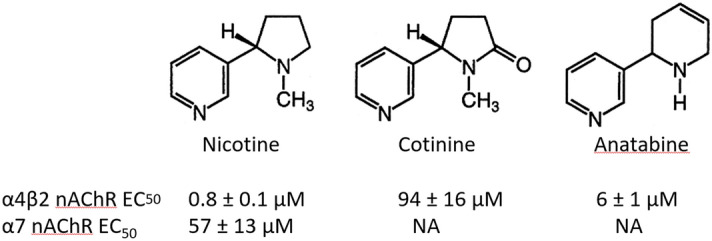
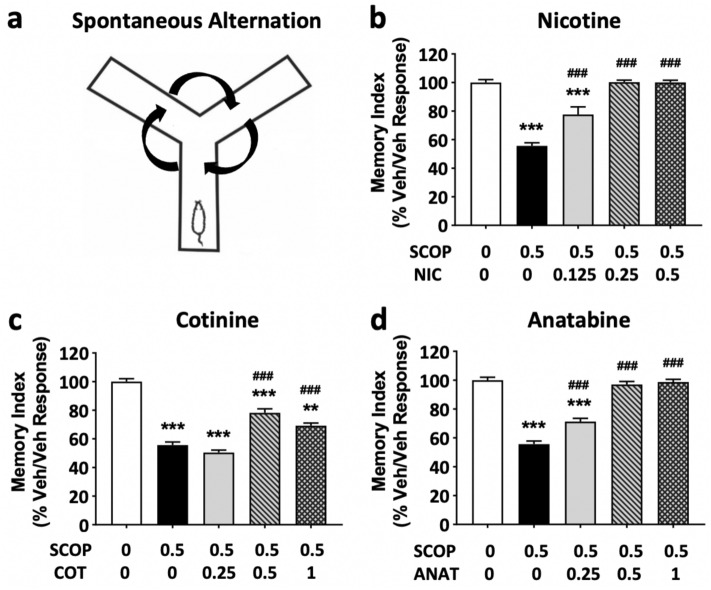
Nicotinic acetylcholine receptors (nAChRs) play a critical role in the neuropharmacology of learning and memory. As such, naturally occurring alkaloids that regulate nAChR activity have gained interest for understanding and potentially improving memory function. In this study, we tested the acute effects of three known nicotinic alkaloids, nicotine, cotinine, and anatabine, in suppressing scopolamine-induced memory deficit in rodents by using two classic memory paradigms, Y-maze and novel object recognition (NOR) in mice and rats, respectively. We found that all compounds were able to suppress scopolamine-induced spatial memory deficit in the Y-maze spontaneous alternation paradigm. However, only nicotine was able to suppress the short-term object memory deficit in NOR, despite the higher doses of cotinine and anatabine used to account for their potential differences in nAChR activity. These results indicate that cotinine and anatabine can uniquely regulate short-term spatial memory, while nicotine seems to have more robust and general role in memory regulation in rodents. Thus, nAChR-activating alkaloids may possess distinct procognitive properties in rodents, depending on the memory types examined.
Conflict of interest statement
M.P., J.H., & K.K. are employed by Philip Morris International. P.C. and A.T. are employed by PBTLI and Medical College of Georgia, Augusta University. Philip Morris International employed PBTLI’s service for NOR experiment and Amylgen’s service for Y-maze experiment. This work was funded solely by Philip Morris International.
Figures

References
Publication types
MeSH terms
Substances
LinkOut - more resources
Full Text Sources
Other Literature Sources
Medical
Research Materials
