


Effects of cadmium stress on growth and physiological characteristics of sassafras seedlings
- PMID: 33972641
- PMCID: PMC8110755
- DOI: 10.1038/s41598-021-89322-0
Effects of cadmium stress on growth and physiological characteristics of sassafras seedlings
Abstract
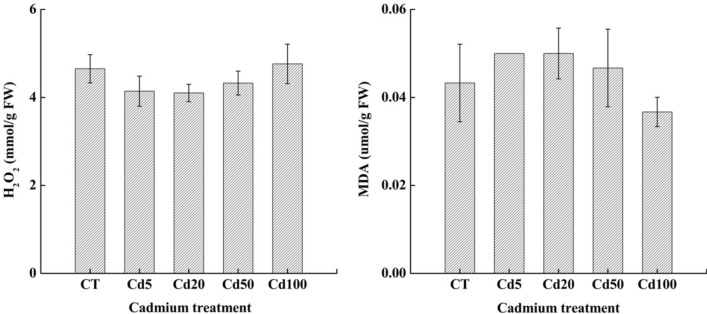
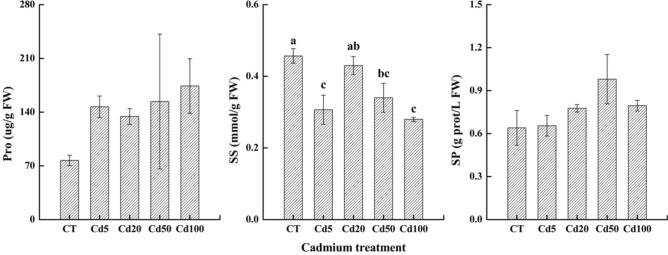
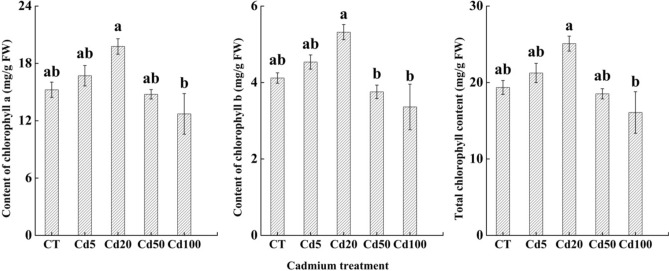
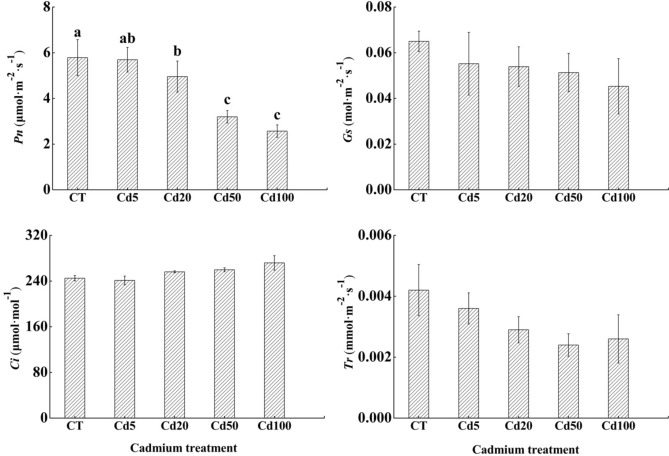
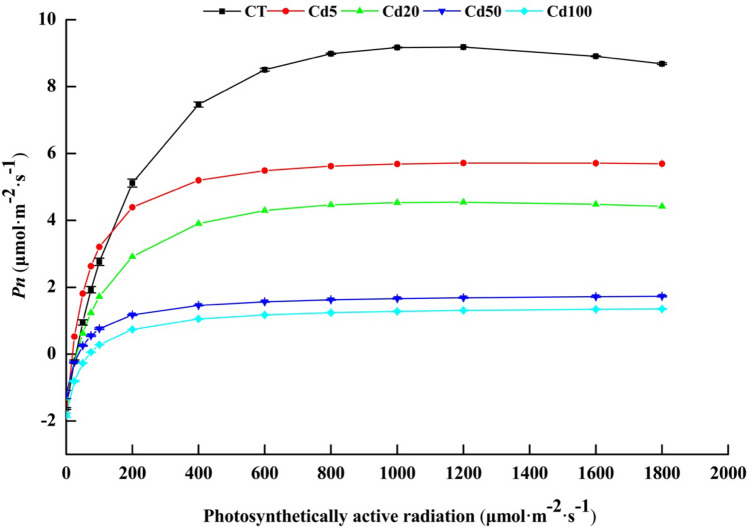
The effects of cadmium stress on the growth and physiological characteristics of Sassafras tzumu Hemsl. were studied in pot experiments. Five Cd levels were tested [CT(Control Treatment) : 0 mg/kg, Cd5: 5 mg/kg, Cd20: 20 mg/kg, Cd50: 50 mg/kg, and Cd100: 100 mg/kg]. The growth and physiological characteristics of the sassafras seedlings in each level were measured. The results showed that soil Cd had negative influences on sassafras growth and reduced the net growth of plant height and the biomass of leaf, branch and root. Significant reductions were recorded in root biomass by 18.18%(Cd5), 27.35%(Cd20), 27.57%(Cd50) and 28.95%(Cd100). The contents of hydrogen peroxide decreased first then increased while malondialdehyde showed the opposite trend with increasing cadmium concentration. Decreases were found in hydrogen peroxide contents by 10.96%(Cd5), 11.82%(Cd20) and 7.02%(Cd50); increases were found in malondialdehyde contents by 15.47%(Cd5), 16.07%(Cd20) and 7.85%(Cd50), indicating that cadmium stress had a certain effect on the peroxidation of the inner cell membranes in the seedlings that resulted in damage to the cell membrane structure. Superoxide dismutase activity decreased among treatments by 17.05%(Cd5), 10,68%(Cd20), 20.85%(Cd50) and 8.91%(Cd100), while peroxidase activity increased steadily with increasing cadmium concentration; these results suggest that peroxidase is likely the main protective enzyme involved in the reactive oxygen removal system in sassafras seedlings. Upward trends were observed in proline content by 90.76%(Cd5), 74.36%(Cd20), 99.73%(Cd50) and 126.01%(Cd100). The increase in proline content with increasing cadmium concentration indicated that cadmium stress induced proline synthesis to resist osmotic stress in the seedlings. Compared to that in CT, the soluble sugar content declined under the different treatments by 32.84%(Cd5), 5.85%(Cd20), 25.55%(Cd50) and 38.69%(Cd100). Increases were observed in the soluble protein content by 2.34%(Cd5), 21.36%(Cd20), 53.15%(Cd50) and 24.22%(Cd100). At different levels of cadmium stress, the chlorophyll content in the seedlings first increased and then decreased, and it was higher in the Cd5 and Cd20 treatments than that in the CT treatment. These results reflected that cadmium had photosynthesis-promoting effects at low concentrations and photosynthesis-suppressing effects at high concentrations. The photosynthetic gas exchange parameters and photosynthetic light-response parameters showed downward trends with increasing cadmium concentration compared with those in CT; these results reflected the negative effects of cadmium stress on photosynthesis in sassafras seedlings.
Conflict of interest statement
The authors declare no competing interests.
Figures

References
-
- Ali B, Qian P, Jin R, Ali S, Khan M, Aziz R, Tian T, Zhou W. Physiological and ultra-structural changes in Brassica napus seedlings induced by cadmium stress. Biol Plant. 2014;58(1):131–138. doi: 10.1007/s10535-013-0358-5. - DOI
-
- Jia L, Liu Z, Chen W, Ye Y, Yu S, He XY. Hormesis effects induced by cadmium on growth and photosynthetic performance in a hyperaccumulator, Lonicera japonica. Thunb. J Plant Growth Regul. 2015;34(1):13–21. doi: 10.1007/s00344-014-9433-1. - DOI
-
- Gallego, S. M., Benavides, M. P. (2019) Cadmium-induced oxidative and nitrosative stress in plants. Cadmium Toxicity and Tolerance in Plants. Elsevier, pp. 233–274.
Publication types
MeSH terms
Substances
LinkOut - more resources
Full Text Sources
Other Literature Sources
