


Extended real-world experience with the ILUVIEN® (fluocinolone acetonide) implant in the United Kingdom: 3-year results from the Medisoft® audit study
- PMID: 33972705
- PMCID: PMC8107780
- DOI: 10.1038/s41433-021-01542-w
Extended real-world experience with the ILUVIEN® (fluocinolone acetonide) implant in the United Kingdom: 3-year results from the Medisoft® audit study
Abstract
Background: This study aimed to assess the long-term effectiveness of the 0.2 μg/day fluocinolone acetonide (FAc) implant over ≥3 years for patients with diabetic macular oedema.
Methods: A retrospective audit of pseudo-anonymised data from patients with chronic diabetic macular oedema (cDMO) and treated with the FAc implant across 14 UK clinical sites. Safety and clinical effectiveness were measured.
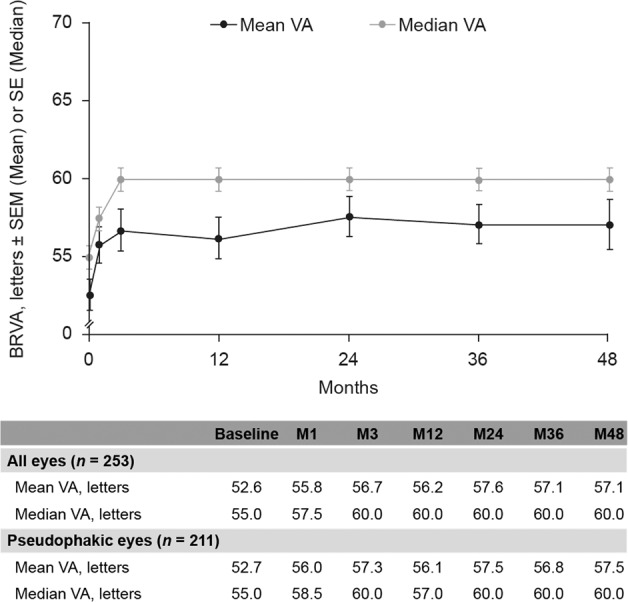
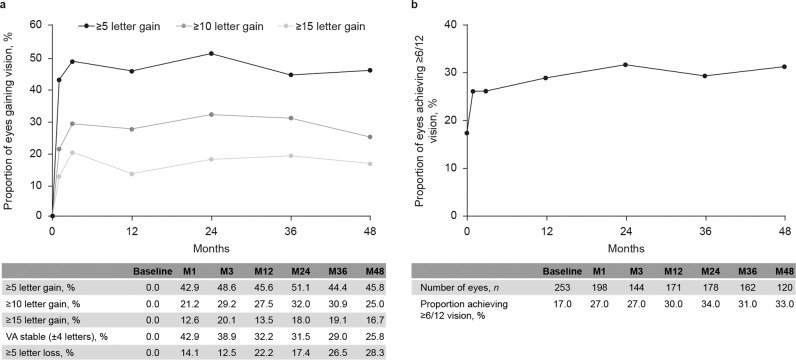
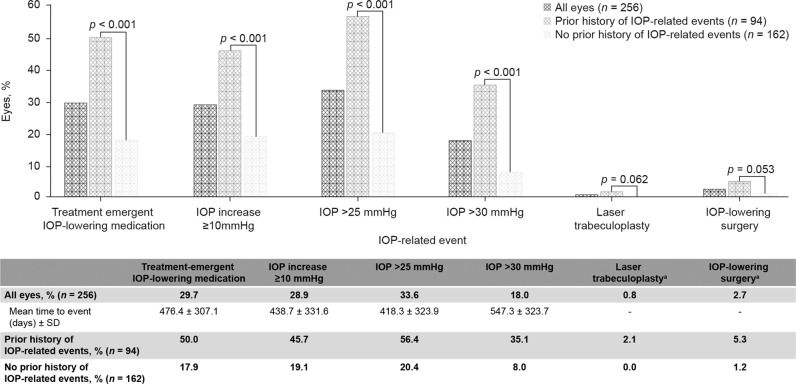
Results: Two-hundred and fifty-six eyes had ≥3 years of follow-up (mean 4.28 years), during which a mean of 1.14 FAc implants were used per eye. Mean best-recorded visual acuity (BRVA) increased from 52.6 to 56.7 letters at month 3 and remained stable thereafter; this trend was also seen in pseudophakic eyes. The proportion of patients attaining a BRVA ≥6/12 increased from 17% at baseline to 27% 1 month after FAc implant and remained stable above 30% from month 12 onwards. Eyes with no prior history of intraocular pressure (IOP)-related events required significantly less treatment-emergent IOP-lowering medication than those with a prior history of IOP events (17.9% vs. 50.0% of eyes; p < 0.001). The incidence of an IOP increase of ≥10 mmHg, use of IOP-lowering medication, laser trabeculoplasty and IOP-lowering surgery was 28.9%, 29.7%, 0.8% and 2.7%, respectively, for the whole cohort. There were significant reductions in mean central foveal thickness and macular volume (p < 0.001).
Conclusions: The FAc implant was well tolerated, with predictable and manageable IOP-related events while delivering a continuous microdose of corticosteroid to eyes with cDMO, providing prolonged vision preservation and a reduced number of treatments.
© 2021. The Author(s).
Conflict of interest statement
CB is a consultant for Bayer, Alimera Sciences, Roche and Novartis. UC is a consultant for Allergan, Bayer, Novartis, Alimera Sciences and Roche. AL is a consultant for Bayer, Roche and Gyroscope Therapeutics. GM is a consultant for Novartis and Bayer. JT is a consultant for Bayer, Alimera Sciences, Allergan and Novartis.
Figures
References
-
- Estebainha R, Goldhardt R, Falcão M. A new approach for diabetic macular edema treatment: review of clinical practice results with 0.19 mg fluocinolone acetonide intravitreal implant including vitrectomized eyes. Curr Ophthalmol Rep. 2020;8:1–10. doi: 10.1007/s40135-020-00225-1. - DOI - PMC - PubMed
-
- Daien V, Eldem BM, Talks JS, Korobelnik J-F, Mitchell P, Finger RP, et al. Real-world data in retinal diseases treated with anti-vascular endothelial growth factor (anti-VEGF) therapy—a systematic approach to identify and characterize data sources. BMC Ophthalmol. 2019;19:206. doi: 10.1186/s12886-019-1208-9. - DOI - PMC - PubMed
-
- Bressler NM, Beaulieu WT, Glassman AR, Blinder KJ, Bressler SB, Jampol LM, et al. Persistent macular thickening following intravitreous aflibercept, bevacizumab, or ranibizumab for central-involved diabetic macular edema with vision impairment: a secondary analysis of a randomized clinical trial. JAMA Ophthalmol. 2018;136:257–69. doi: 10.1001/jamaophthalmol.2017.6565. - DOI - PMC - PubMed
MeSH terms
Substances
LinkOut - more resources
Full Text Sources
Other Literature Sources
Medical
