[Preprint]. 2021 May 4:2021.05.03.442357.
doi: 10.1101/2021.05.03.442357.

Mouse Adapted SARS-CoV-2 protects animals from lethal SARS-CoV challenge

Affiliations

Mouse Adapted SARS-CoV-2 protects animals from lethal SARS-CoV challenge

Antonio Muruato et al. bioRxiv. .

Update in

  • Mouse-adapted SARS-CoV-2 protects animals from lethal SARS-CoV challenge.
    Muruato A, Vu MN, Johnson BA, Davis-Gardner ME, Vanderheiden A, Lokugamage K, Schindewolf C, Crocquet-Valdes PA, Langsjoen RM, Plante JA, Plante KS, Weaver SC, Debbink K, Routh AL, Walker D, Suthar MS, Shi PY, Xie X, Menachery VD. Muruato A, et al. PLoS Biol. 2021 Nov 4;19(11):e3001284. doi: 10.1371/journal.pbio.3001284. eCollection 2021 Nov. PLoS Biol. 2021. PMID: 34735434 Free PMC article.

Abstract

The emergence of SARS-CoV-2 has resulted in a worldwide pandemic causing significant damage to public health and the economy. Efforts to understand the mechanisms of COVID-19 disease have been hampered by the lack of robust mouse models. To overcome this barrier, we utilized a reverse genetic system to generate a mouse-adapted strain of SARS-CoV-2. Incorporating key mutations found in SARSCoV-2 variants, this model recapitulates critical elements of human infection including viral replication in the lung, immune cell infiltration, and significant in vivo disease. Importantly, mouse-adaptation of SARS-CoV-2 does not impair replication in human airway cells and maintains antigenicity similar to human SARS-CoV-2 strains. Utilizing this model, we demonstrate that SARS-CoV-2 infected mice are protected from lethal challenge with the original SARS-CoV, suggesting immunity from heterologous CoV strains. Together, the results highlight the utility of this mouse model for further study of SARS-CoV-2 infection and disease.


Conflict of interest statement

Competing interests

XX, P-YS, and VDM have filed a patent on the reverse genetic system and reporter SARS-CoV-2. Other authors declare no competing interests.

Figures
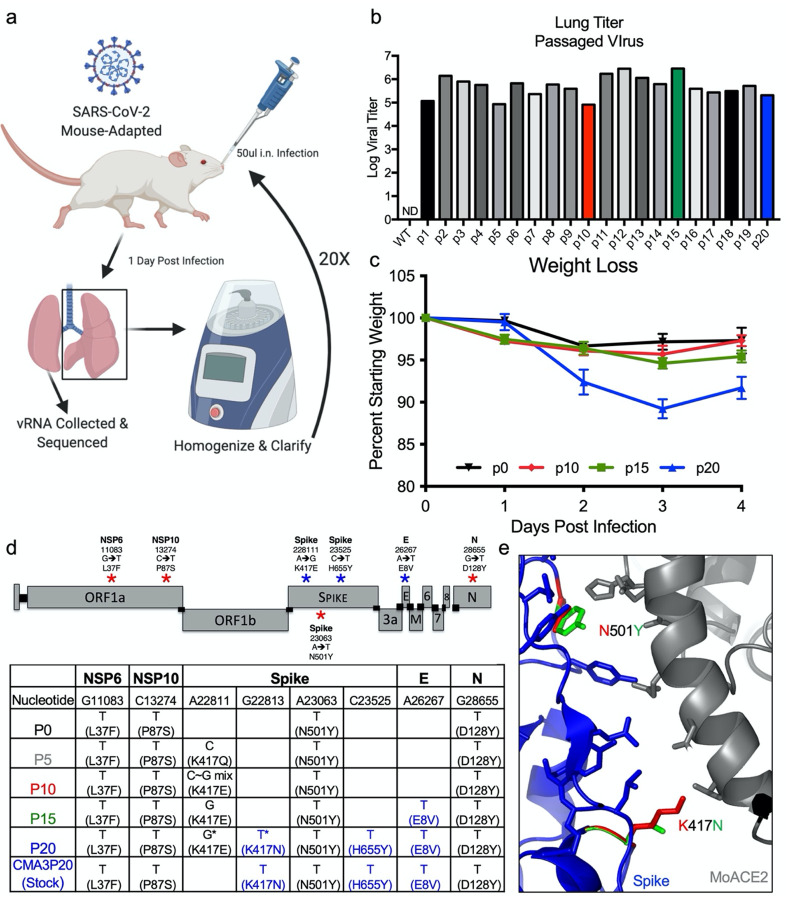
Figure 1.
Figure 1.. Mouse-adaptation of SARS-CoV-2.
a) Schematic of adaptation of SARS-CoV-2 CMA3p20. One ten-week-old female Balb/c mice was infected with SARS-CoV-2 CMA3 for 1 day, euthanized, and lung tissues harvested for viral RNA and viral titer determination. Lung tissues were homogenized, clarified, and 50ul used to inoculate subsequent animals for 20 passages (p). b) Viral replication of CMA3 p1-p20 from lung homogenates isolated from infected mice 1 day post infection. c) Stock virus generated at passages 0, 10, 15, and 20 was used to infect 5 female Balb/c mice at 105 PFU and evaluated for weight loss over a 4-day time course. d). Schematic of engineered (red stars) and passage-acquired (blue stars) mutations in CMA3p20 stock virus. Table includes Sanger equivalent accumulation of mutations over passages p5, p10, p15, p20, and final stock used for subsequent studies. e) Modeling RBD spike mutations N501Y and K417N found in CMA3p20 with mouse ACE2.
Figure 2.
Figure 2.. SARS-CoV-2 CMA3p20 induces disease restricted to the lung.
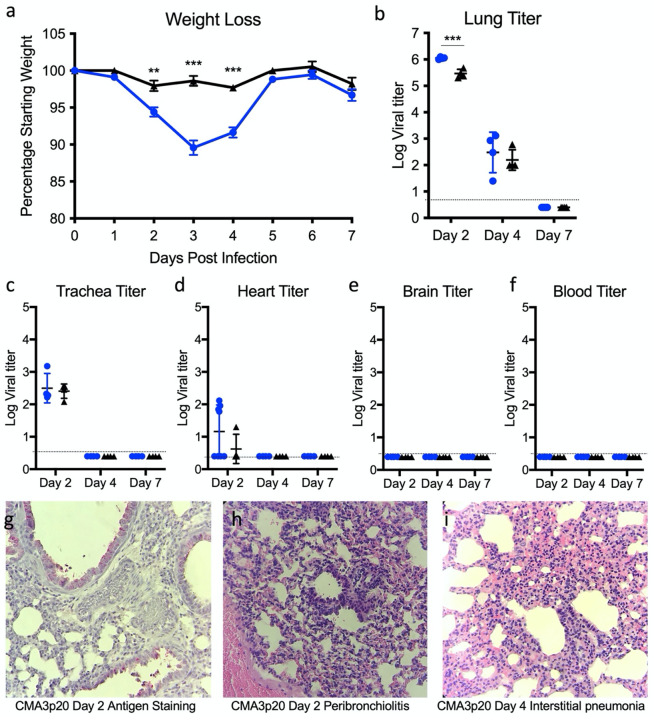
a-f) Ten-week-old Balb/c mice were infected with 105 PFU of SARS-CoV-2 CMA3 (black) or CMA3p20 (blue) and followed for a) weight loss and viral titer in the b) lung, c) trachea, d) heart, e) brain, and f) blood. g-i) Histology from CMA3p20 infected mice showed g) viral antigen (N-protein) staining in the airways and parenchyma at day 2. Significant lung infiltration, inflammation and damage was observed at h) day 2 and i) day 4 post infection. Magnification at 10x for g-i.
Figure 3.
Figure 3.. CMA3p20 strain maintains human replication capacity and antigenicity.
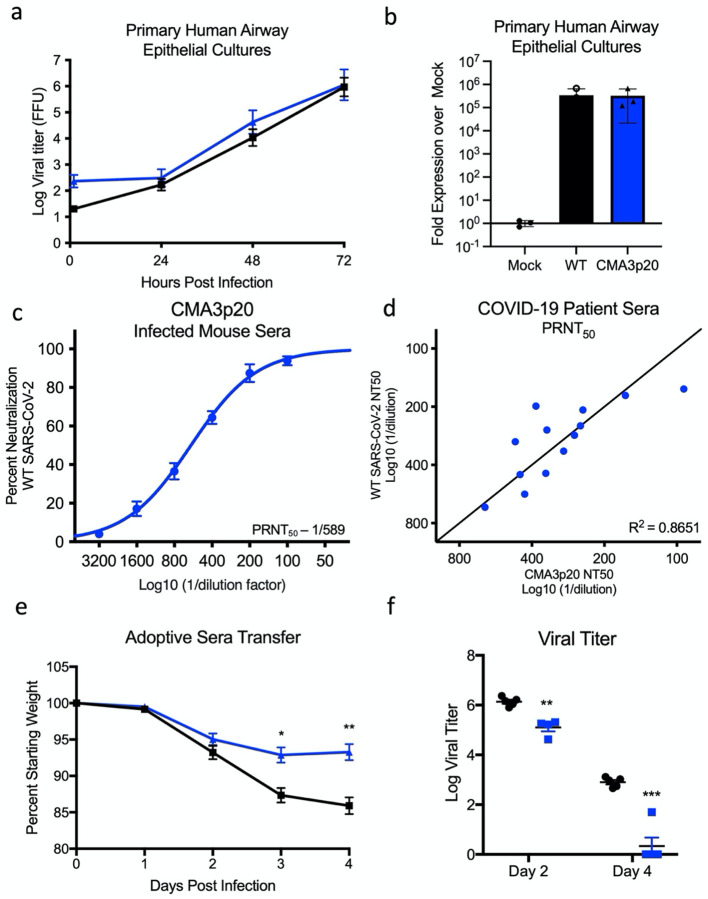
a-b) Primary human airway cultures were infected with SARS-CoV-2 WT (black) or CMA3p20 (blue) at an MOI of 0.01 and evaluated for a) viral titer and b) viral RNA. c) Sera collected from female Balb/c mice 28 days post infection with 106 PFU of SARS-CoV-2 CMA3p20 were evaluated for capacity to neutralize WT SARS-CoV-2 via PRNT50 assay. d) PRNT50 values from COVID19 patient sera plotted against WT virus (y-axis) versus CMA3p20 virus (x-axis). e-f) Ten-week-old female Balb/c mice were treated intraperitoneally with 100ul of human COVID19 sera or control (PBS) one day prior to infection. Mice were subsequently challenged with 105 PFU of SARS-CoV-2 CMA3p20 and evaluated for e) weight loss and f) viral titer in the lung.
Figure 4.
Figure 4.. Prior infection with SARS-CoV-2 protects from lethal SARS-CoV challenge.
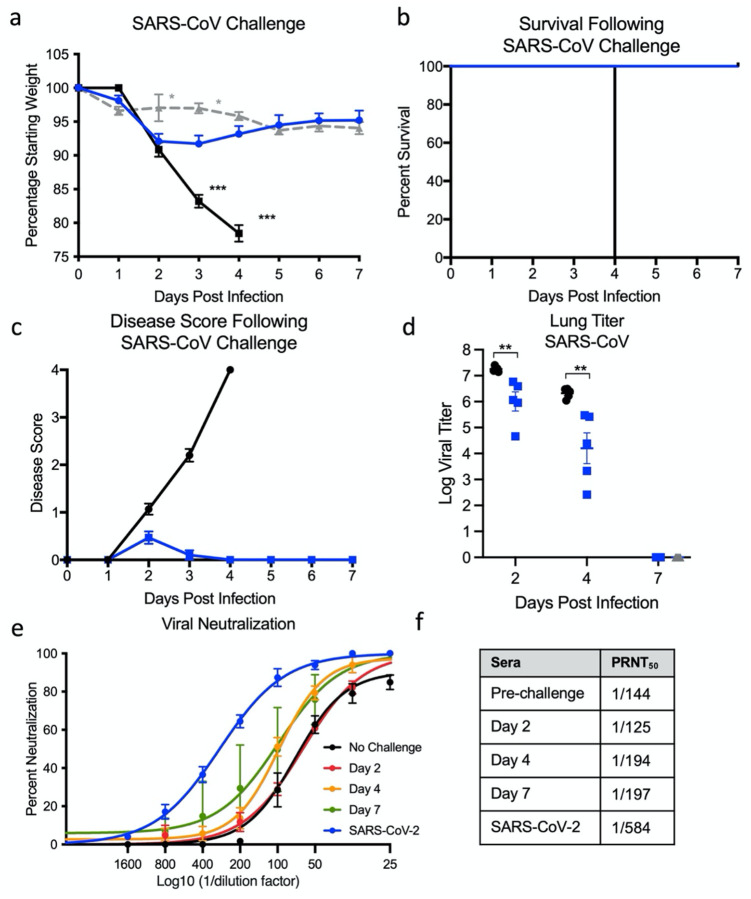
a-c) Ten-week-old female Balb/c mice were previously infected with 106 PFU of SARS-CoV-2 CMA3p20 (blue) or mock (black), monitored for weight loss, and allowed to recover. Twenty-eight days post infection, both groups were challenged with a lethal dose (104 PFU) of mouse-adapted SARS-CoV and evaluated for a) weight loss, b) lethality, and c) disease score. d) Mice were subsequently euthanized at day 2, 4, and 7 and lung tissue examined for viral replication. e) Sera from CMA3p20 infected and SARS-CoV challenged were evaluated for virus neutralization (PRNT50) against SARS-CoV-2 (blue) or SARS-CoV over time (no rechallenge-black, day 2 red, day 4-orange, day 7- green).

References

    1. Gralinski L. E. & Menachery V. D. Return of the Coronavirus: 2019-nCoV. Viruses 12, doi: 10.3390/v12020135 (2020). - DOI - PMC - PubMed
    1. Dong E., Du H. & Gardner L. An interactive web-based dashboard to track COVID-19 in real time. Lancet Infect Dis 20, 533–534, doi: 10.1016/S1473-3099(20)30120-1 (2020). - DOI - PMC - PubMed
    1. Zhu N. et al. A Novel Coronavirus from Patients with Pneumonia in China, 2019. N Engl J Med 382, 727–733, doi: 10.1056/NEJMoa2001017 (2020). - DOI - PMC - PubMed
    1. Huang C. et al. Clinical features of patients infected with 2019 novel coronavirus in Wuhan, China. Lancet 395, 497–506, doi: 10.1016/S0140-6736(20)30183-5 (2020). - DOI - PMC - PubMed
    1. Gao Z. et al. A Systematic Review of Asymptomatic Infections with COVID-19. J Microbiol Immunol Infect, doi: 10.1016/j.jmii.2020.05.001 (2020). - DOI - PMC - PubMed

Publication types

LinkOut - more resources