Review
. 2021 Sep;58(9):1139-1151.
doi: 10.1007/s00592-021-01728-4. Epub 2021 May 10.

Type 2 diabetes mellitus and sepsis: state of the art, certainties and missing evidence

Affiliations
Review

Type 2 diabetes mellitus and sepsis: state of the art, certainties and missing evidence

Elisa Costantini et al. Acta Diabetol. 2021 Sep.

Abstract

Diabetes and sepsis are important causes of morbidity and mortality worldwide, and diabetic patients represent the largest population experiencing post-sepsis complications and rising mortality. Dysregulated immune pathways commonly found in both sepsis and diabetes contribute to worsen the host response in diabetic patients with sepsis. The impact of diabetes on mortality from sepsis is still controversial. Whereas a substantial proportion of severe infections can be attributed to poor glycemic control, treatment with insulin, metformin and thiazolidinediones may be associated with lower incidence and mortality for sepsis. It has been suggested that chronic exposure to high glucose might enhance immune adaptation, leading to reduced mortality rate in septic diabetic patients. On the other hand, higher risk of acute kidney injury has been extensively documented and a suggested lower risk of acute respiratory distress syndrome has been recently questioned. Additional investigations are ongoing to confirm the protective role of some anti-diabetic treatments, the occurrence of acute organ dysfunction, and the risk/benefit of less stringent glycemic control in diabetic patients experiencing sepsis. Based on a MEDLINE/PubMed search from inception to December 31, 2020, the aim of this review is therefore to summarize the strengths and weaknesses of current knowledge on the interplay between diabetes and sepsis.

Keywords: Glycemic control; Immune dysfunction; Mortality; Organ dysfunction; Sepsis; Type 2 diabetes mellitus.


Conflict of interest statement

The authors have no competing interests to declare.

Figures
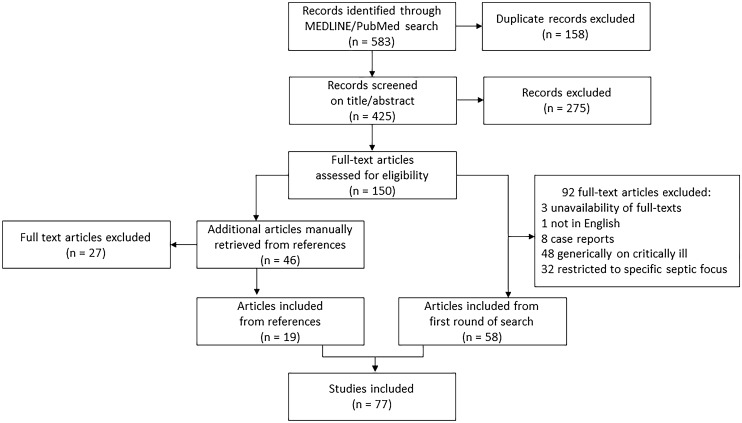
Fig. 1
Fig. 1
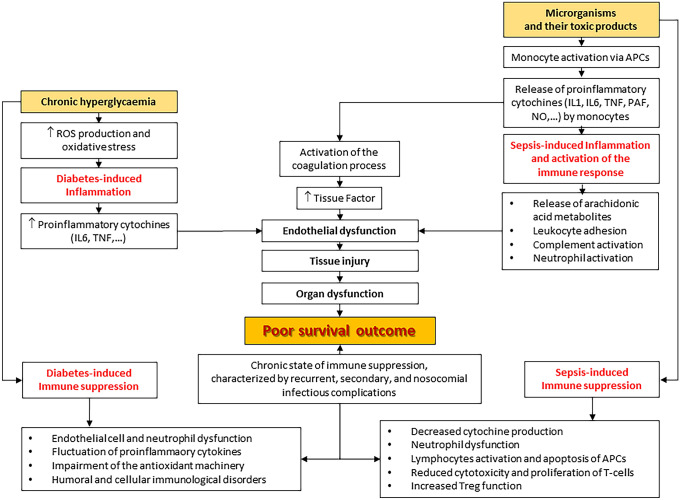
Study flow diagram
Fig. 2
Fig. 2
Interactions between diabetes and sepsis in inflammation and on the immune system ( adapted from Tiwari et al. [13]). Both T2D-related chronic hyperglycemia and toxic products released by invading microorganisms during sepsis contribute to increase inflammatory response [13]. It is generally accepted that the chronic and indolent inflammation induced by T2D and obesity differs from the acute inflammatory response caused by sepsis [77]. However, Frydrych et al. [15] outlined the impairment of several inflammatory responses in both T2D and sepsis (data not shown in the Figure), including: a increased levels of complement proteins (which are defective in T2D) driving systemic inflammation, organ failure and mortality; b mitochondrial dysfunction and redox imbalance as relevant mediators of disease progression; c impaired calcium homeostasis promoting elevated inflammatory responses, cellular dysfunction and toxicity. The increase in pro-inflammatory cytokines, induced by both T2D and sepsis, and the activation of the immune system due to sepsis are responsible for the endothelial dysfunction carrying the organ dysfunction characteristic of sepsis and accountable for poor outcome [13]. Additionally, functional neutrophil defects and deranged recruitment into sites of infection are commonly found not only in T2D but also in sepsis. Apoptosis of both lymphocytes and antigen-presenting cells (APCs) is a hallmark of septic-mediated immune suppression, whereas endothelial cell dysfunction, fluctuation of pro-inflammatory cytokines and the impairment of both the antioxidant machinery and humoral immunity are linked to TD2 [15]. Thus, in diabetic patients surviving from sepsis, the coexistence of the sepsis-induced immune activation over-described and such immune suppression related to both T2D and sepsis weakens the immune response contributing to create a chronic immune suppression leading to further infective complications and poor long-term survival [15]

References

    1. Singer M, Deutschman CS, Seymour C, et al. The third international consensus definitions for sepsis and septic shock (sepsis-3) JAMA. 2016;315:801–810. doi: 10.1001/jama.2016.0287. - DOI - PMC - PubMed
    1. Rudd KE, Johnson SC, Agesa KM, et al. Global, regional, and national sepsis incidence and mortality, 1990–2017: analysis for the global burden of disease study. Lancet. 2020;395:200–211. doi: 10.1016/S0140-6736(19)32989-7. - DOI - PMC - PubMed
    1. Vincent JL, Jones G, David S, et al. Frequency and mortality of septic shock in Europe and North America: a systematic review and meta-analysis. Crit Care. 2019;23:1–11. doi: 10.1186/s13054-019-2478-6. - DOI - PMC - PubMed
    1. Martin GS, Mannino DM, Moss M. The effect of age on the development and outcome of adult sepsis. Crit Care Med. 2006;34:15–21. doi: 10.1097/01.ccm.0000194535.82812.ba. - DOI - PubMed
    1. Kahn JM, Le T, Angus DC, et al. The epidemiology of chronic critical illness in the United States. Crit Care Med. 2015;43:282–287. doi: 10.1097/CCM.0000000000000710. - DOI - PMC - PubMed

LinkOut - more resources