


KEYNOTE-859: a Phase III study of pembrolizumab plus chemotherapy in gastric/gastroesophageal junction adenocarcinoma
- PMID: 33975465
- PMCID: PMC9892960
- DOI: 10.2217/fon-2021-0176
KEYNOTE-859: a Phase III study of pembrolizumab plus chemotherapy in gastric/gastroesophageal junction adenocarcinoma
Erratum in
-
Corrigendum.Future Oncol. 2023 Jun;19(17):1229. doi: 10.2217/fon-2021-0176c1. Epub 2023 Jun 9. Future Oncol. 2023. PMID: 37293712 Free PMC article. No abstract available.
Abstract
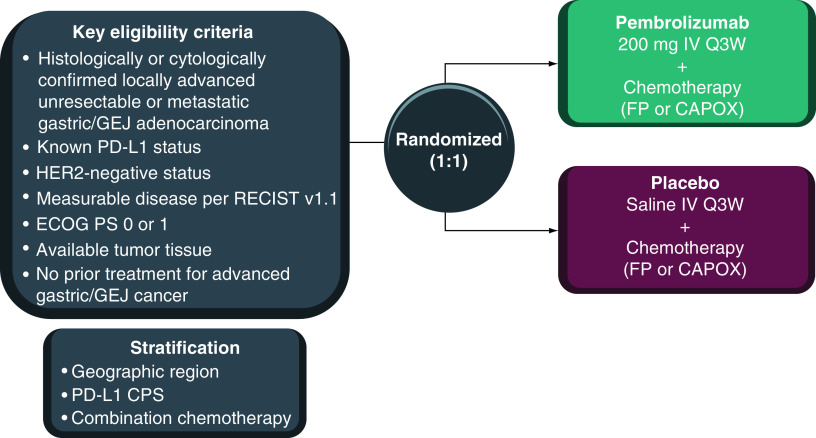
Current guidelines recommend two-drug cytotoxic chemotherapy with a fluoropyrimidine (fluorouracil or capecitabine) and a platinum-based agent (oxaliplatin or cisplatin) as first-line treatment for advanced gastric cancer. Pembrolizumab monotherapy has demonstrated durable antitumor activity in patients with advanced programmed death ligand 1-positive (combined positive score ≥1) gastric/gastroesophageal junction adenocarcinoma. Accumulating evidence indicates that combining pembrolizumab with standard-of-care chemotherapy for the treatment of advanced or metastatic cancer improves clinical outcomes. We describe the rationale for and the design of the randomized, double-blind, placebo-controlled, Phase III KEYNOTE-859 study, which is investigating pembrolizumab in combination with chemotherapy as first-line treatment for patients with human epidermal growth factor receptor 2-negative advanced unresectable or metastatic gastric/gastroesophageal junction adenocarcinoma. The planned sample size is 1542 patients, and the primary end point is overall survival. Clinical trial registration: NCT03675737 (ClinicalTrials.gov).
Keywords: HER2-negative; adenocarcinoma; chemotherapy; first-line therapy; gastric cancer; gastroesophageal junction cancer; immunotherapy; pembrolizumab.
Figures
References
-
- Bray F, Ferlay J, Soerjomataram I, Siegel RL, Torre LA, Jemal A. Global cancer statistics 2018: GLOBOCAN estimates of incidence and mortality worldwide for 36 cancers in 185 countries. CA Cancer J. Clin. 68(6), 394–424 (2018). - PubMed
-
- Ferlay J, Colombet M, Soerjomataram I et al. Estimating the global cancer incidence and mortality in 2018: GLOBOCAN sources and methods. Int. J. Cancer 144(8), 1941–1953 (2019). - PubMed
-
- Colquhoun A, Arnold M, Ferlay J, Goodman KJ, Forman D, Soerjomataram I. Global patterns of cardia and non-cardia gastric cancer incidence in 2012. Gut 64(12), 1881–1888 (2015). - PubMed
-
- National Comprehensive Cancer Network. NCCN clinical practice guidelines in oncology (NCCN guidelines): gastric cancer (version 4.2020). (2020). https://www.nccn.org/store/login/login.aspx?ReturnURL=https://www.nccn.o... - PubMed
Publication types
MeSH terms
Substances
Supplementary concepts
Associated data
Grants and funding
LinkOut - more resources
Full Text Sources
Other Literature Sources
Medical
Research Materials
Miscellaneous
