. 2021 May 11;8(4):e997.
doi: 10.1212/NXI.0000000000000997. Print 2021 Jul.

Perturbed Microbiota/Immune Homeostasis in Multiple Sclerosis

Affiliations

Perturbed Microbiota/Immune Homeostasis in Multiple Sclerosis

Delphine Sterlin et al. Neurol Neuroimmunol Neuroinflamm. .

Abstract

Objective: Based on animal models and human studies, there is now strong suspicion that host/microbiota mutualism in the context of gut microbial dysbiosis could influence immunity and multiple sclerosis (MS) evolution. Our goal was to seek evidence of deregulated microbiota-induced systemic immune responses in patients with MS.

Methods: We investigated gut and systemic commensal-specific antibody responses in healthy controls (n = 32), patients with relapsing-remitting MS (n = 30), and individuals with clinically isolated syndromes (CISs) (n = 15). Gut microbiota composition and diversity were compared between controls and patients by analysis of 16S ribosomal ribonucleic acid (rRNA) sequencing. Autologous microbiota and cultivable bacterial strains were used in bacterial flow cytometry assays to quantify autologous serum IgG and secretory IgA responses to microbiota. IgG-bound bacteria were sorted by flow cytometry and identified using 16S rRNA sequencing.

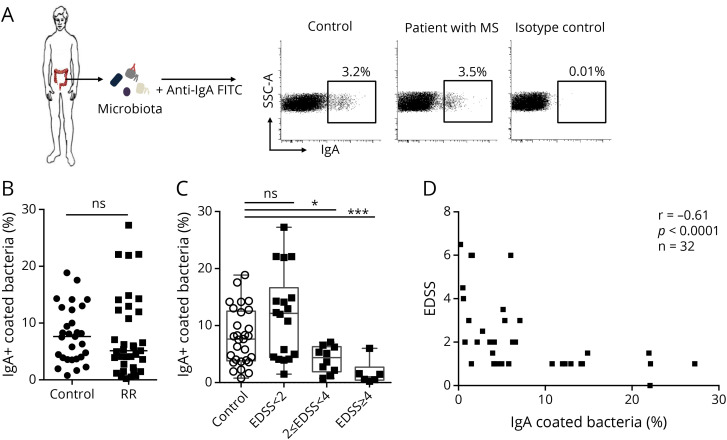
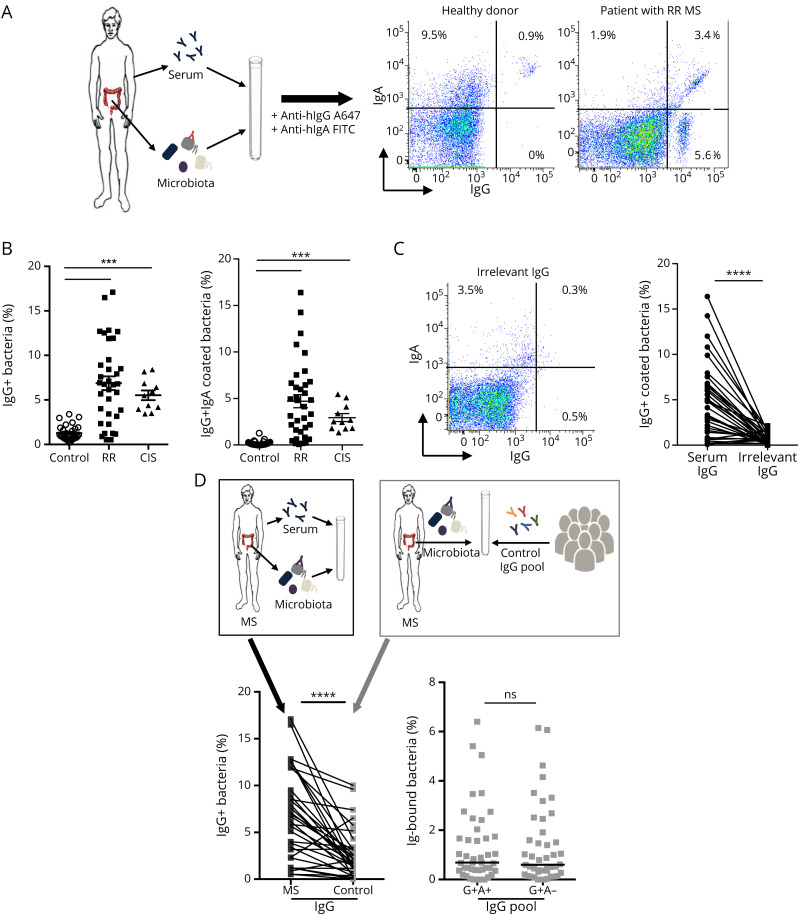
Results: We show that commensal-specific gut IgA responses are drastically reduced in patients with severe MS, disease severity being correlated with the IgA-coated fecal microbiota fraction (r = -0.647, p < 0.0001). At the same time, IgA-unbound bacteria elicit qualitatively broad and quantitatively increased serum IgG responses in patients with MS and CIS compared with controls (4.1% and 2.5% vs 1.9%, respectively, p < 0.001).

Conclusions: Gut and systemic microbiota/immune homeostasis are perturbed in MS. Our results argue that defective IgA responses in MS are linked to a breakdown of systemic tolerance to gut microbiota leading to an enhanced triggering of systemic IgG immunity against gut commensals occurring early in MS.


Figures

Figure 1
Figure 1. IgA-Coated Bacteria Are Reduced in Patients With Severe MS
(A) Representative Flow Cytometry Dot Plot Showing Endogenous Secretory IgA Coating on Indicated Fractions of Fecal Microbiota From a Healthy Donor or a Patient With RR-MS (B) Flow cytometry analysis of the fraction of fecal microbiota bound by secretory IgA in healthy donors (n = 32) and patients with RR-MS (n = 32). Median values are indicated, and groups were compared with a nonparametric Mann-Whitney test (ns, not significant). (C) Flow cytometry analysis of the fraction of fecal microbiota bound by secretory IgA in healthy donors (n = 32) and patients with RR-MS classified according to disease severity, measured by the EDSS. Median values are indicated. Error bars represent minimum and maximum values. p Values were calculated using the nonparametric Mann-Whitney test (*p < 0.05; ***p < 0.001). (D) Disease severity evaluated by the EDSS correlated with the percentage of secretory IgA-bound microbiota in patients with MS-RR. Spearman coefficient (r) and p values are indicated. MS = multiple sclerosis; RR = relapsing-remitting.
Figure 2
Figure 2. Enhanced IgG Antimicrobiota Response in Patients With MS
(A) Procedure (top) and representative flow cytometry detection (bottom) of endogenous secretory IgA and autologous systemic IgG (10 μg/mL) coating on healthy or RR-MS fecal microbiota is presented (middle panels). (B) Proportions of IgG+IgA± (left) and IgG+IgA (right) coated bacteria are compared in healthy donors (n = 30), patients with RR-MS (n = 32), or patients with CIS (n = 12). Median values are indicated. p Values were calculated using the nonparametric Mann-Whitney test (***p < 0.001). (C) Representative flow cytometry dot plot (left) and analysis (right) of irrelevant IgG (anti-TNFα 10 μg/mL) binding to RR-MS and CIS fecal microbiota (n = 44). (D) Procedure (top), representative flow cytometry dot plot (middle panel) and analysis (bottom) of autologous IgG or pooled healthy IgG binding to RR-MS fecal microbiota (n = 32). Proportions of IgG+IgA± coated bacteria (bottom left), IgG+IgA+ and IgG+IgA coated bacteria (bottom right) are shown. p Value was calculated by using the Wilcoxon paired test (****p < 0.0001; ns = nonsignificant). CIS = clinically isolated syndrome; MS = multiple sclerosis; RR = relapsing-remitting.
Figure 3
Figure 3. MS IgG Binds a Diverse Repertoire of Commensals
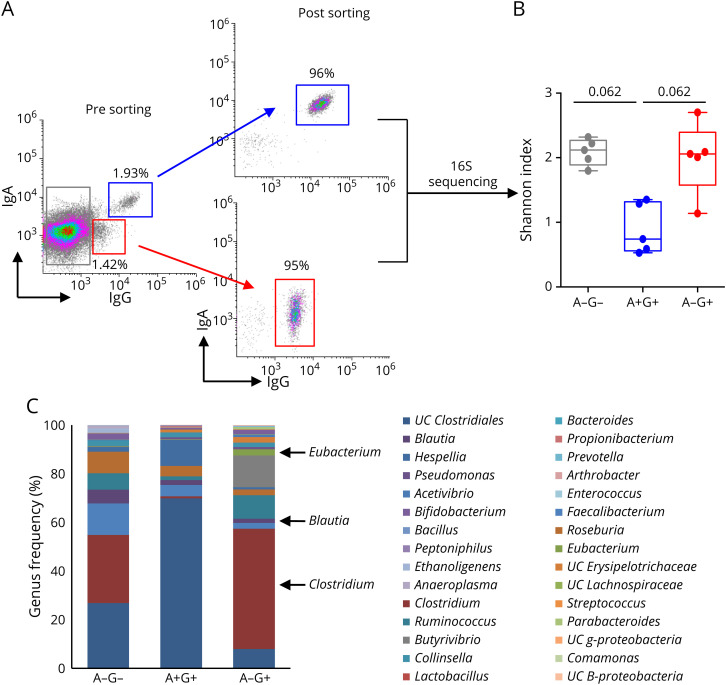
(A) Sorting strategy of IgG+IgA+ and IgG+IgA-coated bacteria in 5 patients with RR-MS. Composition of sorted fractions was next analyzed by using 16S rRNA sequencing. (B) Genera diversity in IgG+IgA+ and IgG+IgA-sorted fractions calculated by using the Shannon index. (C) Median relative abundance of the 30 most frequent genera in sorted fractions from 1 representative RR-MS patient. MS = multiple sclerosis; RR = relapsing-remitting.
Figure 4
Figure 4. IgG-Bound Commensal Shift in Patients With MS
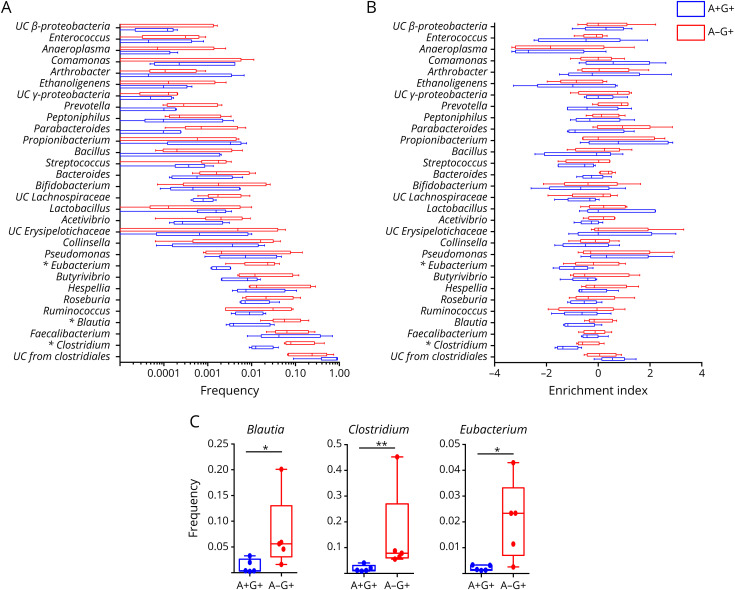
(A) Relative abundance of the 30 most frequent genera in IgG+IgA+ and IgG+IgA-sorted fractions, in blue and red, respectively. (B) EI of the 30 most frequent genera in IgG+IgA+ and IgG+IgA-sorted fractions compared, in blue and red, respectively. (C) Blautia, Clostridium, and Eubacterium frequencies in IgG+IgA+ and IgG+IgA fractions. For all box plots, each dot represents 1 donor, errors bars represent maximum and minimum values, and medians are indicated. p Values were calculated by using the nonparametric Mann-Whitney test (*p < 0.05; **p < 0.01). EI = enrichment index; MS = multiple sclerosis.
Figure 5
Figure 5. MS Antimicrobiota IgG Signature Measured on Cultivable Bacterial Strains
(A) Representative flow cytometry analysis of serum IgG binding to F nucleatum. Gray histogram represents isotype control; blue, red, and red dotted lines represent a healthy control, patient with RR-MS, and patient with CIS, respectively. (B) Flow cytometry analysis of serum IgG binding to IgA-unbound bacteria (from left to right: F nucleatum and P oris) in healthy donors (n = 30), patients with RR-MS (=32), and patients with CIS (n = 12). (C) Flow cytometry analysis of serum IgG binding to IgA-bound bacteria (from left to right: A muciniphila and R obeum) in healthy donors (n = 30), patients with RR-MS (=32), and patients with CIS (n = 12). Dark bars represent medians. p Values were calculated by using the nonparametric Mann-Whitney test (*p < 0.05; **p < 0.01; ***p < 0.001); ****p < 0.0001). MS = multiple sclerosis; RR = relapsing-remitting.

References

    1. Berer K, Mues M, Koutrolos M, et al. Commensal microbiota and myelin autoantigen cooperate to trigger autoimmune demyelination. Nature 2011;479:538-541. - PubMed
    1. Cekanaviciute E, Yoo BB, Runia TF, et al. Gut bacteria from multiple sclerosis patients modulate human T cells and exacerbate symptoms in mouse models. Proc Natl Acad Sci USA 2011;114:10713-10718. - PMC - PubMed
    1. Miyake S, Kim S, Suda W, et al. Dysbiosis in the gut microbiota of patients with multiple sclerosis, with a striking depletion of species belonging to clostridia XIVa and IV clusters. PLoS One 2015;10:e0137429. - PMC - PubMed
    1. Chen J, Chia N, Kalari KR, et al. Multiple sclerosis patients have a distinct gut microbiota compared to healthy controls. Sci Rep 2016;6:28484. - PMC - PubMed
    1. Jangi S, Gandhi R, Cox LM, et al. Alterations of the human gut microbiome in multiple sclerosis. Nat Commun 2016;7:12015. - PMC - PubMed

Publication types

MeSH terms

LinkOut - more resources