


Understanding VA's Use of and Relationships With Community Care Providers Under the MISSION Act
- PMID: 33976074
- PMCID: PMC8132889
- DOI: 10.1097/MLR.0000000000001545
Understanding VA's Use of and Relationships With Community Care Providers Under the MISSION Act
Abstract
Background: Congress has enacted 2 major pieces of legislation to improve access to care for Veterans within the Department of Veterans Affairs (VA). As a result, the VA has undergone a major transformation in the way that care is delivered to Veterans with an increased reliance on community-based provider networks. No studies have examined the relationship between VA and contracted community providers. This study examines VA facility directors' perspectives on their successes and challenges building relationships with community providers within the VA Community Care Network (CCN).
Objectives: To understand who VA facilities partner with for community care, highlight areas of greatest need for partnerships in various regions, and identify challenges of working with community providers in the new CCN contract.
Research design: We conducted a national survey with VA facility directors to explore needs, challenges, and expectations with the CCN.
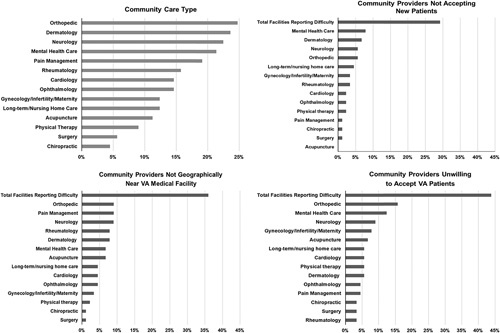
Results: The most common care referred to community providers included physical therapy, chiropractic, orthopedic, ophthalmology, and acupuncture. Open-ended responses focused on 3 topics: (1) Challenges in working with community providers, (2) Strategies to maintain strong relationships with community providers, and (3) Re-engagement with community providers who no longer provide care for Veterans.
Conclusions: VA faces challenges engaging with community providers given problems with timely reimbursement of community providers, low (Medicare) reimbursement rates, and confusing VA rules related to prior authorizations and bundled services. It will be critical to identify strategies to successfully initiate and sustain relationships with community providers.
Copyright © 2021 The Author(s). Published by Wolters Kluwer Health, Inc.
Conflict of interest statement
The authors declare no conflict of interest.
Figures
References
-
- Mattocks KM, Mengeling M, Sadler A, et al. The Veterans choice act: a qualitative examination of rapid policy implementation in the Department of Veterans Affairs. Med Care. 2017;55:S71–S75. - PubMed
-
- Mattocks KM, Yehia B. Evaluating the Veterans choice program: lessons for developing a high performing integrated network. Med Care. 2017;55:1–3. - PubMed
-
- Congressional Research Service. 2018. VA Maintaining Internal systems and Strengthening Integrated Outside Networks Act of 2018. Available at: https://fas.org/sgp/crs/misc/R45390.pdf. Accessed January 16, 2020.
-
- Aggarwal N. Ramifications of the VA MISSION Act of 2018 on mental health: potential implementation challenges and solutions. JAMA Psychiatry. 2020;77:337–338. - PubMed
Publication types
MeSH terms
Grants and funding
LinkOut - more resources
Full Text Sources
Other Literature Sources
Research Materials
